Parliaments and Representatives

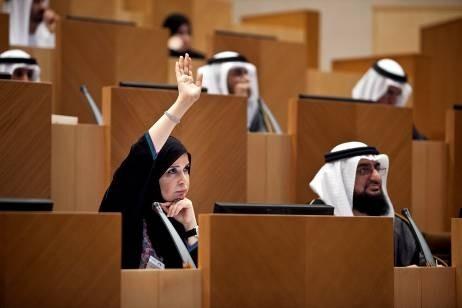
Democracy and the equal participation of men and women in the political arena are closely intertwined. No parliament or any decision-making body can claim to be representative without the participation of both men and women. As stated in the Universal Declaration on Democracy adopted by the Inter-Parliamentary Union’s Member Parliaments in 1997, "The achievement of democracy presupposes a genuine partnership between men and women in the conduct of the affairs of society in which they work in equality and complementarity, drawing mutual enrichment from their differences."

Recent years have seen a steady increase in the number of women in parliament, though the world average of less than 22 percent remains far from the goal of parity between women and men. The election of women to the highest positions of state and government in several countries has also contributed to the changing face of politics.

While the road to election is a difficult one, the challenges for women do not stop there. Once women enter parliament or other bodies, they are faced with many new challenges. Parliament is traditionally a male-oriented domain where the rules and practices have been written by men. It is, therefore, an ongoing challenge to transform parliament into a gender-sensitive environment, to ensure that actions are gender-sensitive and to guarantee that gender is mainstreamed throughout the legislature.

May 15, 2013
Joyce Banda at WEF: Sisters, stick together, Malawi

At a small discussion at Thursday’s World Economic Forum on Africa, the issue of gender equality in African politics took centre stage.

May 14, 2013
More than 50 women to run for polls, Lebanon

More than 50 women are planning to run for the upcoming parliamentary polls, as activists are still campaigning for quota in both the Parliament and Cabinet.

The Global Gender Gap Report 2012

Back
May 10, 2013

The Global Gender Gap Report 2012

The Global Gender Gap Report 2012 benchmarks national gender gaps of 135 countries on economic, political, education- and health-based criteria.

The Global Gender Gap Report 2012 benchmarks national gender gaps of 135 countries on economic, political, education- and health-based criteria.

May 10, 2013
In Pakistan, women work to strengthen democracy

Zameer Akhtar, 28, is participating in the electoral process for the very first time. Being a woman and living in a joint family in Pakistan, getting consent from her elders for her decision wasn’t simple at first.

May 9, 2013
Gender-Based Quotas Needed In Jamaica

Quotas are one way to ensure that women are given a fair proportion of what is available, meaning equal spaces to influence and effect posit

May 9, 2013
Women Candidates and the June 17 Parliamentary Elections in Jordan

On June 17th women in Jordan will make history, when at least six women will be elected to parliament as part of sweeping election reforms enacted by King Abdullah earlier this year.

May 8, 2013
It's a puzzle: Why isn't Iowa electing women?, USA

Iowa — It was among the first states to legalize gay marriage and served as the 2008 campaign liftoff site for the first black president, but in other arenas Iowa isn't quite so progressive – it's also one of just two states to never elect a woman governor or member of Congress.

May 8, 2013
Women’s issues: Who will be fair to the fairer sex?, Pakistan

According to a 2012 survey by the World Economic Forum, Pakistan is still considered to be one of the worst places in the world to be a woman.

May 8, 2013
448 women candidates contesting elections on general seats, Pakistan

LAHORE: As many as 147 women are contesting election 2013 in 105 National Assembly and 301 women in 203 provincial assembly constituencies on general seats.