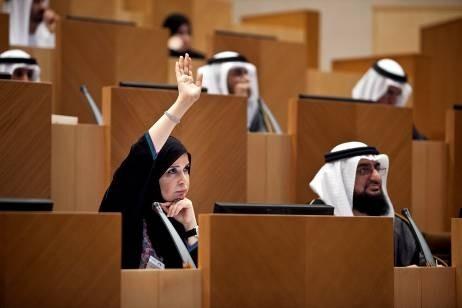
Parliaments and Representatives

Democracy and the equal participation of men and women in the political arena are closely intertwined. No parliament or any decision-making body can claim to be representative without the participation of both men and women. As stated in the Universal Declaration on Democracy adopted by the Inter-Parliamentary Union’s Member Parliaments in 1997, "The achievement of democracy presupposes a genuine partnership between men and women in the conduct of the affairs of society in which they work in equality and complementarity, drawing mutual enrichment from their differences."

Recent years have seen a steady increase in the number of women in parliament, though the world average of less than 22 percent remains far from the goal of parity between women and men. The election of women to the highest positions of state and government in several countries has also contributed to the changing face of politics.

While the road to election is a difficult one, the challenges for women do not stop there. Once women enter parliament or other bodies, they are faced with many new challenges. Parliament is traditionally a male-oriented domain where the rules and practices have been written by men. It is, therefore, an ongoing challenge to transform parliament into a gender-sensitive environment, to ensure that actions are gender-sensitive and to guarantee that gender is mainstreamed throughout the legislature.

UN Women Annual Report 2011 - 2012

Back
May 7, 2013

UN Women Annual Report 2011 - 2012

By UN Women’s first anniversary at the start of 2012, we could look back on a year of accomplishment. It was a year of rapid progress but also challenges, both those inherent in the creation of a new organization, and those taking place in the outside world.

By UN Women’s first anniversary at the start of 2012, we could look back on a year of accomplishment. It was a year of rapid progress but also challenges, both those inherent in the creation of a new organization, and those taking place in the outside world.

May 7, 2013
Women less likely to get involved in politics, seek office

The political gender gap isn’t just among voters. It also includes those they get to vote for.

Event

May 6, 2013
Italian women rise to positions of power under new prime minister

Enrico Letta continues the political revolution that began under Mario Monti by naming seven women in his 22-member cabinet. Arguably the most important woman in the closing months of Silvio Berlusconi's 2008-11 government was Karima el-M

May 5, 2013
Italy’s Female Politicians Speak Out Against Death Threats

When Laura Boldrini, 52, was elected as speaker of Italy’s lower house last month, she knew the job would come with enormous challenges. But she didn’t expect it to come with death threats.

Videos

Gender Quotas: Lessons Learned from Kenya to Tunisia

Submitted by iKNOW Politics on
Back
May 3, 2013

Gender Quotas: Lessons Learned from Kenya to Tunisia

Quotas are in increasingly important policy tool used in more than 50 countries to ensure women's entry into high-level decision making roles in political parties and government.

Quotas are in increasingly important policy tool used in more than 50 countries to ensure women's entry into high-level decision making roles in political parties and government.

May 2, 2013
Why don't young women stay in UK politics?

Lots of vibrant young women enter UK politics - but only a few of them stand the test of time.

May 2, 2013
What are Female Politicians Doing for Women?, Pakistan

Though female participation helps in terms of making specific policies related to women, MNA Bushra Gohar of Awami National Party thinks serving women is not the only purpose of a woman politician.“We shouldn’t be asking these questions now.

May 1, 2013
How do voices of 14 million women get heard?, Malaysia

IT’S mind-boggling. After more than 50 years since independence, and 13 general elections the percentage of women candidates being offered to the electorate has never broken through 10 per cent ceiling.