Parliaments and Representatives

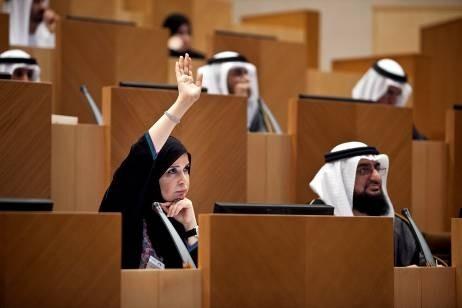
Democracy and the equal participation of men and women in the political arena are closely intertwined. No parliament or any decision-making body can claim to be representative without the participation of both men and women. As stated in the Universal Declaration on Democracy adopted by the Inter-Parliamentary Union’s Member Parliaments in 1997, "The achievement of democracy presupposes a genuine partnership between men and women in the conduct of the affairs of society in which they work in equality and complementarity, drawing mutual enrichment from their differences."

Recent years have seen a steady increase in the number of women in parliament, though the world average of less than 22 percent remains far from the goal of parity between women and men. The election of women to the highest positions of state and government in several countries has also contributed to the changing face of politics.

While the road to election is a difficult one, the challenges for women do not stop there. Once women enter parliament or other bodies, they are faced with many new challenges. Parliament is traditionally a male-oriented domain where the rules and practices have been written by men. It is, therefore, an ongoing challenge to transform parliament into a gender-sensitive environment, to ensure that actions are gender-sensitive and to guarantee that gender is mainstreamed throughout the legislature.

Women in Parliament in 2012: The Year in Perspective

Back
March 11, 2013

Women in Parliament in 2012: The Year in Perspective

2012 represented nearly a 1 percentage-point increase in the world average (20.3%).  With the exception of 2007, this is nearly double the annual rate of increase.

2012 represented nearly a 1 percentage-point increase in the world average (20.3%).  With the exception of 2007, this is nearly double the annual rate of increase.

March 11, 2013
President calls for more women in politics, Ireland

President Michael D Higgins said last night that the low level of women in the political world was of serious concern.

March 11, 2013
Few Women in Politics Despite Record Numbers, USA
  • U.S. Congress is made up of 18.1% women.
  • Of the mayors of America’s 100 biggest cities, 12 are women.
  • 5 of the country’s governors are women.
  • 4.2% of Fortune 500 company CEOs are women.
March 11, 2013
Caucus wants more women in politics, Indonesia

The Indonesian Women’s Caucus for Politics (KPPI) in Bali has started a movement for the greater representation of women in the legislature for the 2014 general elections. 

March 11, 2013
New age for China's female politicians

BEIJING, March 8 (Xinhua) -- The ongoing annual session of the 12th National People's Congress (NPC) has given Shen Jilan, 84, a chance to consolidate her position as one of the world's most venerable political figures.

March 11, 2013
Tanzania assesses the State of Local Democracy from a gender perspective

The Tanzanian Centre for Democracy – an organization bringing together all political parties to promote multi-party democracy in Tanzania – will conduct an assessment of local democracy later this year from a gender perspective using International IDEA’s State of Local Democracy (S

March 8, 2013
Latin America: Statistics are encouraging, but parity is still out of reach

Lima, 8 March 2013

March 8, 2013
Malta could have four female MEPS after March election

Malta could have up to four female representatives in the European Parliament, if all four MEPs contesting the 9 March general election are successful in their bid to be elected in parliament.


March 8, 2013
Women in the driver’s seat of democratic politics

Gender equality in politics is not about the system allowing women in. It is not about politics giving something to women. It is about women actively taking their rightful place as equals with men in political decision-making. It is about women being agents of change.