September 7, 2012
Iran: Activist to Discuss Country’s Nuclear Program
Haghighatjoo, who holds a doctorate in psychology, served in the Iranian Parliament for four years beginning in 2000.
Democracy and the equal participation of men and women in the political arena are closely intertwined. No parliament or any decision-making body can claim to be representative without the participation of both men and women. As stated in the Universal Declaration on Democracy adopted by the Inter-Parliamentary Union’s Member Parliaments in 1997, "The achievement of democracy presupposes a genuine partnership between men and women in the conduct of the affairs of society in which they work in equality and complementarity, drawing mutual enrichment from their differences."
Recent years have seen a steady increase in the number of women in parliament, though the world average of less than 22 percent remains far from the goal of parity between women and men. The election of women to the highest positions of state and government in several countries has also contributed to the changing face of politics.
While the road to election is a difficult one, the challenges for women do not stop there. Once women enter parliament or other bodies, they are faced with many new challenges. Parliament is traditionally a male-oriented domain where the rules and practices have been written by men. It is, therefore, an ongoing challenge to transform parliament into a gender-sensitive environment, to ensure that actions are gender-sensitive and to guarantee that gender is mainstreamed throughout the legislature.
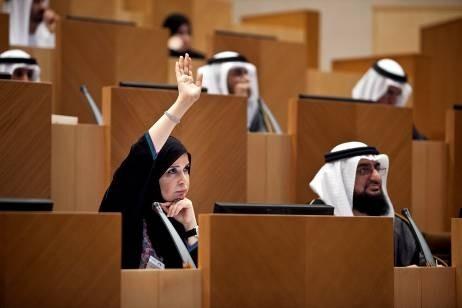
Haghighatjoo, who holds a doctorate in psychology, served in the Iranian Parliament for four years beginning in 2000.
India moved one step closer to protecting millions of its working women from sexual harassment by passing a new bill to tackle unwelcome behaviour such as sexual advances, requests for sexual favours and sexual innuendoes made at work.
Much has changed since the wannabe prime minister David Cameron pledged to give a third of his first government's jobs to women, thereby ending what he called the "scandalous under-representation" in parliament.
Leaders of 15 Pacific Island nations have pledged to remove barriers to women’s economic empowerment, end violence against women and pave the way for their increased political representation, at the conclusion of the 43rd Pacific Islands Forum in Rarotonga in the Cook Islands, last wee
Mongolia lags in three of the UN Millennium Development Goals (MDGs): poverty reduction, environmental sustainability and gender equality, according to the UNDP country report for 2012-2016.
U.S. Secretary of State Hillary Clinton has joined Pacific leaders in a call for full gender equality - equal treatment of men and women in all parts of social, economic and political life.
Yesterday Loujaya Toni MP - gardener, teacher, poet, singer, journalist, mother, wife and (judging by a lively phone interview) political firebrand - was in the Cook Islands, where she was to be welcomed into the fold by some rather more experienced female political operators: US Secretary of Sta
he struggle for women's empowerment, is not a new battle. This is what Home Affairs Minister, Nkosazana Dlamini-Zuma told dignitaries last night's Women's Parliament gala dinner.
The Minister of Economic Development, Mr Ebrahim Patel, has called for the increased participation of women in the mainstream economy.