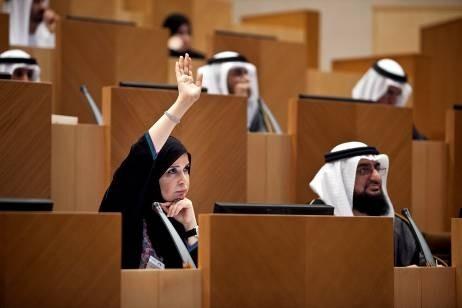
Parliaments and Representatives

Democracy and the equal participation of men and women in the political arena are closely intertwined. No parliament or any decision-making body can claim to be representative without the participation of both men and women. As stated in the Universal Declaration on Democracy adopted by the Inter-Parliamentary Union’s Member Parliaments in 1997, "The achievement of democracy presupposes a genuine partnership between men and women in the conduct of the affairs of society in which they work in equality and complementarity, drawing mutual enrichment from their differences."

Recent years have seen a steady increase in the number of women in parliament, though the world average of less than 22 percent remains far from the goal of parity between women and men. The election of women to the highest positions of state and government in several countries has also contributed to the changing face of politics.

While the road to election is a difficult one, the challenges for women do not stop there. Once women enter parliament or other bodies, they are faced with many new challenges. Parliament is traditionally a male-oriented domain where the rules and practices have been written by men. It is, therefore, an ongoing challenge to transform parliament into a gender-sensitive environment, to ensure that actions are gender-sensitive and to guarantee that gender is mainstreamed throughout the legislature.

AGORA Newsletter: September 2010

Back
October 7, 2010

AGORA Newsletter: September 2010

AGORA is a multilateral initiative, jointly managed by the United Nations Development Programme (UNDP), the World Bank Institute (WBI), the National Democratic Institute for International Affairs (NDI), the International Institute for Democracy and Electoral Assistance (International Idea), and

AGORA is a multilateral initiative, jointly managed by the United Nations Development Programme (UNDP), the World Bank Institute (WBI), the National Democratic Institute for International Affairs (NDI), the International Institute for Democracy and Electoral Assistance (International Idea), and

Political Participation of Women in Norway: Strong Involvement by both Politicians and the Public

Back
October 1, 2010

Political Participation of Women in Norway: Strong Involvement by both Politicians and the Public

It is often said that in Nordic countries gender equality has been achieved to a great extent than in other countries.

Event

Promoting Women’s Participation in Conflict and Post-Conflict Societies

Back
August 1, 2010

Promoting Women’s Participation in Conflict and Post-Conflict Societies

It is widely recognized that women bear a heavy burden in conflict and post conflict societies, both directly through violence perpetrated against themselves and their families and as survivors 

Event

International Parliamentary Conference on “Parliaments, minorities and indigenous peoples: Effective participation in politics”.

Back

International Parliamentary Conference on “Parliaments, minorities and indigenous peoples: Effective participation in politics”.

The conference will give an opportunity for members of parliament to review the findings of the survey on the participation of minorities and indigenous communities, together with experts and repre

One Size Does Not Fit All: Lessons Learned from Legislative Gender Commissions and Caucuses

Back
July 6, 2010

One Size Does Not Fit All: Lessons Learned from Legislative Gender Commissions and Caucuses

This guide demonstrate that women’s collective efforts in the legislature are crucial not only because of their impact on public policies that effectively respond to citizens’ demands and interests, but also because of their effect on the consolidation and progress of women’s leadership.

This guide demonstrate that women’s collective efforts in the legislature are crucial not only because of their impact on public policies that effectively respond to citizens’ demands and interests, but also because of their effect on the consolidation and progress of women’s leadership.

Event

Event

Event