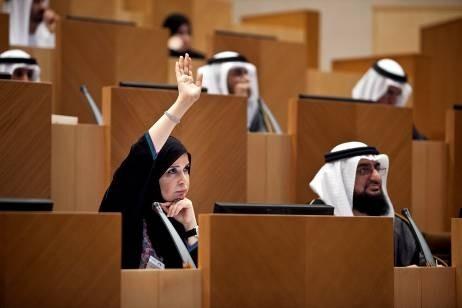
Parliaments and Representatives

Democracy and the equal participation of men and women in the political arena are closely intertwined. No parliament or any decision-making body can claim to be representative without the participation of both men and women. As stated in the Universal Declaration on Democracy adopted by the Inter-Parliamentary Union’s Member Parliaments in 1997, "The achievement of democracy presupposes a genuine partnership between men and women in the conduct of the affairs of society in which they work in equality and complementarity, drawing mutual enrichment from their differences."

Recent years have seen a steady increase in the number of women in parliament, though the world average of less than 22 percent remains far from the goal of parity between women and men. The election of women to the highest positions of state and government in several countries has also contributed to the changing face of politics.

While the road to election is a difficult one, the challenges for women do not stop there. Once women enter parliament or other bodies, they are faced with many new challenges. Parliament is traditionally a male-oriented domain where the rules and practices have been written by men. It is, therefore, an ongoing challenge to transform parliament into a gender-sensitive environment, to ensure that actions are gender-sensitive and to guarantee that gender is mainstreamed throughout the legislature.

Assembly of Kosovo: Public Hearing Manual

Back
March 8, 2007

Assembly of Kosovo: Public Hearing Manual

This manual describes public hearings as an integral part of the work of parliamentary committees. It serves as a guide for members of parliamentary committees in Kosovo on conducting a public hearing.

This manual describes public hearings as an integral part of the work of parliamentary committees. It serves as a guide for members of parliamentary committees in Kosovo on conducting a public hearing.

The Role and Practice of Legislative Hearings in Democracies: Examples from Germany and the United States

Back
March 8, 2007

The Role and Practice of Legislative Hearings in Democracies: Examples from Germany and the United States

This paper was written for a series of seminars on public legislative hearings held in Beijing and Shanghai, China.

This paper was written for a series of seminars on public legislative hearings held in Beijing and Shanghai, China.

Promoting Women's Political Participation: Women Representatives Training (WRT) Program Trainer's Manual

Back
March 8, 2007

Promoting Women's Political Participation: Women Representatives Training (WRT) Program Trainer's Manual

This training manual includes a detailed description of an eight-week long training session conducted for women political leaders in Nepal.

This training manual includes a detailed description of an eight-week long training session conducted for women political leaders in Nepal.

Women’s Candidate Training Program: Trainer's Manual Nepal

Back
March 8, 2007

Women’s Candidate Training Program: Trainer's Manual Nepal

This manual provides training tips and workshop techniques for political party trainers to train Nepali women candidates for local government.

This manual provides training tips and workshop techniques for political party trainers to train Nepali women candidates for local government.

Constituency Outreach In Sierra Leone: A Guide For Members of Parliament

Back
March 8, 2007

Constituency Outreach In Sierra Leone: A Guide For Members of Parliament

This manual provides guidelines for Members of Parliament (MPs) in Sierra Leone on how to prepare an effective community outreach program.

This manual provides guidelines for Members of Parliament (MPs) in Sierra Leone on how to prepare an effective community outreach program.

Republic of Macedonia Code of Conduct Of Political Parties For Free and Fair Parliamentary Elections

Back
March 8, 2007

Republic of Macedonia Code of Conduct Of Political Parties For Free and Fair Parliamentary Elections

This code of conduct, agreed upon by the political parties of Macedonia, sets forth rules and standards for ensuring free and fair parliamentary elections. It focuses particularly on regulations relating to rule of law and electoral conduct.

This code of conduct, agreed upon by the political parties of Macedonia, sets forth rules and standards for ensuring free and fair parliamentary elections. It focuses particularly on regulations relating to rule of law and electoral conduct.

Lobbying for Women's Political Rights: Strategies for Poland and Ukraine

Back
March 7, 2007

Lobbying for Women's Political Rights: Strategies for Poland and Ukraine

This report describes a collaborative project between the Center for Russian, Central and East European Studies at Rutgers University; the Information Center on Women’s Organizations and Initiatives (OSKA) in Poland; and the Kharkiv Center for Women’s Studies (KCWS) in Ukraine.

This report describes a collaborative project between the Center for Russian, Central and East European Studies at Rutgers University; the Information Center on Women’s Organizations and Initiatives (OSKA) in Poland; and the Kharkiv Center for Women’s Studies (KCWS) in Ukraine.

Parliament and the Budgetary Process, Including From a Gender Perspective: Regional Seminar (Philippines)

Back
February 23, 2007

Parliament and the Budgetary Process, Including From a Gender Perspective: Regional Seminar (Philippines)

This report compiles the speeches and presentations made during the seminar entitled, "Parliament and the Budgetary Process, Including from a Gender Perspective," held in Manila, Philippines in July 2002.

This report compiles the speeches and presentations made during the seminar entitled, "Parliament and the Budgetary Process, Including from a Gender Perspective," held in Manila, Philippines in July 2002.

Beijing Parliamentary Declaration

Back
February 22, 2007

Beijing Parliamentary Declaration

This declaration was adopted by participants to Parliamentarians' Day, which was held by the Inter-Parliamentary Union (IPU) on the occasion of the Fourth World Conference on Women.

This declaration was adopted by participants to Parliamentarians' Day, which was held by the Inter-Parliamentary Union (IPU) on the occasion of the Fourth World Conference on Women.