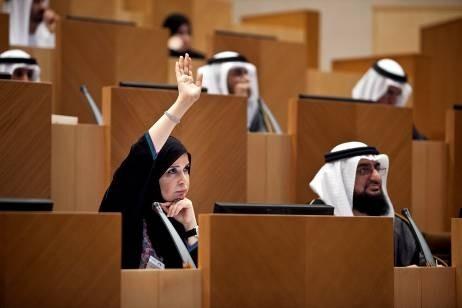
Parliaments and Representatives

Democracy and the equal participation of men and women in the political arena are closely intertwined. No parliament or any decision-making body can claim to be representative without the participation of both men and women. As stated in the Universal Declaration on Democracy adopted by the Inter-Parliamentary Union’s Member Parliaments in 1997, "The achievement of democracy presupposes a genuine partnership between men and women in the conduct of the affairs of society in which they work in equality and complementarity, drawing mutual enrichment from their differences."

Recent years have seen a steady increase in the number of women in parliament, though the world average of less than 22 percent remains far from the goal of parity between women and men. The election of women to the highest positions of state and government in several countries has also contributed to the changing face of politics.

While the road to election is a difficult one, the challenges for women do not stop there. Once women enter parliament or other bodies, they are faced with many new challenges. Parliament is traditionally a male-oriented domain where the rules and practices have been written by men. It is, therefore, an ongoing challenge to transform parliament into a gender-sensitive environment, to ensure that actions are gender-sensitive and to guarantee that gender is mainstreamed throughout the legislature.

July 4, 2023
Australia: multicultural quotas on the cards for Labor

Labor would be forced to pick culturally diverse and Indigenous candidates under a quota plan that is expected to attract support from across the party at its national con

July 4, 2023
Zimbabwe: lobby group frets over few women politicians

WOMEN’s Academy for Leadership and Political Excellence (Walpe) has expressed concern over the low number of women candidates fielded for the August general elections.

Women’s interest in entering politics surged after Dobbs. So why aren’t they running?

Back
July 4, 2023

Women’s interest in entering politics surged after Dobbs. So why aren’t they running?

Susanna Gibson remembers where she was and what she was doing on June 24, 2022, the way some remember 9/11 or the Challenger explosion.

Susanna Gibson remembers where she was and what she was doing on June 24, 2022, the way some remember 9/11 or the Challenger explosion.

Canada: The Toronto we want: we can all win when immigrant women lead

Back
July 3, 2023

Canada: The Toronto we want: we can all win when immigrant women lead

More than 500,000 votes. That’s how many ballots were cast for the top two candidates in Monday’s mayoral byelection.

More than 500,000 votes. That’s how many ballots were cast for the top two candidates in Monday’s mayoral byelection.

When will things improve for women in parliament? They already have

Back
July 3, 2023

When will things improve for women in parliament? They already have

Let’s not sugar coat it, last week was a demoralising and often disturbing time to be a woman in Australian politics.

Let’s not sugar coat it, last week was a demoralising and often disturbing time to be a woman in Australian politics.

July 3, 2023
Women leaders call for action to break up ‘old boys club’ in politics

Women leaders from Bersatu, DAP, and PKR have urged the government to implement affirmative action policies to bring more women into political positions.

July 3, 2023
Zimbabwe: ‘Women candidates prejudiced by exorbitant nomination fees’

Two aspiring female presidential candidates failed to submit their nomination papers last week due to payment challenges.

Sexual harassment claims dealt with too slowly in politics, says Caroline Nokes

Back
June 29, 2023

Sexual harassment claims dealt with too slowly in politics, says Caroline Nokes

Sexual harassment complaints in parliament are dealt with too slowly and opaquely, the chair of the Commons equalities committee has said, after concerns were raised over a former Downing Street special adviser.

Sexual harassment complaints in parliament are dealt with too slowly and opaquely, the chair of the Commons equalities committee has said, after concerns were raised over a former Downing Street special adviser.