
Partner News

5 April 2012 - Delegates at the 126th Assembly of the Inter Parliamentary Union (IPU) in Kampala, Uganda have asked parliamentary institutions in the world to prioritise matters of maternal and child health.

In the resolution passed, yesterday, parliamentarians were urged to ensure a coordinated approach to all matters pertaining to maternal and child health, such as sanitation, access to safe drinking water, the fight against malnutrition, and gender quality.

For the full story, see All Africa.

9 April 2012 - This week, “In the Shadow of a Man”, a film commissioned by UN Women, is taking the compelling stories of four Egyptian women to the Istanbul Film Festival, as part of a string of international screenings. The documentary premiered at the Berlin International Film Festival earlier this year, and will be followed soon with a second film by the director on women candidates in Egypt’s 2011-2012 parliamentary elections. In an interview with UN Women, young British-Egyptian director Hanan Abdalla weighs in on the issues the film addresses, and its relevance as the women’s movement gathers momentum in the country.
For the full story, see UN Women.

9 April 2012 - This week, “In the Shadow of a Man”, a film commissioned by UN Women, is taking the compelling stories of four Egyptian women to the Istanbul Film Festival, as part of a string of international screenings. The documentary premiered at the Berlin International Film Festival earlier this year, and will be followed soon with a second film by the director on women candidates in Egypt’s 2011-2012 parliamentary elections. In an interview with UN Women, young British-Egyptian director Hanan Abdalla weighs in on the issues the film addresses, and its relevance as the women’s movement gathers momentum in the country.

For the full story, see UN Women.

9 April 2012 - This week, “In the Shadow of a Man”, a film commissioned by UN Women, is taking the compelling stories of four Egyptian women to the Istanbul Film Festival, as part of a string of international screenings. The documentary premiered at the Berlin International Film Festival earlier this year, and will be followed soon with a second film by the director on women candidates in Egypt’s 2011-2012 parliamentary elections. In an interview with UN Women, young British-Egyptian director Hanan Abdalla weighs in on the issues the film addresses, and its relevance as the women’s movement gathers momentum in the country.

For the full story, see UN Women.

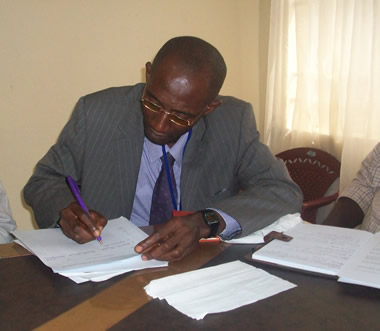
12 April 2012 - All of Sierra Leone’s eight registered political parties have signed an “Open and Safe Elections Pledge” to promote an electoral atmosphere free of violence and intimidation and to encourage women to participate in the election process. The country is slated to have presidential, parliamentary and local elections on Nov. 17.

The pledge is in part a response to interparty violence, which had begun to cast a shadow on the Nov. 17 polls. Last September, youth from the ruling All People’s Congress (APC) threw stones at the presidential candidate of a major opposition party, the Sierra Leone People’s Party (SLPP). SLPP youth responded by torching APC party offices. The violence spread to include an assault on a local APC chairwoman, and young supporters of both parties attacked each other during a January by-election. Tensions between the parties remain high.
 

For the full story, see NDI.

12 April 2012 - All of Sierra Leone’s eight registered political parties have signed an “Open and Safe Elections Pledge” to promote an electoral atmosphere free of violence and intimidation and to encourage women to participate in the election process. The country is slated to have presidential, parliamentary and local elections on Nov. 17.

The pledge is in part a response to interparty violence, which had begun to cast a shadow on the Nov. 17 polls. Last September, youth from the ruling All People’s Congress (APC) threw stones at the presidential candidate of a major opposition party, the Sierra Leone People’s Party (SLPP). SLPP youth responded by torching APC party offices. The violence spread to include an assault on a local APC chairwoman, and young supporters of both parties attacked each other during a January by-election. Tensions between the parties remain high.
 

For the full story, see NDI.

12 April 2012 - All of Sierra Leone’s eight registered political parties have signed an “Open and Safe Elections Pledge” to promote an electoral atmosphere free of violence and intimidation and to encourage women to participate in the election process. The country is slated to have presidential, parliamentary and local elections on Nov. 17.

The pledge is in part a response to interparty violence, which had begun to cast a shadow on the Nov. 17 polls. Last September, youth from the ruling All People’s Congress (APC) threw stones at the presidential candidate of a major opposition party, the Sierra Leone People’s Party (SLPP). SLPP youth responded by torching APC party offices. The violence spread to include an assault on a local APC chairwoman, and young supporters of both parties attacked each other during a January by-election. Tensions between the parties remain high.
 

For the full story, see NDI.

It is a crisp spring morning in Ghonchi district in northern Tajikistan, and a large crowd of women from across the district have gathered outside of the main government building, the Khukumat. They are here for an historic event – the opening of Tajikistan’s first One Stop Shop for public service delivery.

This new initiative means that every Saturday morning, the Chiefs of the most critical government departments will come together in one “service hall” of the government building to provide speedy action and services for the local population. UN Women supported the Khukumat and the local Women’s Watch groups to conduct a study visit to Moldova, where a similar “Service Halls” concept is improving public service delivery to the most vulnerable.

For the full story, see UN Women.

It is a crisp spring morning in Ghonchi district in northern Tajikistan, and a large crowd of women from across the district have gathered outside of the main government building, the Khukumat. They are here for an historic event – the opening of Tajikistan’s first One Stop Shop for public service delivery.

This new initiative means that every Saturday morning, the Chiefs of the most critical government departments will come together in one “service hall” of the government building to provide speedy action and services for the local population. UN Women supported the Khukumat and the local Women’s Watch groups to conduct a study visit to Moldova, where a similar “Service Halls” concept is improving public service delivery to the most vulnerable.

For the full story, see UN Women.

It is a crisp spring morning in Ghonchi district in northern Tajikistan, and a large crowd of women from across the district have gathered outside of the main government building, the Khukumat. They are here for an historic event – the opening of Tajikistan’s first One Stop Shop for public service delivery.

This new initiative means that every Saturday morning, the Chiefs of the most critical government departments will come together in one “service hall” of the government building to provide speedy action and services for the local population. UN Women supported the Khukumat and the local Women’s Watch groups to conduct a study visit to Moldova, where a similar “Service Halls” concept is improving public service delivery to the most vulnerable.

For the full story, see UN Women.

20 April 2012 - Entrenched and often autocratic one-man rule is causing a “democracy deficit” and impeding political development in many African countries, Christopher Fomunyoh, senior associate and regional director for Central and West Africa at NDI, said in congressional testimony April 18. But, speaking before the Senate Foreign Relations Subcommittee on African Affairs, Fomunyoh said that significant political change has occurred in Africa in the last two decades through better elections and peaceful transfers of power. He was joined at the hearing, "U.S. policy response to entrenched African leadership," by Johnnie Carson, assistant secretary of state for African affairs; Earl Gast, assistant administrator for Africa at the U.S. Agency for International Development; and Mo Ibrahim, founder of the Mo Ibrahim Foundation.

For the full statement, see NDI.

20 April 2012 - Entrenched and often autocratic one-man rule is causing a “democracy deficit” and impeding political development in many African countries, Christopher Fomunyoh, senior associate and regional director for Central and West Africa at NDI, said in congressional testimony April 18. But, speaking before the Senate Foreign Relations Subcommittee on African Affairs, Fomunyoh said that significant political change has occurred in Africa in the last two decades through better elections and peaceful transfers of power. He was joined at the hearing, "U.S. policy response to entrenched African leadership," by Johnnie Carson, assistant secretary of state for African affairs; Earl Gast, assistant administrator for Africa at the U.S. Agency for International Development; and Mo Ibrahim, founder of the Mo Ibrahim Foundation.

For the full statement, see NDI.

20 April 2012 - Entrenched and often autocratic one-man rule is causing a “democracy deficit” and impeding political development in many African countries, Christopher Fomunyoh, senior associate and regional director for Central and West Africa at NDI, said in congressional testimony April 18. But, speaking before the Senate Foreign Relations Subcommittee on African Affairs, Fomunyoh said that significant political change has occurred in Africa in the last two decades through better elections and peaceful transfers of power. He was joined at the hearing, "U.S. policy response to entrenched African leadership," by Johnnie Carson, assistant secretary of state for African affairs; Earl Gast, assistant administrator for Africa at the U.S. Agency for International Development; and Mo Ibrahim, founder of the Mo Ibrahim Foundation.

For the full statement, see NDI.

21 April 2012 - Good morning! It is my pleasure to join you today at the 12th International Association of Women in Development Forum on Women’s Rights and Development.

I bring you greetings from New York, and from all colleagues worldwide at UN Women.

I thank you for inviting me to be part of this panel on: “Economic Power, Why does it matter and how to understand it in the current global context”.

For the full transcript, see UN Women.

21 April 2012 - Good morning! It is my pleasure to join you today at the 12th International Association of Women in Development Forum on Women’s Rights and Development.

I bring you greetings from New York, and from all colleagues worldwide at UN Women.

I thank you for inviting me to be part of this panel on: “Economic Power, Why does it matter and how to understand it in the current global context”.

For the full transcript, see UN Women.

18 April 2012- “Rise up and sit at the table. Negotiate, because you are not alone. We are many women waiting for you to negotiate on our behalf “. The call comes from a strong commitment among Mexican women and SUMA (meaning sum of all parts in Spanish), an alliance of five civil society organizations which is working to increase women in decision-making in Mexico. The organization has been supported since 2011 by UN Women’s Fund for Gender Equality, in cooperation with the National Institute for Women. The Fund aims to advance women’s economic and political empowerment through high-impact, multi-year grants of up to USD 1 million

For the full story, see UN Women.

18 April 2012- “Rise up and sit at the table. Negotiate, because you are not alone. We are many women waiting for you to negotiate on our behalf “. The call comes from a strong commitment among Mexican women and SUMA (meaning sum of all parts in Spanish), an alliance of five civil society organizations which is working to increase women in decision-making in Mexico. The organization has been supported since 2011 by UN Women’s Fund for Gender Equality, in cooperation with the National Institute for Women. The Fund aims to advance women’s economic and political empowerment through high-impact, multi-year grants of up to USD 1 million

For the full story, see UN Women.

18 April 2012- “Rise up and sit at the table. Negotiate, because you are not alone. We are many women waiting for you to negotiate on our behalf “. The call comes from a strong commitment among Mexican women and SUMA (meaning sum of all parts in Spanish), an alliance of five civil society organizations which is working to increase women in decision-making in Mexico. The organization has been supported since 2011 by UN Women’s Fund for Gender Equality, in cooperation with the National Institute for Women. The Fund aims to advance women’s economic and political empowerment through high-impact, multi-year grants of up to USD 1 million

For the full story, see UN Women.

18 April 2012 - International IDEA works with Electoral Management Bodies (EMBs), the institutions responsible for administering elections in a country.

In a series of interviews, IDEA is speaking with EMBs from its 27 Member States, bringing their daily work closer to our readers.

While the organization of elections is a central function of any EMB, this series will highlight the work that keeps them busy beyond election-day.

In this first interview, IDEA had some questions for the EMB of Finland

For the full story, see IDEA.

18 April 2012 - International IDEA works with Electoral Management Bodies (EMBs), the institutions responsible for administering elections in a country.

In a series of interviews, IDEA is speaking with EMBs from its 27 Member States, bringing their daily work closer to our readers.

While the organization of elections is a central function of any EMB, this series will highlight the work that keeps them busy beyond election-day.

In this first interview, IDEA had some questions for the EMB of Finland

For the full story, see IDEA.

18 April 2012 - International IDEA works with Electoral Management Bodies (EMBs), the institutions responsible for administering elections in a country.

In a series of interviews, IDEA is speaking with EMBs from its 27 Member States, bringing their daily work closer to our readers.

While the organization of elections is a central function of any EMB, this series will highlight the work that keeps them busy beyond election-day.

In this first interview, IDEA had some questions for the EMB of Finland

For the full story, see IDEA.

16 April 2012 — A new partnership between the EU and UN Women set up to strengthen cooperation between the two organizations on their work on empowering women and gender equality, was today signed by High Representative for Foreign Affairs and Security Policy/ Vice President of the Commission Catherine Ashton and Commissioner for Development Andris Piebalgs, with Under-Secretary-General and Executive Director of UN Women Michelle Bachelet.

For the full story, see UN Women.

16 April 2012 — A new partnership between the EU and UN Women set up to strengthen cooperation between the two organizations on their work on empowering women and gender equality, was today signed by High Representative for Foreign Affairs and Security Policy/ Vice President of the Commission Catherine Ashton and Commissioner for Development Andris Piebalgs, with Under-Secretary-General and Executive Director of UN Women Michelle Bachelet.

For the full story, see UN Women.

Chairperson

Honourable Ministers
Distinguished Delegates
Ladies and Gentlemen

UN Women commends the Commission on Population and Development (CPD) and its focus on adolescence and youth this year.

The Commission provides invaluable and timely evidence on population and development status and trends related to gender equality and the empowerment of young women and girls. CPD is a key contributor for effectively mainstreaming a gender perspective in norms, policies and programmes.

For the full statement, see UN Women.

Chairperson

Honourable Ministers
Distinguished Delegates
Ladies and Gentlemen

UN Women commends the Commission on Population and Development (CPD) and its focus on adolescence and youth this year.

The Commission provides invaluable and timely evidence on population and development status and trends related to gender equality and the empowerment of young women and girls. CPD is a key contributor for effectively mainstreaming a gender perspective in norms, policies and programmes.

For the full statement, see UN Women.