Aller au contenu principal

Parliaments and Representatives

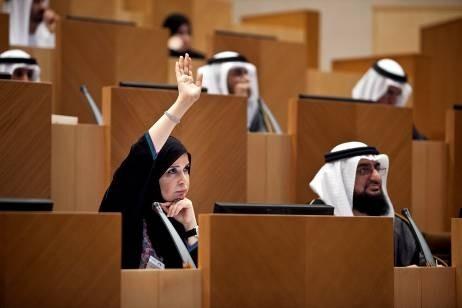
Democracy and the equal participation of men and women in the political arena are closely intertwined. No parliament or any decision-making body can claim to be representative without the participation of both men and women. As stated in the Universal Declaration on Democracy adopted by the Inter-Parliamentary Union’s Member Parliaments in 1997, "The achievement of democracy presupposes a genuine partnership between men and women in the conduct of the affairs of society in which they work in equality and complementarity, drawing mutual enrichment from their differences."

Recent years have seen a steady increase in the number of women in parliament, though the world average of less than 22 percent remains far from the goal of parity between women and men. The election of women to the highest positions of state and government in several countries has also contributed to the changing face of politics.

While the road to election is a difficult one, the challenges for women do not stop there. Once women enter parliament or other bodies, they are faced with many new challenges. Parliament is traditionally a male-oriented domain where the rules and practices have been written by men. It is, therefore, an ongoing challenge to transform parliament into a gender-sensitive environment, to ensure that actions are gender-sensitive and to guarantee that gender is mainstreamed throughout the legislature.

Samia Suluhu Hassan was sworn in at State House in Dar es Salaam (file image)
mars 19, 2021
Tanzania swears in Samia Suluhu Hassan as first female president

Samia Suluhu Hassan has been sworn in as President of Tanzania, becoming the first female head of state in the east African country following the death of president John Magufuli.

Les femmes en politique : 2021

Back
March 10, 2021

Les femmes en politique : 2021

La carte UIP-ONU Femmes, qui comprend le classement mondial des pays en fonction du nombre de femmes à des postes exécutifs ou gouvernementaux au 1er janvier 2021, fait état du plus haut niveau jamais atteint de femmes chefs d'État et de gouvernement

La carte UIP-ONU Femmes, qui comprend le classement mondial des pays en fonction du nombre de femmes à des postes exécutifs ou gouvernementaux au 1er janvier 2021, fait état du plus haut niveau jamais atteint de femmes chefs d'État et de gouvernement

Event

Que faudra-t-il faire pour atteindre la parité en politique dans le monde post-COVID-19 ?

Back

Que faudra-t-il faire pour atteindre la parité en politique dans le monde post-COVID-19 ?

Réunion parlementaire annuelle de l’UIP et ONU Femmes (65e session CCF)

Vidéos

Déclaration du Président de l'UIP, Duarte Pacheco, à l'occasion de la Journée internationale des femmes

Soumis par admin le
Back
March 9, 2021

Déclaration du Président de l'UIP, Duarte Pacheco, à l'occasion de la Journée internationale des femmes

L'UIP promeut l'égalité des sexes depuis que la première femme parlementaire a pris la parole lors d'une conférence de l'UIP en 1922.

L'UIP promeut l'égalité des sexes depuis que la première femme parlementaire a pris la parole lors d'une conférence de l'UIP en 1922.

© Hagen Hopkins/Getty Images via AFP
mars 5, 2021
Davantage de femmes parlementaires, mais une parité difficile à instaurer

À la suite des élections tenues en 2020, la proportion de femmes parlementaires dans le monde a atteint un taux record de 25,5 pour cent, soit une augmentation de 0,6 point par rapport à 2019.

Event