Advocacy & Lobbying

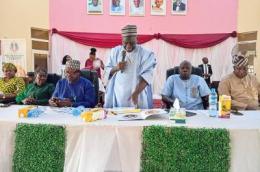
The Director-General of the Michael Imoudu National Institute for Labour Studies, Issa Aremu, has called for deliberate constitutional and policy reforms that would increase women’s representation in governance, including the creation of special seats for women in Nigeria’s National Assembly.

Aremu made the call in Ilorin during the 2026 International Women’s Day celebration organised by the institute in collaboration with the Development Research and Projects Centre in Abuja

The event, themed “Advancing Women Through Unity: The Impact of Collective Support – Give to Gain,” brought together labour leaders, market women, people living with Disabilities, government officials and development partners in a citizenship engagement to discuss strategies for strengthening women’s participation in leadership and national development.

Full article.

Discrimination in the workplace. Difficult choices between career and family responsibilities. Online harassment. Across Europe, many women experience inequality in their everyday lives.

Gender equality has been a core value of the European Union since its beginnings. The European Parliament is helping to translate that principle into practical action.

In recent years, the Parliament has legislated to increase pay transparency, strengthened protection against violence, improved work-life balance rights, and supported greater representation of women in leadership and decision-making.

Beyond adopting laws, Parliament also keeps up the pressure on EU countries and institutions to advance women’s rights, by monitoring progress and calling for specific action.

Read on for an overview of the EU laws fighting inequalities between women and men and the areas where the European Parliament is pushing EU countries and institutions to do more.

Full article.

This International Women’s Day, Euronews Green highlights some of the female politicians spearheading the never-ending fight against climate change.

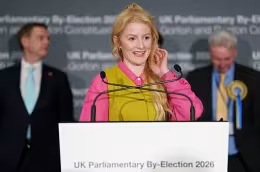
“A Green tidal wave is coming at the next general election,” declared Hannah Spencer, as she became the first ever Green Party MP to be elected in the north of England last week. She and a growing cohort of women are at its crest.

Spencer is not the typical face of green politics. A plumber who left school at 16 and was still completing her plastering training during the campaign, she represents the kind of voter the Green Party – with its middle-class, southern UK heartland – has long struggled to reach.

Promising in her speech to “make lives better for people like us – to bring down the cost of living, introduce rent controls, and get the litter and fly tipping off our streets,” now she seeks to represent them.

That kind of commitment comes at a personal cost. Even before Spencer had taken her seat, her professional and working-class credentials were being questioned, while false rumours of a multimillionaire husband circulated.

Full article.

As public trust in politics remains fragile and Australians continue to call for leadership that reflects integrity, capability and lived experience, Pathways to Politics for Women has opened applications for its nationally recognised program.

Since its establishment 10 years ago, the program has supported 92 electoral successes nationally, demonstrating a proven pathway for women who are serious about driving change through political leadership. 62 alums are currently serving in parliaments and councils across Australia.

“Strong democracies depend on leaders who are well-prepared for office, driven by their values and deeply connected to their communities,” said Dr Meredith Martin, Program Director at the University of Melbourne and National Co-Convenor of Pathways to Politics for Women.

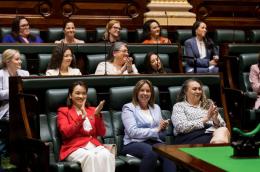
“At the University of Melbourne, where Pathways to Politics for Women first began, we have seen the impact of investing in women’s political leadership over the past decade. Seven Victorian alums, across different five parties, currently sit in the Victorian Parliament, with a further two in federal parliament and 19 in local government. These outcomes reflect not only the strength of the program, but the depth of preparation and multipartisan support that enables women to step forward and succeed.”

Full article.

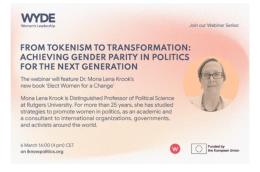
This webinar focused on barriers, challenges and strategies pertaining to the issue of gender parity for women in politics. Our guest speaker for the discussion was Dr. Mona Lena Krook.

Applying an intersectional lens the webinar discussion drew on research from Dr. Mona Lena Krook’s book, Elect Women for a Change: The Path to Gender Parity in Politics, Dr. Krook presented a core thesis: the global political community must move beyond aspirational "critical mass" targets (typically 30%) toward a non-negotiable 50/50 parity framework. This shift represents a transition from viewing women’s participation as an elective "add-on" to recognizing it as a fundamental requirement for democratic legitimacy.

Full report.

Watch the full webinar.


Women in Montenegro are no less interested and competent in politics, but they are limited by deep-rooted gender norms, stereotypes about social roles, unequal distribution of power within political structures, as well as a hostile environment that includes discrediting, hate speech, and gender-based attacks in public spaces.

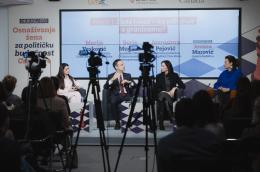
This was announced at the roundtable "Empowering Women for the Political Future of Montenegro", organized by the Center for Monitoring and Research (CeMI).

CeMI Program Director Teodora Gilić She said that an improved legal framework, including a 40 percent quota for the less represented gender, does not automatically mean substantial equality for women in politics, reports PR Center.

"Numbers are important, but they do not in themselves guarantee real influence, equal participation in decision-making, or a change in political culture," said Gilić.

She pointed out that women in Montenegro are not less interested in politics or less competent, but that they are limited by deep-rooted gender norms, stereotypes about social roles, unequal distribution of power within political structures, as well as a hostile environment that includes discrediting, hate speech and gender-based attacks in public space.

Full article.

Publication date: 16 October 2025
Author: Abigael Baldoumas, Anila Noor, Duncan Knox, Fionna Smyth, Helen Kezie-Nwoha, Maria Alabdeh, Marie Sophie Pettersson 

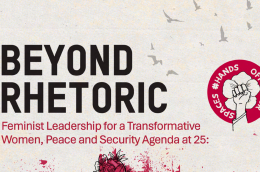
Twenty-five years after the United Nations adopted Resolution 1325, the Women, Peace and Security (WPS) agenda is both a landmark in diplomacy and a study in unfulfilled promise. Its most profound achievement has been to force open a conversation about the gendered power structures that fuel conflict. But that opening is narrowing. Escalating wars, a backlash against gender justice and a collapse in funding now threaten to strip the agenda of its transformative edge. The WPS agenda remains an essential tool for women peacebuilders. Whether it survives as a force for justice depends on whether the global community backs its principles with the resources and political will to make them real. Without that, the resolution’s 25th anniversary will mark the start of its decline, not its maturity.

Full article here.


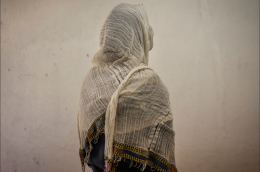
This report was written by researchers from the Organization for Justice and Accountability in the Horn of Africa (OJAH) and Physicians for Human Rights (PHR).
The report benefited from reviews by members of PHR staff, the PHR Advisory Council, and the PHR Board of Directors, as well as members of the OJAH Board of Directors.

The research team would like to recognize the strength and resilience of the survivors whose experiences and stories are reflected in this data, as well as the dedication of the health professionals who provided services and documented these violations—often at grave risk to their personal safety.

About Physicians for Human Rights (PHR)

Physicians for Human Rights (PHR) uses medicine and science to document and draw attention to human rights violations. PHR was founded on the belief that physicians and other health professionals possess unique skills that lend significant credibility to the investigation and documentation of human rights abuses.

In response to the scourge of sexual violence, PHR launched its Program on Sexual Violence in Conflict Zones in 2011. The program works to confront impunity for sexual violence in the Central African Republic, the Democratic Republic of the Congo, Ethiopia, Iraq, Kenya, Myanmar, and Ukraine.

PHR has conducted research to understand the scale and scope of conflict-related sexual violence in various conflicts and contexts, including in the Democratic Republic of the Congo, Kenya, Myanmar, and Sierra Leone.

About the Organization for Justice and Accountability in the Horn of Africa (OJAH)

The Organization for Justice and Accountability in the Horn of Africa (OJAH) is an independent and impartial organization dedicated to strengthening justice and accountability mechanisms in the Horn of Africa through evidence collection and preservation.

The organization’s mission is to deter war crimes, crimes against humanity, conflict-related sexual violence, and other severe human rights abuses across the Greater Horn of Africa. It pursues this mission by conducting documentation and investigations, advancing the environment for justice and accountability, preserving and analyzing materials, and supporting international justice and accountability actors and efforts.

Full report here.
 

This report advocates for thorough protection of human rights in the digital age, emphasizing the strength of constitutional safeguards over ordinary legislation. As digital technologies increasingly influence civil and political rights, online as well as offline, robust constitutional frameworks are essential to address new challenges such as unwarranted surveillance, censorship and data monopolies. Ensuring adequate constitutional protection helps anchor fundamental rights in an evolving digital landscape.

Click here to read the full report.


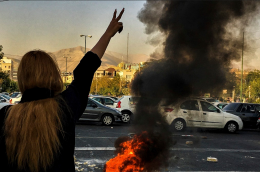
It’s been six months since the latest spark ignited mass protests in Iran — the death of 22-year-old Kurdish-Iranian Mahsa (Jina) Amini in morality police custody after she was arrested for allegedly failing to wear her hijab properly.

The outrage over her killing resulted in women-led protests. Their slogan “woman, life, freedom,” originally a Kurdish manifesto, has helped fuel the Iranian protesters’ demands for radical change.

Read more: Iranian women keep up the pressure for real change – but will broad public support continue? 

The perseverance, bravery and determination of the Iranian protesters, particularly women and girls, have been heroic. Despite risks to their lives and freedoms due to a brutal government crackdown, many remain active in publicly articulating their grievances in a variety of ways.

In recent months, while some street presence has continued in Iran — for example, in response to the poisonings of schoolgirls in cities across the country — protesters are also organizing strikes, sit-ins, boycotts and publicizing their demands in the form of manifestos, charters and bills of rights.

Read more: Iran: poisoning of thousands of schoolgirls piles more pressure on Islamic Republic struggling for survival 

In fact, a key distinguishing factor between the recent protests and the previous ones is that Iranians have been forming coalitions to advocate for important structural and institutional changes in support of equality, human rights, democracy and freedom.

Full article here.


Over the past two decades, the structures of social communication and public discourse have undergone profound transformations. The digital sphere has become a contested arena and a central space where identities are produced and symbolic and social meanings are shaped. It has also become a place where new subcultures emerge and existing hierarchies are often reinforced. Within this landscape, feminist and political movements have created counter-public spheres that enabled women and marginalized groups to break the monopoly of power over meaning, expose patriarchal violence, and build transnational networks of solidarity. 

Such networks helped dismantle the ideological structures that sustained violence and victim-blaming for decades. The broader shifts in societal values unfolded alongside a surge of revolutionary consciousness across the Global South, which exposed the colonial and capitalist structures underpinning political and social life. This awakening was met, however, with intensified surveillance, repression, and the mobilization of power to resist change. 

Digital surveillance cannot be understood simply as the use of technology by those in power. It reflects the transformation of the digital sphere itself into a disciplinary apparatus that reproduces colonial and neo-fascist modes of control. Once absorbed into a capitalist ownership structure monopolized by transnational corporations, the internet ceased to be a neutral space for knowledge or communication. It became an infrastructure of domination, where data and algorithms are deployed to sort, control, and exclude.

Algorithmic architectures reinforce hierarchies of language, gender, race, and class. Through mechanisms of digital moderation that reflect the logic of white, masculine, and capitalist privilege, feminist and anti-authoritarian content is systematically excluded. In this way, algorithms have become ideological tools that silence and erase voices deviating from the dominant norms enforced by structures of power.

Full report.


Despite the progress made during decades of work by women’s rights organizations and democratic institutions, gender equality is still a long way off. There is a growing understanding that gender equality will only be achieved when men and women work together towards full gender equality and equal respect for the rights of all individuals and groups. 

This paper presents nine policy and good practice recommendations to support diverse audiences in their work to include men in building a more gender-equal, peaceful, prosperous and democratic world.

Full report.