Advocacy & Lobbying

Discrimination in the workplace. Difficult choices between career and family responsibilities. Online harassment. Across Europe, many women experience inequality in their everyday lives.

Gender equality has been a core value of the European Union since its beginnings. The European Parliament is helping to translate that principle into practical action.

In recent years, the Parliament has legislated to increase pay transparency, strengthened protection against violence, improved work-life balance rights, and supported greater representation of women in leadership and decision-making.

Beyond adopting laws, Parliament also keeps up the pressure on EU countries and institutions to advance women’s rights, by monitoring progress and calling for specific action.

Read on for an overview of the EU laws fighting inequalities between women and men and the areas where the European Parliament is pushing EU countries and institutions to do more.

Full article.

This International Women’s Day, Euronews Green highlights some of the female politicians spearheading the never-ending fight against climate change.

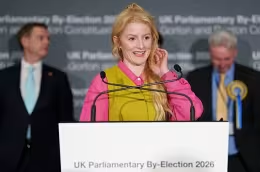
“A Green tidal wave is coming at the next general election,” declared Hannah Spencer, as she became the first ever Green Party MP to be elected in the north of England last week. She and a growing cohort of women are at its crest.

Spencer is not the typical face of green politics. A plumber who left school at 16 and was still completing her plastering training during the campaign, she represents the kind of voter the Green Party – with its middle-class, southern UK heartland – has long struggled to reach.

Promising in her speech to “make lives better for people like us – to bring down the cost of living, introduce rent controls, and get the litter and fly tipping off our streets,” now she seeks to represent them.

That kind of commitment comes at a personal cost. Even before Spencer had taken her seat, her professional and working-class credentials were being questioned, while false rumours of a multimillionaire husband circulated.
Full article.

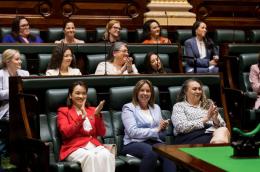
As public trust in politics remains fragile and Australians continue to call for leadership that reflects integrity, capability and lived experience, Pathways to Politics for Women has opened applications for its nationally recognised program.

Since its establishment 10 years ago, the program has supported 92 electoral successes nationally, demonstrating a proven pathway for women who are serious about driving change through political leadership. 62 alums are currently serving in parliaments and councils across Australia.

“Strong democracies depend on leaders who are well-prepared for office, driven by their values and deeply connected to their communities,” said Dr Meredith Martin, Program Director at the University of Melbourne and National Co-Convenor of Pathways to Politics for Women.

“At the University of Melbourne, where Pathways to Politics for Women first began, we have seen the impact of investing in women’s political leadership over the past decade. Seven Victorian alums, across different five parties, currently sit in the Victorian Parliament, with a further two in federal parliament and 19 in local government. These outcomes reflect not only the strength of the program, but the depth of preparation and multipartisan support that enables women to step forward and succeed.”

Full article.

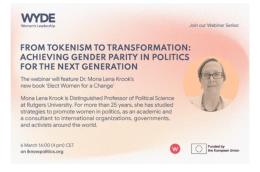
This webinar focused on barriers, challenges and strategies pertaining to the issue of gender parity for women in politics. Our guest speaker for the discussion was Dr. Mona Lena Krook.

Applying an intersectional lens the webinar discussion drew on research from Dr. Mona Lena Krook’s book, Elect Women for a Change: The Path to Gender Parity in Politics, Dr. Krook presented a core thesis: the global political community must move beyond aspirational "critical mass" targets (typically 30%) toward a non-negotiable 50/50 parity framework. This shift represents a transition from viewing women’s participation as an elective "add-on" to recognizing it as a fundamental requirement for democratic legitimacy.

Full report.

Watch the full webinar.


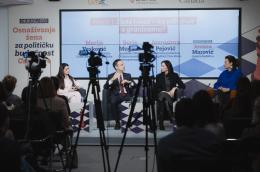
Women in Montenegro are no less interested and competent in politics, but they are limited by deep-rooted gender norms, stereotypes about social roles, unequal distribution of power within political structures, as well as a hostile environment that includes discrediting, hate speech, and gender-based attacks in public spaces.

This was announced at the roundtable "Empowering Women for the Political Future of Montenegro", organized by the Center for Monitoring and Research (CeMI).

CeMI Program Director Teodora Gilić She said that an improved legal framework, including a 40 percent quota for the less represented gender, does not automatically mean substantial equality for women in politics, reports PR Center.

"Numbers are important, but they do not in themselves guarantee real influence, equal participation in decision-making, or a change in political culture," said Gilić.

She pointed out that women in Montenegro are not less interested in politics or less competent, but that they are limited by deep-rooted gender norms, stereotypes about social roles, unequal distribution of power within political structures, as well as a hostile environment that includes discrediting, hate speech and gender-based attacks in public space.

Full article.

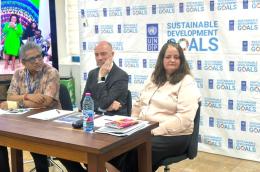
As Ghana prepares for local elections in 2027, new research presented in Accra today warns that violence against women in politics remains a significant barrier to democratic participation at the local level.

At a joint roundtable hosted by the United Nations Development Programme (UNDP) Ghana and the Nordic Africa Institute (NAI), researchers, policymakers, development partners and members of the diplomatic community convened to examine structural barriers to women’s political participation and identify strategies for safer, more inclusive local governance.

Presenting on NAI’s research, Senior Researcher Diana Højlund Madsen shared findings from the newly published book Making Politics Safer – Mitigating violence against women in politics in Africa: insights from Ghana, Kenya and Zimbabwe, released in NAI’s Current African Issues series The book draws on 134 interviews with politically active women and highlights how women in local politics face systematic forms of physical, sexual, psychological, economic and semiotic violence designed to deter their participation and preserve male-dominated political systems.

“In Ghana, only 4.1 per cent of district assembly members are women. If we want inclusive local governance, we must look not only at how to bring women into politics, but at the conditions under which they participate,” said Diana Højlund Madsen. “Violence and intimidation are not isolated incidents. They are structured obstacles that shape who is able to stand for office and remain in politics.”

Full article.

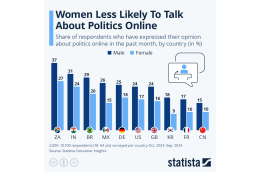
Women are more likely to be hesitant in expressing their opinions about politics online than men, a new survey by Statista Consumer Insights has found. This was the case in all of the 21 countries polled, with the gender gap narrowest in Finland at 3 percentage points (22 percent male, 19 percent female) and widest in Mexico at 10 percentage points (26 percent male, 15 percent female). This mirrors wider patterns of gender roles and equality in society, with Finland having scored in the top three places in this year’s Global Gender Gap Index by the World Economic Forum.

Even aside from gender, the degree to which people express their views on politics online varies greatly by country. For example, in China only 13 percent of respondents on average said they had expressed their opinion about politics online in the past month. This includes having commented on or even liked a post related to politics on social media. In Japan (not shown on this chart), the figure was even lower at just 5 percent (7 percent men, 3 percent women). At the other end of the spectrum comes South Africa, where 32 percent of respondents said they had expressed their political opinion in the past four weeks (37 percent men, 27 percent women).

Read here the full article published by Statista on 17 January 2025.

Image by Statista


Background

The access to water and sanitation is recognised as human right and the access to clean drinking water and sanitation are essential to the realisation of all human rights.  The EESC with this own-initiative opinion is aiming to address the issue of water-related challenges for the most vulnerable population on the planet and to propose options for their empowerment.

Key points

In the opinion the EESC:

  • stresses that young people, women, and indigenous and local communities (including migrants and people with disabilities) are the most vulnerable to water stress and have a large untapped potential for contributing to sustainable water management, for turning water into an instrument of peace and stability, and, thus, for contributing to blue diplomacy;
  • calls on the EU to pay due attention to these groups in its external relations and international cooperation and suggests a lighthouse partnership programme related to water stress for addressing how to empower them in an integrated manner;
  • notes that access to clean water, education, employment and participation in policymaking are key elements of empowerment. Better access to water, sanitation and hygiene (WASH) services is crucial, as it frees up time for education and vocational training and opens up more diverse options for employment and the ability to contribute to water management and policies;
  • reaffirms that blue and digital technologies are instrumental for improving water management and access to clean water and sanitation;
  • highlights that meaningful partnership and funding are critical in the development of infrastructure, education and general capacity building. Both EU funds and national donors’ programmes play a crucial role here and coordination is vital to create synergies and make the most of the allocated resources.

Read here the full article published by the European Economic and Social Committee on 4 December 2024.

Image by the European Economic and Social Committee


What you need to know:

  • To effectively address TFGBV, support systems must be integrated into existing reporting mechanisms, providing clear communication channels for women to report incidents.

Uganda is making significant strides in its democratic processes, but the intersection of technology and politics poses both opportunities and challenges, especially for women. Technology-facilitated gender-based violence (TFGBV) has emerged as a major barrier for women in politics, where harassment, intimidation, and violence are prevalent. 

As we commemorate the 16 Days of Activism against Gender-Based Violence under the theme “Towards Beijing +30: UNiTE to End Violence Against Women and Girls,” it is crucial to address TFGBV through a multifaceted approach, including communication channels, education, awareness, and strong support systems. TFGBV is a pervasive issue that affects women at all levels of political engagement, from grassroots activism to national leadership. 

The Amplified Abuse report by Pollicy highlights the alarming prevalence of online violence during periods of political activity in Uganda. This violence, particularly directed at women in public life, exemplifies Violence Against Women in Politics (VAW-P). The research, conducted during the January 2021 general elections, examined social media accounts to assess how online harassment affects women’s political engagement

Read here the full article published by Monitor on 25 November 2024.

Image by Monitor


By the time the first verified reports about COVID-19 were published, misinformation about the virus was already being shared. Disinformation and ‘fake news’ soon followed. It didn’t take much time at all before distortions, lies and fictions were reaching more people, more quickly, than facts. 

None of this should surprise us, since we’ve known for some time that lies spread faster than truth. The real problem arises when lies are believed. And when does that happen? Research tells us that lies are more likely to be believed, and especially catch fire, when they reinforce our pre-existing beliefs. While some beliefs are harmless, others can be weaponized, with the help of disinformation, to achieve undemocratic ends. 

In the world of politics, this is already happening. Disinformation campaigns regularly rely on sexist beliefs about women, power and politics in attempts to delegitimize women who hold or seek office. Distinct from online abuse, trolling, revenge porn or even pornographic deepfakes, disinformation is a stealthier, more pernicious way to undermine women and dissuade them from entering politics. This emerging threat has devastating implications for women in public life and, by extension, democracies everywhere.

It’s crucial that we pay attention, and commit energy and resources to better understand this problem. What’s at stake is simply too important to ignore, especially now. Just when women are inching closer to a more equitable share of public power, trying to actualize democracy’s promise of government by the people, for the people—women being a key part of the people—gendered disinformation puts hard-fought gains at risk.

Read here the full overview published by Fundación Multitudes.


Multiple studies show that the use of social media has a negative impact on the political leadership of women and girls in Latin America. Social media is one of citizens' most used tools in the region to get information and communicate with others, with a high level of internet penetration, and raising a series of issues related to the low level of digital literacy in the countries. 

One of the biggest problems with the massive penetration of social media in Latin America is that users don’t have the knowledge nor the tools to know what is real and what is not. Identifying gender political violence online, including disinformation and fake news, is particularly difficult considering that lies spread faster than truth , making them more vulnerable to disinformation. 

In order to understand if the safeguards in place are efficient, it is essential to identify the state of implementation of the institutional incentives for women to participate in politics, in addition to looking at the existing safeguards and legislation to counter online gender-based violence and disinformation in Latin America. Specifically, we look at the current state of affairs in four countries of the region. Our research question is: What is the state of implementing the institutional incentives for women to participate in politics, the existing safeguards to counter gender-based violence online, and the existing legislation against disinformation in Colombia, Mexico, Argentina, and Brazil?

Access here the full report published by Fundación Multitudes.


A research study by Voice of Women Radio has shown why women don’t vote for female political aspirants in Nigeria.

The reasons ranged from their ignorance of the existing female political aspirants to beliefs that existing female political aspirants are inexperienced. Similarly, many women in the grassroots believe that men are better leaders than women.

There is also the issue of culture, inaccessibility of campaign funding for women as their male counterparts, and family upbringing, which favour males taking up leadership roles. However, higher among the reasons is female electives’ inability to connect with or impact their female electorates once elected into office.

The report detailing the research carried out in the six geopolitical zones of Nigeria reveals that only 31 percent of 83 percent of female voters (that is, 8 out of 10 women possessing permanent voters’ cards) voted for women at the last elections.

Read here the full article published by Leadership News Nigeria on 8 October 2024.

Image by Leadership News Nigeria