Advocacy & Lobbying
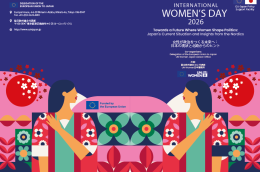
Gender equality and women empowerment remain a globally important priority policy issues. “Women in Politics” is an indispensable part of progress towards nurturing greater gender equality. In this seminar, we focus on key success factors underlying Nordic model of higher female representation in politics and how could this potentially be achieved in Japan. European and Japanese stakeholders will discuss common challenges, share experiences and best practices, and identify potential avenues of cooperation.
Please join us for the online viewing of this seminar.[Deadline - Tuesday, 3 March 2026]:
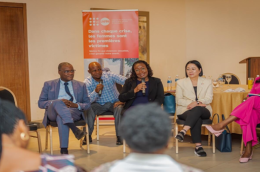
On a visit to the DRC, the UNFPA Regional Director for East and Southern Africa (ESARO), Ms. Lydia ZIGOMO, and the Humanitarian Director, Shoko ARAKAKI, met with women's organizations and Women Leaders (WLOs) in Kinshasa and Goma.
This high-level exchange aimed to reaffirm the United Nations' support for the Women, Peace, and Security (WPS) Agenda in the Democratic Republic of Congo, focusing on the challenges and priorities of women on the ground.
The two Directors hailed the frontline leadership and agility of women operating in high-risk areas, emphasizing their indispensable role in protection against Gender-Based Violence (GBV) and advocating for women's participation in peace processes in the DRC.
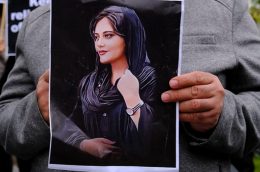
As a wave of protests stemming from the death of a 22-year-old Iranian woman enters its second month, demonstrations have spread worldwide.
Claudia Yaghoobi, an Iranian Armenian American and the director of the Center for Middle East and Islamic Studies, answered questions from The Well about what led to the historic protests, how the fallout compares to previous conflicts and more. Yaghoobi is also the Roshan Institute Associate Professor in Persian Studies in the College of Arts and Sciences’ department of Asian and Middle Eastern studies.
What sparked the protests and who is protesting?
In September 2022, protests broke out spontaneously across the country after images appeared on social media of 22-year-old Mahsa Jina Amini, an Iranian Kurdish woman, unconscious on a hospital bed. She was declared dead on Sept. 16, three days after being arrested on a Tehran street by the morality police.
The Kurdish phrase “Jin, Jiyan, Azadi” (“Woman, Life, Freedom”), derived from years of Kurdish resistance and activism, became the slogan of this moment. Amini’s parents made a conscious decision to hold her funeral publicly even though they had been told not to. This incited protests in Saghez during the funeral when women began taking off their veils and cutting their hair. Thereafter, in almost all cities of Iran protests arose and women began cutting their hair and burning their hijabs in solidarity. The protests, or what’s been called feminist social revolution, continue to this day, as we are in the sixth week.
The protests are different in a few aspects from other protests or revolutions. For instance, they are leaderless, and people from various socio-economic gender, sexual, ethno-religious backgrounds are united. This is no longer the revolution of the educated urban middle class or upper middle class. This is a movement where all sectors of the society — Kurdish and Baluch people, men and women, the trans and queer communities, urban and rural — have come together. Mahsa Jina Amini was an ordinary woman from Saghez visiting Tehran with her family. She was not a dissident or anti-veiling activist. So, this could be anyone. And that’s why she’s united everyone.
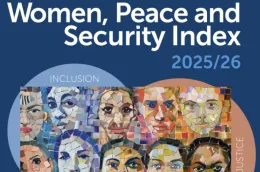
Turkey was ranked 106th out of 183 countries in the 2025/26 Global Women Peace and Security Index (WPS Index), down from 99th in the previous edition, according to a biennial report released by the Georgetown Institute for Women, Peace and Security (GIWPS) and the Peace Research Institute Oslo (PRIO).
Turkey’s overall score of 0.664 was well below both the developed-country average of 0.847 and the 0.715 average for its regional peer group of Central and Eastern Europe and Central Asia.
Published biennially since 2017, the WPS Index measures women’s status across 13 indicators covering three dimensions: inclusion, justice, and security. The inclusion dimension measures women’s achievements in education, employment, parliamentary representation and access to financial services. The justice dimension covers legal discrimination, access to justice and maternal mortality. The security dimension examines community safety as well as violence by intimate partners and during political conflict.
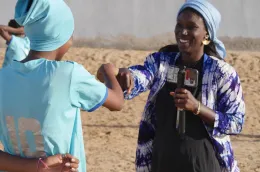
Hawa Bâ is a self-taught journalist based in Mauritania, a country where civic space remains subject to certain limitations and reporting on sensitive issues often comes with risk. She reports for Initiatives News and focuses on women’s rights, gender-based violence, health, and political participation, working in a media environment where journalists face pressure and limited access to information.
In Mauritania, journalists covering protests or public events can have their equipment confiscated, internet access is periodically disrupted, and independent reporting is frequently discouraged. Women journalists encounter additional barriers, including gendered harassment and attempts to discredit their work. Despite these challenges, journalists like Bâ continue to document social realities that would otherwise remain invisible.
Bâ is also the communications lead for a network of journalists working to address violence against women and girls in Mauritania, a collective effort supported by the UN Human Rights Office (OHCHR). Through training, coordination, and international visibility, OHCHR supports journalists working in restrictive environments to strengthen their reporting, protect their rights, and continue informing the public.
In her own words, Hawa Bâ shares how she became a journalist, why she chose mobile reporting, and what it takes to tell women’s stories in a context where speaking openly can carry consequences.
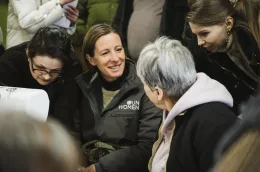
Four years have passed since the full-scale invasion of Ukraine on February 24, 2022. Daily life is a struggle to survive and tackle economic insecurity, power outages during brutal winters, constant security risks, and displacement.
But this is only half the story.
The other half is about remarkable resilience, courage, and determination of Ukrainian women who have led the war response from day one. They've distributed aid to those most in need, kept food on tables and businesses running, fought on the front lines, held communities together, cared for the sick, and kept essential services operating. Yet today, Ukrainian women and women-led organizations need our support more than ever to keep going and to continue the critical work they do.
Implementation Of The Beijing Declaration And Platform For Action (1995) And The Outcomes Of The Twenty Third Special Session Of The General Assembly (2000) In The Context Of The Of The Thirtieth Anniversary Of The Fourth World Conference On Women And The Adoption Of The Beijing Declaration And Platform For Action 2020
Read here the full country report published by UN Women Africa on 30 September 2024.
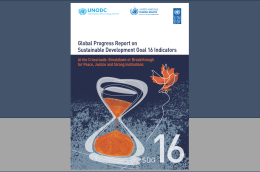
The 2nd Global Progress Report on SDG16 Indicators represents a unique and pivotal UN inter-agency effort toward supporting the realization of the 2030 Agenda. This report reveals critical trends that, if not reversed, could jeopardize the achievement of all goals set by the international community, leaving an increasing number of people behind.
Released in 2023, the first joint Global Progress Report on SDG 16 served as a wake-up call for action on strengthened efforts towards justice, peace, and strong institutions. The report portrayed a sobering picture, revealing that progress toward the 2030 Agenda was alarmingly off track, with advancements on goal 16 worryingly slow. In some instances, even moving in the wrong direction. The report, however, acknowledged some significant strides towards supporting countries in addressing data gaps through partnership, technical assistance and production of evidence.
This report, the second dedicated to Goal 16, compiles contributions from all indicators in a single document providing the best regional and global data that the UN system can offer across all targets. The data, statistics and accompanying analysis spotlight trends that have and will continue to shape our world, policy options and underscore the urgent need for action to reverse negative trends and to foster a more just and sustainable future.
Click here to access the full report published by UNDP on 17 July 2024.
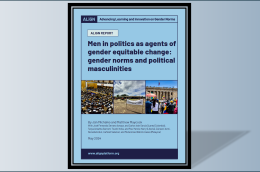
Men in politics as agents of gender equitable change examines why men in politics decide to support gender equality, how they explain and frame their allyship, and how their actions are perceived by women politicians, activists and students. Drawing on evidence from three countries: Colombia, Liberia and Malaysia, this research contributes in-depth, qualitative and cross-country analysis of how gender norms are influencing decisions of men politicians to support gender equality in the Global South.
As key stakeholders in changing norms around political masculinities and representation in politics, the project responded to feminist calls for a better understanding of how more men can be motivated to take an active role in addressing gender inequalities. Despite their diverse histories, social, political and economic contexts, all three countries had senior government officials expressing support for feminist foreign policy and a greater public discourse on gender equality or feminist politics among men politicians.
Based on key informant interviews and focus group discussions with politicians, activists and university students, the study explores how personal motivations, political institutions, social norms, and global gender equality regimes help to shape men’s engagement – or lack of it – with gender equality, while being mindful of the risk of the appropriation of feminist principles to maintain patriarchal inequalities and intersecting systems of oppression.
This cross-country analysis, together with the three country reports, tease out the implications for politicians, international donors, civil society and researchers on how best to engage with men in positions of power to promote the sustainable transformation of unequal gender norms.
Read here the full report published by the ALIGN Gender Norms Platform on 28 May 2024.
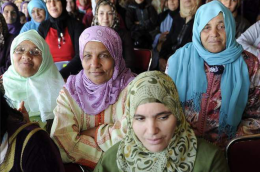
Despite overall progress in terms of more women participating in political decision-making worldwide, gender equality in political participation remains elusive. Deeply entrenched discrimination continues to hinder women’s full participation in political and electoral processes. In its efforts to advance women’s rights and gender equality, UN Women recognizes women’s political participation as a key area of focus.
UN Women’s initiatives to advance women’s political participation include:
¨promoting supportive legislative and institutional reforms;
¨building the capacity of women political aspirants and leaders;
¨monitoring, preventing and mitigating violence against women in politics; and
¨encouraging social norms change to recognize women’s political leadership.
UN Women is also actively engaged in promoting women’s political participation through coordination and advocacy efforts across the UN system.
In 2023, UN Women’s Independent Evaluation Service conducted an evaluation of UN Women’s support to women’s political participation. The primary focus of the evaluation was the impact of UN Women’s efforts to support women’s political participation at the national (and subnational) level. The evaluation also identified lessons learned; examined the contribution of regional and global-level support/guidance; and tracked both positive and negative unintended consequences, including cases of backlash against women’s political participation.
The evaluation included a retrospective view of results achieved during the UN Women Strategic Plan 2018–2021 period, as well as a forward-looking view to support implementation of the UN Women Strategic Plan 2022–2025. The geographic scope covered UN Women’s programming across all six regions through a representative sample of 12 country offices.
Read here the full report published by UN Women on 18 May 2024.
KARACHI: The Uks Research Centre (URC) has urged the media outlets in the country to recognise the transformative potential of women in politics and foster a more inclusive media environment for democratic, inclusive, and representative discourse.
The Pakistani media has been urged to increase the coverage of women's issue to address gender imbalance prevailing in the country -- a phenomenon witnessed during the news coverage of pre-and post-election period.
The URC organised a dialogue, titled 'Gender Representation in Media During Pakistan's 2024 Elections'. The event, hosted by URC Executive Director Tasneem Ahmar, was attended by politicians, representatives of journalists, and researchers.
In her brief remarks, Ahmar said that her organisation monitored gender representation in the Pakistani media, and conducted research on emerging trends and created awareness about inclusion and negative stereotyping through training and advocacy.
On the occasion, Shahrezad Samiuddin presented a data-based analysis of the media coverage of the pre- and post-election scenarios. She highlighted that during the election coverage, more than 90% of journalists, who reported to both print and electronic media, were males.
A better representation of was seen on TV screens where 33% announcers were women. Similarly, Samiuddin pointed out that the coverage of women-specific news did not exceed 10-13% in both forms of media. The share of women-related news increased in the current affairs shows to 38%.
Read here the full article published by The Express Tribune on 18 May 2024.
Image by The Express Tribune
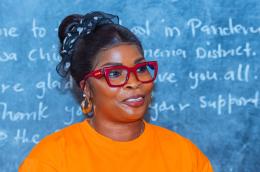
Africa Renewal: What best practices you would you like to share with other countries regarding your government’s work to empower women?
Dr. Mahoi: Everybody knows what we have been through in Sierra Leone—war, Ebola, landslides, flooding, and more. In all these, women suffered the most but we have picked ourselves up. Our focus now is ensuring that women's empowerment is at the centre of development.
We have ratified numerous international agreements such as the Convention on the Elimination of All Forms of Discrimination against Women (CEDAW), the Protocol to the African Charter on Human and Peoples' Rights on the Rights of Women in Africa, also known as the Maputo Protocol, and the Beijing Declaration, and so on. So, we are on course in domesticating these treaties and implementing our mandates and obligations as a country.
On the domestic front, we have enacted many gender-related laws such as the Devolution of Estates Act, 2007; the Domestic Violence Act of 2007; and the Customary Marriage and Divorce Act of 2009. For me, these are outdated laws, even though they were steps in the right direction at the time.
In the last few years, we reviewed some of those laws and are trying to address existing gaps. For example, in 2019, we reviewed the Sexual Offenses Act of 2012, to impose stiffer punishments on perpetrators of sexual violence. President Julius Maada Bio demonstrated his passion for the well-being of women by declaring in 2019 a State of Emergency over rape and sexual violence.
We established a Sexual Offences Model Court to try cases of sexual violence against minors and impose stiff punishment. Those cases are now fast-tracked. We enacted the Gender Equality and Women’s Empowerment Act(GEWE), in 2022, to reaffirm our commitment to the empowerment of women and girls. We also have the Customary Land Rights Act, which guarantees women the right to own, hold, use, and inherit land.
All these efforts are translating into tangible results.
Click here to read the full article published by the United Nations Africa Renewal News on 30 April 2024.
Image by UN News
.