Elections

Women politicians have bemoaned rising violence against women in politics which discourages their participation in key decision-making processes.

This comes at a time when female candidates are increasingly occupying higher political positions in government and in political parties.

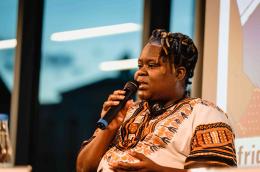
Linda Masarira, who failed to register as female presidential candidate for the 2023 polls, said women face violence simply for daring to challenge for spaces traditionally occupied by men.

“Violence against women in politics is a deeply concerning issue that has hindered the participation of women in decision-making spaces,” said Masarira.

“Women who step into the political arena often face targeted harassment, verbal abuse, and even physical violence, simply for daring to occupy spaces traditionally dominated by men. This violence not only discourages women from participating but also perpetuates a culture of fear and exclusion.

Only three women registered to compete for the top office in Zimbabwe’s elections in 2018: Joice Mujuru. Thokozani Khupe and Violet Mariyacha. In 2023, only Elisabeth Valerio was brave enough to enter the poll ring.

Masarira said violence against women was designed to undermine confidence, discredit them and their capabilities, and silence their voices.

“It creates a hostile environment that discourages potential female leaders from stepping forward, leading to a severe gender imbalance in political representation.”

Read here the full article published by NewsDay Zimbabwe on 20 November 2024.

Image by NewsDay Zimbabwe


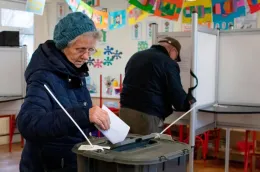
A record number of women candidates are registered to stand in this month's general election in the Republic of Ireland, according to a campaign group.

Figures released by Women for Election suggest 247 women are running for seats across the country - a 53% increase on the last election in 2020.

The group analysed nominations published by the returning officers in all 43 constituencies, and described the figures as "phenomenal".

Nominations closed on Saturday. A total of 685 candidates will contest the election which will be held on 29 November.

Parties have been issued with a candidate gender quota, requiring them to have at least 40% men and 40% women on their ballots.

Those failing to reach that quota face a reduction of 50% in state funding.

The Women for Election group said Ireland was the 104th in the world in terms of the number of women in national parliaments.

It said the last Daíl (Irish parliament) had 37 women TDs (members of the Dáil) out of 160.

The total number of TDs due to be elected has increased to 174.

Read here the full article published by the BBC on 17 November 2024.

Image by BBC


On Election Day, Donald Trump beat the second woman to ever win a major-party nomination for the presidency — just eight years after he beat the first. Did Kamala Harris’ loss this year, and Hillary Clinton’s loss in 2016, have anything to do with their gender? Or was it something else? We asked a group of leading women in journalism, politics and academia to explain why a woman has still not been elected president in the United States.

There is plenty of evidence that voters could have gendered biases that factored into their votes in 2016 and 2024, and our contributors know it well. One pointed to studies in which participants judged a personnel file with a woman’s name as less competent than that with a man’s name — and then, when more information was included to show her superior competence, the same participants found her more competent but less likeable.

There were others, though, who thought that gender might be at play, but not necessarily in a way that would make voters less likely to vote for a woman. “Harris didn’t lose the election because she’s a woman, but she was put into the position to lose this election because she was a woman,” one former Trump official wrote.

Many of the women blamed a mix — gender, yes, but gender combined with the Democratic Party’s failure to win working-class men and how voters see the party in general. “No woman in the United States has yet been able to clear that bar,” one contributor wrote. “The first to do so may well come from the right.”

Read here the full article published by Politico on 15 November 2024.

Image by Politico
 

Toplines

U.S. Congress

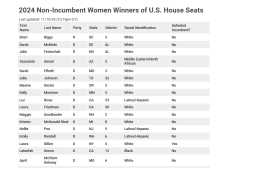
Women in the 119th Congress: Thus far, 148 (109D, 39R) women will serve in the 119th Congress in 2025 (current record: 151, set in 2023). They will be at least 27.7% of all members of Congress. Currently, 151 (107D, 43R, 1Ind) women serve in the U.S. Congress, holding 28.2% of all seats. Five (3D, 2R) women candidates remain in congressional contests that are too close to call. 

Women in the U.S. Senate: Twenty-five (16D, 9R) women will serve in the U.S. Senate in 2025 (current record: 26, first set in 2020). They will be 25% of all members of the Senate. Currently, 25 (15D, 9R, 1Ind) serve in the U.S. Senate, holding 25% of all seats. 

Women in the U.S. House: Thus far, 123 (93D, 30R) women will serve in the U.S. House in 2025 (current record: 126, set in 2023). They will be at least 28.3% of all members of the U.S. House. Currently, 126 (92D, 34R) women serve in the U.S. House, holding 29% of all seats. Five (3D, 2R) women candidates remain in U.S. House contests that are too close to call.

Read here the full article published by CAMP on 14 November 2024.

Image by CAWP


Donald Trump’s victory was helped in no small part by the unexpected shift of support he received among Gen Z voters. 

While voters under the age of 30 still broke for Kamala Harris, her margin of victory was much smaller than the one enjoyed by President Joe Biden, who, according to a survey based on 2020 validated voter files, secured 59 percent of the youth vote compared with 35 percent of young voters who backed Trump. Depending on which exit poll you view, Trump improved his performance by between 8 points and 11 points among young voters compared with the 2020 race.

Trump’s performance with the nation’s youngest voters, however, was very uneven along gender lines. Analysis of the AP Vote Cast Survey by CIRCLE at Tufts University shows young women preferred Harris to Trump by an 18-point margin (58 percent to 40 percent), while young men broke for Trump by 15 points (56 percent to 42 percent). Trump’s gains among young male voters were particularly large, as a slight majority of men under 30 backed Joe Biden just four years ago.

Why did Trump do so much better among young men? 

Read here the full article published by The Hill on 13 November 2024.

Image by The Hill


Right now, we’re existing in an especially tense and unstable “in between.” 

We know what’s to come next January – yet at the same time, we have no idea what’s to come. Once-again President-elect Donald Trump has already promised mass deportations and a gutting of the Department of Education. His followers have already shown us shades of their callousness to come, in telling women that consent is now a matter of, in their disgusting words, “your body, my choice.” But we have no clue if there is a rock-bottom still looming below.

At present, I – and most every politically engaged progressive I’ve spoken with – is in a place of: “What can I do about it?” Some of us are taking quiet moments to regroup, to prepare bodies and minds and spirits for a long haul. And then there are people like me, who have spent the past week being rather vocal – encouraging others against the allure of quick fixes, while also howling against each new sign of injustice that crops up in the social media feeds we (fine, I) can’t quite step away from.

There is another option, though. As a number of the women candidates I’ve spoken with throughout 2024 have proposed, we might also consider running for office ourselves.

Read here the full article published by The Story of Exchange on 13 November 2024.

Image by The Story of Exchange