Elections

In the final week of the US presidential election campaign, there is a real possibility a woman will make it into the top job. But why has it taken so long – and has Kamala Harris got what it takes to make history?

My research examines celebrated women in history and how, collectively, they represent women’s changing status in society. In particular, I have looked for the historical themes and patterns that explain the rise of the first elected women leaders.

Women in politics are generally assumed to be a minority, emerging from a position of disadvantage. When successful, they are considered exceptions in a masculine system that was previously out of bounds.

But due to the complex workings of gender, race, class and culture, it’s not quite that straightforward, as discussion of Harris’s biracial identity shows.

I have identified three broad groups of women who have succeeded in becoming elected leaders of their countries since Sirimavo Bandaranaike of Ceylon (now Sri Lanka) became the world’s first female prime minister in 1960.

Does Kamala Harris fit within any of these groups? And, if so, based on the pattern so far, does she have what it takes to become president? Or does being a global superpower mean the US demands a new form of female leadership?

Read here the full article published by The Conversation on 28 October 2024.

Image by The Conversation


In Chile, the last municipal elections were held on the 15th and 16th of May of 2021. In these elections, authorities responsible for local administration were elected, including mayors of 345 municipalities that administer 346 communes, the smallest administrative division in the country, and 13 regional governors. This was the first-time in Chile’s history that governors were democratically elected given they were previously always designated by the President of the Republic.

The next municipal and regional elections are set to take place on the 26th and 27th of October 2024.

International Conventions

​​Chile is signatory of the main international instruments on gender equality and women’s empowerment, including the Convention on the Elimination of All Forms of Discrimination against Women (CEDAW), that upholds women’s right to participate in public life, and the Beijing Platform for Action adopted in 1995, which calls for removing all barriers to equal participation.

The CEDAW Convention was signed and ratified in 1980 and 1989, and the CEDAW Optional Protocol in 1999 and 2020 respectively.

National Legislation

Political participation

Gender quotas to promote women’s representation at local levels have not been legislated in Chile. Other temporary special measures to address youth and indigenous peoples underrepresentation in local decision-making have also not been legislated to date.

However, a draft law (Bulletin No. 11994-34) establishing gender quotas for regional governors and local councillors, that establishes a maximum representation of 60 per cent for either sex in candidate lists is currently in the second stage of constitutional review in the Senate.[1]

Chile also introduced parliamentary gender quotas in the the 2015–2016 electoral reforms establishing at least 40 per cent of candidates standing for Parliament must be women. This temporary measure established under Act No. 20.840 is set to last until the parliamentary elections of 2029. It also provides that at least 10 per cent of state funding contributed to each political party must be used to promote the political participation of women.

Chile is also the first country in the world to carry out a constitutional electoral process with a gender parity mechanism for both lists of candidates and election results, as provided in 2020 by Act No. 21.216 on constitutional reform. As a result, the body currently has a membership of 77 women and 78 men. In addition, in 2020 the inclusion of 17 seats reserved for representatives of indigenous peoples was approved, 9 of which are occupied by women.[2]

Read here the full article published by GWL Voices on 24 October 2024.

Image by GWL Voices
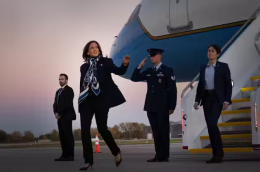
 

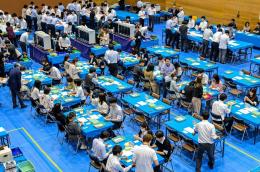
A record number of women have been elected to Japan's house of representatives, projections showed on Monday (October 28, 2024), but at less than 16% they remain a minority.

Public broadcaster NHK projected that women had won 73 of 465 lower house seats up for grabs, figures expected to be confirmed in official results later in the day. In Japan's 2021 general election, some 45 women were elected to the lower house.

The broadcaster and other outlets had previously reported that a record number of women were running in the election, accounting for around a quarter of candidates.

Women leaders are still rare in business and politics in Japan, which ranked 118 out of 146 in the 2024 World Economic Forum's Global Gender Gap report. Prime Minister Shigeru Ishiba's 20-strong Cabinet includes just two women.

Read here the full article published by The Hindu on 28 October 2024.

Image by The Hindu


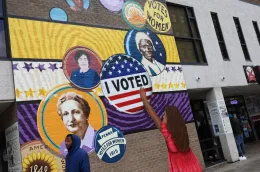
A massive gender gap has been evident in poll after poll of this election — a significant trend that underscores the pivotal role women could play this November.

Most recently, a late October Quinnipiac survey of Michigan found 57 percent of women in the state back Vice President Kamala Harris, while 40 percent of men did the same. Conversely, 56 percent of men backed former President Donald Trump, while 37 percent of women did. That’s repeatedly been the case in national polls, too. For example, a recent poll from USA Today/Suffolk University found that Harris had a 16-point gap in the support that she saw from men and women.

“It’s the battle of the sexes, and it’s no game,” Quinnipiac pollster Tim Malloy said in a statement. “There is a glaring gap in Michigan and Wisconsin between the number of women supporting Harris and the number of men supporting Trump.” In Quinnipiac polls conducted in five of the seven key swing states throughout October, Harris had a significant lead among women, while Trump saw a comparable advantage among men in those same places. (Quinnipiac has not released October results for Nevada and Arizona.)

Read here the full article published by VOX on 26 October 2024.

Image by VOX


ISLAMABAD: The gender gap in registered voters in Pakistan has narrowed significantly, now standing at less than 10 million, according to the latest data. This is a notable achievement, considering the country’s historical disparities in voter registration.

The gap between male and female voters today stands at 9,905,801 with total male voters recorded at 70,718,723 and females at 60,812,922. The overall voter database is now 131,531,645, whereas it was 130,444,891 on June 14, 2024. The percentage of male voters in the country is 53.77pc while that of female voters is 46.23pc, as reflected in the latest data, released by the Election Commission of Pakistan.

Read here the full article published by The News Pakistan on 23 October 2024.

Image by The News Pakistan


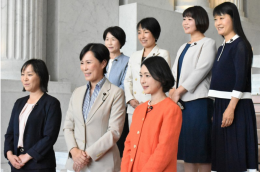
The city of Shiroi, located in the northwestern part of Chiba Prefecture and known for its sprawling commuter towns, is home to one of the few female-majority local assemblies in Japan. Of the 18 assembly members, 10 are women. During the general questions session held last month, four of the five speakers on the first day were women. One was Atsuko Odagawa, 57, who broadly addressed the issue of making information more accessible to people with disabilities, focusing on "creating a community where anyone can understand and live comfortably."

The Shiroi Municipal Assembly had already had a large number of female members, but during last spring's unified local elections, the female-male ratio reversed. Odagawa describes the atmosphere in the assembly: "It has fostered fair decision-making standards not bound by gender. Opportunities for speaking are equally available, making it a comfortable assembly for women as well."

Read here the full article published by The Mainichi on 24 October 2024.

Image by The Mainichi