Elections
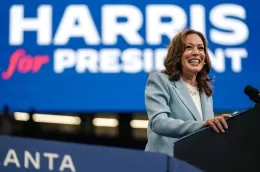
On the second night of the Democratic National Convention (DNC) of 2016, Hillary Clinton appeared via satellite as a collage of all male presidents was graphically shattered to show her live image. In that moment, she said, “I can’t believe that we just put the biggest crack in that glass ceiling yet,” referring to what she called the “highest, hardest glass ceiling” of the U.S. presidency eight years prior. When Clinton takes the DNC stage on Monday, she will do so again with the mission to see that ceiling shattered once and for all by Vice President Kamala Harris.
Understanding the gendered terrain that Harris is now navigating as just the second woman major-party nominee for president means appreciating how and why that terrain has shifted since Clinton’s history-making bid in 2016.
Since 2016, women have made record gains in officeholding. When Clinton took the stage in July 2016, women were under 20% of Congress, under 25% of state legislators, and just six of 50 governors nationwide, according to the Center for American Women and Politics at Rutgers University (CAWP). But immediately following Clinton’s defeat – and at least in part because of it – women’s political participation surged, from protest at women’s marches to record levels of women’s candidacies in the 2018 midterm elections.
Read here the full article published by Forbes on 16 August 2024.
Image by Forbes
The number of women running for the House and Senate has dropped, including a record number of incumbent women not running for reelection.
Women continue to make record-breaking progress in politics — most notably with Vice President Kamala Harris becoming the first woman of color at the top of a major party presidential ticket. However, an annual report by RepresentWomen, a nonprofit organization that supports institutional reforms to help women enter public office, found that progress has been inconsistent.
The report, called the Gender Parity Index, tracks gender representation across local, state and federal offices.
“The 2024 Index reflects our complex political landscape, suggesting progress in women’s political representation may stagnate or even backslide,” according to the report.
Overall, the United States lags behind most established democracies. Women are still underrepresented at every level of government, holding under one-third of all elected positions despite accounting for more than 50 percent of the total national population. In the last year, the number of women congressional candidates has fallen by 20 percent in the House and 26 percent in the Senate. And a record number of incumbent women are not running for reelection.
Read here the full article published by 19th News on 12 August 2024.
Image by 19th News
What you need to know:
-
There’s a growing consensus among academicians that these quotas “work”.
-
However, there is a conundrum as women who are elected in countries with gender quotas are often criticised as being less qualified.
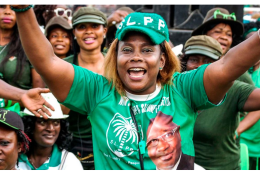
Standing in the scorching afternoon heat, Aminata Bilkisu Kanu took off her sunglasses to wipe away the beads of sweat trickling down her face as she appealed to the crowd of mostly male voters.
“Think ‘women’ when voting in the June 24 elections,” she told them.
“We keep your resources within; the men take them away.”
The 24-year-old single mother was the first woman to run for the national parliament from Mamoi village, part of the Masimera Chiefdom in Port Loko District, located in the conservative north of the country.
Patriarchal culture runs deep in Sierra Leone, but it is even stronger in the north and parts of the east, where customs do not allow for women to become a paramount chief, the traditional name for the district leader.
Read here the full article published by The Nation on 11 August 2024.
Image credits: The Nation

Feliz viernes, Rulers! We’re sure having a weird summer. I’m happy to be back with you this week for a humbling interview about the remarkable leaders braving their country’s tumult.
Let’s get to it.
Autocratic Venezuelan President Nicolás Maduro stole his reelection, according to opposition leaders, tally analyses, sources with direct knowledge of the president’s decision and international allies including the U.S.
The race was between Maduro and Edmundo González Urrutia, but it is women — led by Maria Corina Machado, dubbed the “iron lady” of Venezuela — who are heading the opposition fight. Machado, despite fearing for her life, has remained publicly ubiquitous, taking to the streets and leading rallies and protests in the capital city of Caracas.
Machado won her party’s primary by 93 percent in October, but in January, Venezuela’s Supreme Justice Tribunal banned her from running for office, accusing her of conspiracy and corruption. Her chosen replacement, Corina Yoris, was then also blocked from running. A day before the deadline, the little-known González was written in as the party’s candidate.
Since the elections on July 28, when Maduro claimed victory against González, protests have racked the country, more than 2,000 people have been jailed and at least 23 killed.
Read here the full article published by Politico on 9 August 2024.
Image by Politico
With voters heading to the polls in countries around the world, 2024 has been dubbed the year of elections. While a recent change in the United States election will put a woman at the top of a major party ticket, a June presidential election just over the border in Mexico stood out. Earlier this summer, Claudia Sheinbaum Pardo was elected president of Mexico, shattering the political glass ceiling in North America. In second place came Xóchitl Gálvez Ruiz, another woman. Sheinbaum–in addition to perhaps being born a leader (and having a Nobel-prize winning brain)–and Gálvez are the product of an enabling environment–otherwise, how to explain the rise in women’s political leadership only in the second half of the 20th century? The first woman ever to be elected to the highest office (in this case, the office of prime minister) occurred in Ceylon (present-day Sri Lanka) in 1960.
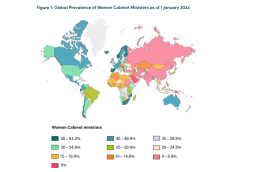
This blog, part of CGD’s work on women’s leadership, focuses on political leaders and explores which conditions enable women’s leadership by contrasting Latin America and the Caribbean (LAC), a region that is ahead of most in women’s presence in politics, with Sub-Saharan Africa (SSA) that is currently some steps behind. The 42 countries in LAC have had a total of 26 women heads of state, presidents, or prime ministers (PMs), with seven incumbent women heads of government (including Sheinbaum who will assume office on October 1, 2024). The 48 countries in SSA have had a total of 16 women heads of state, presidents, or PMs, with four incumbent ones.[1] Women currently hold 36 percent of parliamentary seats in LAC and 27 percent in SSA. Countries in LAC also have a higher share of women cabinet ministers.
Read here the full article published by the Center for Global Development on 09 August 2024.
Image by Center for Global Development
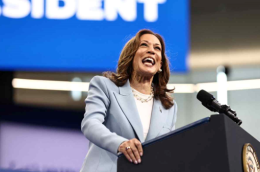
NEW YORK -- Vice President Kamala Harris' official nomination on Monday as the Democratic Party presidential nominee will be the second time a woman heads a major-party ticket in the U.S., a country that has never elected a female president.
Should Harris win the election in November, it would mark a historic moment for the major democracy and a powerful symbol of progress just over a century after women won the right to vote in the country.
Her rise from California's attorney general to vice president, and now possibly the president of a global superpower, has renewed public discourse over female leadership -- or lack thereof -- in politics. Breaking the glass ceiling in the Oval Office would also allow the U.S. to join many countries in Asia that have led the way in electing female heads of government.
Since the end of World War II, at least 13 Asian and Pacific countries and regions have had women hold the top leadership position.
Sirimavo Bandaranaike became the first woman elected prime minister not only in Asia, but the entire world, when she first took office in 1960 in Sri Lanka, at the time still called the dominion of Ceylon. Bandaranaike was elected less than a year after the assassination of her husband, then-Prime Minister S.W.R.D. Bandaranaike.
Read here the full article published by Nikkei Asia on 4 August 2024.
Image by Nikkei Asia