Elections
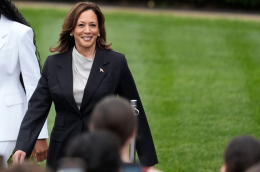
Vice President Kamala Harris is gaining support to become the Democratic nominee for president.
Before she vaulted to the national stage, Kamala Harris served as California’s top prosecutor — state Attorney General — and was raised by immigrant parents in the San Francisco Bay Area.
In speeches and in her memoir, the 59-year-old Harris has often cast herself as a prosecutor who fought from the inside for progressive change. Some, however, have criticized her for upholding the status quo, saying she remained silent on state initiatives to legalize marijuana and reduce penalties for certain crimes.
Despite this, in 2016, Harris was elected as California’s U.S. Senator just four years before she was picked as Joe Biden’s vice president. She made history as the first woman, Black person and person of South Asian descent to serve in the position.
If she’s selected as the Democratic nominee and beats former President Donald Trump in November, she would be the first female president.
CapRadio’s Politics Editor Chris Nichols spoke with Kelly Dittmar of the nonpartisan Center for American Women and Politics at Rutgers University about the significance of Harris’ rise in national politics.
Read here the full article published by Capradio on 22 July 2024.
Image by Capradio
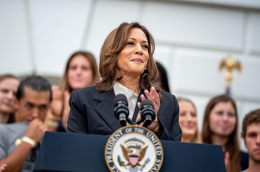
As the 2024 US presidential election looms, Kamala Harris is emerging as a likely candidate for the Democratic Party after President Joe Biden announced his decision to drop out of the race. Harris’s potential candidacy is set to let loose an unprecedented wave of misogyny upon the American political landscape. Despite her qualifications and historic achievements, Harris will face a unique convergence of gender and racial prejudice.
Harris potential presidential candidacy can be contextualised by examining the experiences of previous female candidates, who have faced a great deal of overt and covert misogyny from across the media and political spectrum.
Bias in media reporting of women candidates
Hillary Clinton’s 2016 campaign, for example, encountered relentless misogynistic attacks, ranging from media scrutiny of her appearance to baseless accusations about her health and integrity. Throughout 2016, Clinton was frequently criticised for traits that were praised in her male counterparts, such as ambition and assertiveness.
Another prominent example is Sarah Palin who endured sexist commentary that often overshadowed her political stances during the 2008 race. As the Republican vice-presidential nominee running alongside John McCain, Palin was frequently subjected to derogatory remarks about her appearance and intelligence, and her qualifications were questioned in a way that male candidates rarely experienced.
The media’s focus on Palin’s looks, wardrobe, and personal life diverted attention from her policy positions and political record. Indeed, there is evidence to suggest that the focus on her appearance led to reduced intentions to vote for the McCain–Palin ticket in the 2008 US presidential election. Moreover, an analysis of her debate with the Democratic vice-presidential nominee Joe Biden later revealed that coverage of Palin was more likely to include references to her family, physical appearance, and social issues — particularly in newspapers and political blogs — while coverage of Biden focused more on foreign policy and the economy.
Read here the full article published by ABC Australia on 23 July 2024.
Image by ABC Australia
Last week saw a change of Government and a brand-new cohort of MPs (335 new MPs) elected; but with all this churn how representative is our new House of Commons? Before the election we published analysis of the candidates standing for election showing that only 31% of selected candidates were women. Let’s see how many were elected…
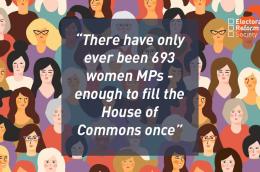
At the end of the last parliament, the UK had only ever had 564 women MPs, not enough to fill the House of Commons once over. But, with the 129 new women MPs elected on Thursday 4th July we have finally managed to fill the chamber once over (with 43 extra!).
The House of Commons is slowly creeping towards gender parity; however we are still lackadaisical in our approach to achieving gender parity in our elected bodies, leaving it up to parties to field women candidates rather than ensuring that women are on the ballot paper via other mechanisms such as gender quotas.
Read here the full article published by the Electoral Reform Society on 10 July 2024.
Image by Electoral Reform Society
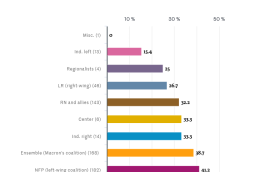
Only 208 women will sit in the Assemblée Nationale, representing just over a third of all MPs. This is the second time in two years that the proportion of women in the Assemblée has fallen.
Less than two years after the previous legislative elections, France voted to elect the 577 members of the Assemblée Nationale in snap parliamentary elections that followed French President Emmanuel Macron's decision to dissolve the chamber. The new MPs will meet on July 18 for their first session. While this Assemblée stands out for not having a clear political majority, its profile remains similar to that of the previous legislature: Women are poorly represented.
With 36% of women, parity is even further behind
Only 208 women, compared with 369 men, will sit in the next Assemblée, representing just over a third (36%) of all MPs. This is the second time in a row that the proportion of women in parliament has fallen: There were 224 female MPs in 2017, but just 215 in 2022.
Read here the full article published by Le Monde on 9 July 2024.
Image by Le Monde
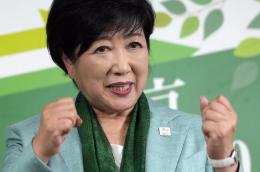
The first woman governor of Tokyo, Yuriko Koike, has won a third term – against another woman candidate. The race between multiple women signifies a push for greater female representation in Japanese politics, which is still overwhelmingly dominated by men.
Eight years ago, Yuriko Koike became the first woman to lead Tokyo, beating her male predecessor. She won her third term as governor July 7, and one of her closest rivals was a woman.
Multiple women competing for a top political office is still rare in Japan, which has a terrible global gender-equality ranking, but Ms. Koike’s win highlights a gradual rise in powerful female officials and a society more open to gender balance in politics. That said, even if a woman eventually becomes prime minister, politics here is still overwhelmingly dominated by men, and experts see a huge effort needed for equal representation.
“There are growing expectations for women to play a greater role in politics,” said parliamentarian Chinami Nishimura, a senior official with the main opposition Constitutional Democratic Party of Japan. “In politics or parliament, which are still largely considered men’s work, it is extremely meaningful for women to show their presence and have our voices heard.”
Read here the full article published by The Christian Science Monitor on 9 July 2024.
Image by The Christian Science Monitor
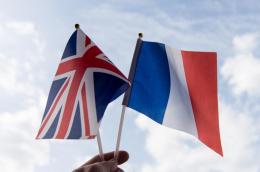
Following an intense week of elections, the IPU’s two founding members, France and the United Kingdom, have just completed their parliamentary elections.
How have both parliaments fared in terms of gender equality? How do they compare to previous chambers and the IPU’s global average of women in parliament which stood at 26.9% before these latest elections?
In the United Kingdom, provisional numbers show that a record number of women lawmakers were elected to the British lower chamber on 4 July, constituting 41% of MPs overall (263 out of 650). This marks a significant increase from the previous chamber elected in 2019, where women made up 34.8% of the total, according to the IPU’s ranking of women in parliament.
This significant increase can be partly attributed to the winning Labour Party's electoral success, as they fielded a higher number of female candidates and won a majority of seats. Some 46% of Labour seats are now held by women (188 out of 411), a proportion similar to the Liberal Democrats (33 out of 72). Both parties have voluntary party quotas. In contrast, the Conservative Party has only 24% of female MPs (29 out of 121).
However, across the channel in France, preliminary results from the second round of parliamentary elections on 7 July show a slight decrease in the number of women MPs. Out of the 577 members of the National Assembly, 208 are women, representing around 36%. This is a decline compared to the 2022 chamber, which had 37.3% women, and the 2017 election, which saw a record 38.8% of French lawmakers in the Assembly who were women according to IPU data.
Read here the full article published by the Inter-Parliamentary Union on 8 July 2024.