Elections

Nepal has progressive laws and quotas for women’s representation in politics, but patriarchy and gender discrimination run deep and influence the decisions of parties.
On April 28, misogyny in Nepal’s politics and society was on full display during a panel discussion at a Kathmandu college.
A young woman questioned the integrity of Keshav Sthapit, a mayoral candidate for Kathmandu Metropolitan City in the upcoming local elections. Sthapit, who has been accused of sexual harassment by two women in the past, sought to insult her.
“You are a nice lady but thutuno thik chhaina,” Sthapit said in a condescending and aggressive tone, accusing her of using inappropriate language. Wagging his index finger, the Communist Party of Nepal (Unified Marxist–Leninist) politician threatened to malign her by publishing allegations that she is a prostitute.
Click here to read the full article published by The Diplomat on 12 May 2022.
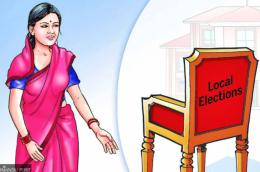
Their representation in local elections has been trimmed but they cannot speak up. Female politicians say the fight will continue though.
Out of 46,693 nominations for executive positions at the local level —mayor, deputy mayor, chairpersons and vice-chairpersons and ward chairpersons—only 4,851 are women.
While women’s nomination makes up a total of 37.84 percent, only 8.4 percent of the candidates are for executive positions, according to the Election Commission.
The remaining nominations—for female ward member and Dalit female ward member—are mandated by law.
Nepal is holding local level elections on May 13, and given the number of nominations of women, their representation will be hugely reduced compared to the 2017 elections.
Click here to read the full article published by The Kathmandu Post on 30 April 2022.
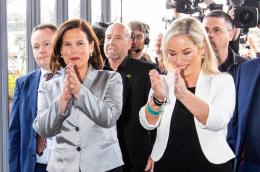
Voters in Northern Ireland have returned a record number of women to the Assembly.
Of the 90 MLAs elected to Stormont, 32 are women – an increase from 33pc in 2020 to just over 36pc.
The first Assembly formed after the Good Friday Agreement in 1998 had just 13pc female representation.
Among them were Monica McWilliams and Jane Morrice of the Women’s Coalition, Sinn Féin’s Bairbre de Brún, the DUP’s Iris Robinson, Joan Carson for the UUP and Bríd Rodgers of the SDLP, who was a minister in the first executive.
Click here to read the full article published by Independent.ie on 9 May 2022.

With more and more women running for office, races between women candidates will become the norm — not a novelty. Shared Hurdles reveals how candidates’ race, political party, and gender interact to influence voter opinion when more than one woman is on the ballot.
Research on gender dynamics in politics has seldom studied races between two women candidates. This research helps to fill that gap — and give women the tools they need to resonate with voters in races against other women. Shared Hurdles shows that in an election between two women candidates, gender biases are still prevalent, and voters hold both women to a higher standard than they hold male candidates. Shared Hurdles is a timely update on how gender shapes politics, and it provides a framework for women candidates who are campaigning against other women.
Click here to access the report.
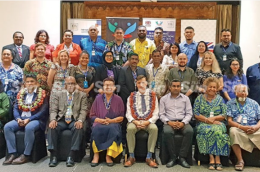
Young eligible Fijians are encouraged to take part in the 2022 General Elections.
Young eligible Fijians are encouraged to take part in the 2022 General Elections.
United Nations Senior Peace and Development Advisor in the Pacific, Agus Wandi made this comment at the ‘2022 Fijian National Elections: A Dialogue On The Issues That Matter’ event hosted at the Warwick Fiji in the Coral Coast on Thursday.
The two-day event on electoral issues was organised by Dialogue Fiji under the ‘Building Public Confidence in Elections in Fiji through Civil Society action’ project, funded by U.K Aid, and jointly implemented with International Institute for Democracy and Electoral Assistance.
Click here to read the full article published by Fiji Sun on 1 May 2022.

The two top candidates in Monday’s presidential election offer Filipino voters a stark choice: the country’s vice president who has served as a check on President Rodrigo Duterte versus the scion of the Philippines’ most controversial political family.
Leni Robredo, who was elected separately from Mr. Duterte, is an outspoken critic of the president and a frequent target of his insults. She is polling a far second behind the front-runner, Ferdinand Marcos Jr., the only son and namesake of the former dictator.
But perhaps the biggest surprise in this election has been the groundswell of support for Ms. Robredo from “Generation Z” and thousands of millennials. Many of her supporters are first-time voters, or are too young to vote.
Click here to read the full article published by The New York Times on 9 May 2022.