Parliaments & Representatives
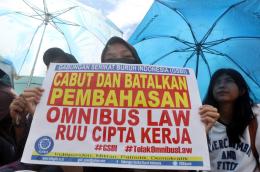
The 2025 report from the Inter-Parliamentary Union (IPU) paints a chilling portrait of political life for women in the Asia-Pacific: Three in four women parliamentarians have endured psychological violence, and one in four has been subjected to sexual violence. Far from isolated incidents, these acts form a disturbing pattern of abuse targeting women for daring to lead. Violence, both online and offline, has become an entrenched feature of public life for women in politics.
More than 60 percent of women in political office have been victims of online hate, threats and disinformation campaigns. Parliamentary staff, especially young women, are similarly vulnerable. These attacks are not random: They are deliberate, systematic efforts to degrade, silence and push women out of politics.
This is not just a gendered struggle; it is a profound democratic crisis that erodes the very foundations of inclusive governance.
Full article by The Jakarta Post.
Image by The Jakarta Post
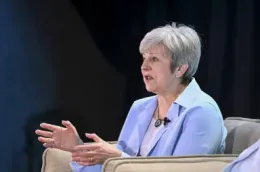
Theresa May, Britain’s ex-prime minister, says that rather than reaching for social media the second major news breaks, former world leaders would be better off taking a step back and bringing a “measured voice” to the table. For female leaders in particular, she advises: “Don’t react in the way you think other people think you should react.”
“Be a measured voice.” That is the advice former U.K. prime minister Theresa May has for fellow ex-world leaders.
Speaking on stage in Riyadh at Fortune’s Most Powerful Women International summit, the British politician—who served as premier from July 2016 to July 2019—said that instead of reacting to live events on social media, her peers should sit back and be more picky about what they comment on.
“It’s important for former world leaders to not feel that they have to constantly be saying something about what is happening,” May stressed. “Be a voice, a measured voice, perhaps in the background. Sometimes you can work with people who are in leadership positions.”
“As a former leader you can, from time to time, raise your voice and make points about things that are happening,” she said. One time she did that was during the pandemic. “I actually wrote about what I thought we should have seen, which was a greater international coming together to deal with this, rather than this retreating behind country borders.”
“So it’s about raising your voice from time to time, not feeling you’re constantly commenting on everything.”
Read full article published by Fortune on 21 May 2025.
Image by Fortune

Americans are deeply divided about the use of quotas in hiring and education, but quotas are used in many countries to assure a balance of power between men and women in legislative bodies. New research co-authored at UC Berkeley finds that when governments are gender-balanced, people believe the political process and policy outcomes are more fair and democratic.
In a major study that included 17,000 people in a dozen countries—in Europe, the Pacific and the Americas—researchers found overwhelming support for a balance of representation between men and women, even when quotas are needed to achieve it. The U.S. and the U.K. don't use such quotas for national office, but even so, respondents in the study saw strong benefit, said Berkeley political scientist Amanda Clayton, the lead author.
The most important finding "is that citizens in democracies around the world strongly prefer women's equality to women's exclusion, regardless of how the equality is achieved," Clayton said in an interview.
Full article published by Phys on 22 May 2025.
Image by Phys

Online Gender-Based Violence (OGBV) has become a pervasive threat in the digital age. It undermines democratic processes, silences marginalised voices, and perpetuates systemic inequality. Harassment, threats, and abuse—both online and offline—have become so common that women and gender-minoritised people often view them as “the cost of doing politics.” As a result, 21 percent of women parliamentarians in Europe said that they did not want to pursue another term in office.
This briefing is part of a series examining OGBV on TikTok in English, German, French and Hungarian. It is part of a project titled ‘Monitoring Online Gender Based Violence Around the European Parliament Election 2024’, funded by the German Federal Foreign Office.
This report summarises ISD’s findings across key issue areas and offers evidence-based recommendations for creating safer, more inclusive online spaces that uphold democratic values. ISD’s findings demonstrate that addressing OGBV requires a holistic approach – one that not only strengthens content moderation but also tackles the underlying social norms and biases that enable online gender-based violence.
Article published by the Institute of Strategic Dialogue on 19 May 2025.
Image by Institute of Strategic Dialogue
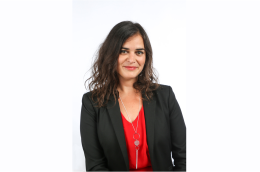
Elise Pereira Nunes is the Deputy Mayor of Tours (France) for gender equality, international relations and city networks. An academic expert in gender issues, Elise has been a long-time activist in several movements for women and LGBTQI+ rights and regularly contributes to seminars. Her political commitment stems from her desire to be a voice at the intersection of the worlds of academic research, citizen mobilization and political action. As a deputy mayor, she demonstrates that exchanges between local authorities, locally and internationally, are vectors of progress on environmental, economic and societal issues. Internationally, she advocates for the recognition of local governments within the multilateral system and champions the political participation and empowerment of women. Elise joined a two-day Expert Group Meeting organized by UN Women to address one of the most persistent barriers to gender equality in political and public life: discriminatory social norms. This experts’ meeting was organized under the WYDE | Women’s Leadership, funded by the European Union, which is a collaborative global effort aimed at advancing women’s full and effective political participation and decision-making at all levels, especially those most often left furthest behind.
“In my role as Deputy Mayor, my focus is on making gender equality a core part of our city’s policies. Our goal is to create a city where everyone, regardless of gender, origin, age, or ability, can thrive. I also connect gender equality with international affairs, building partnerships with sister cities across Europe, Japan, South Korea, and Spain. Change must happen both locally and globally—if the world around us struggles, we will be affected too.
Of course, working in politics comes with challenges. Bureaucracy, budget constraints, and slow progress can be frustrating. But meaningful change requires both short-term action and long-term vision. Some policies take immediate effect, while others take years to show results. What matters is planting seeds for a better future. I take pride in pushing these issues forward and making gender equality a cross-cutting priority in city governance.
One challenge I faced was entering politics without ties to any political party or organization. I had to learn how political structures operate while ensuring my voice was heard as someone from civil society. Even if you don’t belong to a party, it’s essential to make politicians understand that they need engaged citizens, just as much as citizens need politicians to represent them. Citizens shape the projects that affect their communities, while political parties provide the platform and resources to implement them. It’s a partnership that can drive real change.
Another challenge is overcoming stereotypes about women in politics. Despite gender parity laws, I often hear claims that it’s "hard to find women willing to engage" or that their "quality" is questionable, implying that all male candidates are automatically competent. I wanted to prove that being a woman from civil society is not a limitation.
I also firmly believe in feminist municipalism. If we want more women in politics, we must demonstrate that it’s possible, including at local level. Too often, those who want to get involved hesitate because they feel they lack legitimacy, whereas their diverse perspectives are essential. Diverse voices—across social, economic, ethnic, racial, gender or disability backgrounds—enrich decision-making.
Local politics is crucial because it’s where real engagement with citizens happens, it’s where we can understand and respond to people’s needs. We may not be able to solve every problem, but we can do our best to make an impact with the power we have. Women have a major role to play in shaping the future. If there isn’t enough space for us, we will make space, because our voice is needed.”
Interview published by Capacity4Dev (European Union) on 14 May 2025.

When Florida state Rep. Fiona McFarland's infant daughter, Grace Melton, crawled for the first time, the mom of four was right next door, hard at work with her legislative policy staff in the state Capitol.
Thanks to the on-site child care available in the statehouse, McFarland didn't miss that magical first milestone in her 7-month-old's young life.
“The sitter I had with her just grabbed me out of my meeting right next door and I came over and got to witness it,” McFarland recalled.
As more women and young people run for public office, they're bringing more than fresh policy ideas to statehouses — some are bringing their kids.
Like working parents across the country, some lawmakers are scrambling to find child care that fits their often unpredictable schedules, at a price they can afford. Rushing back and forth from their districts, they juggle meetings with constituents and coordinate their children's drop-offs, power through late-night floor sessions and step out to pump breast milk between votes, hoping to make it home for their kids' bedtime.
“Looking back, I'm like, ‘How did I do that?'" Michigan state Sen. Stephanie Chang said, recalling those frenzied years when she was a new legislator and a new mom.
The Democrat used to race across the state with her baby and freezer bags of milk in tow, leaving her daughter with family members so she could make her 9 a.m. committee meetings at the state Capitol in Lansing.
Full article published by NBC Miami on 10 May 2025.
Image credits: NBC Miami
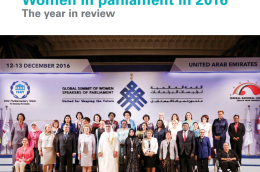
The annual brochure provides an overview and analysis of progress made and setbacks encountered by women in parliament further to elections and renewals held over a year. Produced every year on the occasion of International Women's Day (8 March), it presents data on women in national parliaments, regional and world trends, information on women presiding officers and women candidates. It also analyses mechanisms aimed at supporting women's access to parliament. The brochure is short and easy to read, providing a snapshot on the situation of women in parliaments worldwide.
Click here to access the brochure.
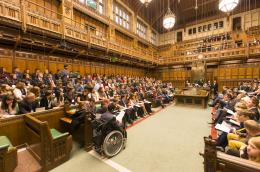
Gender quotas have emerged globally as a key solution for improving women's political representation. Yet in Britain—where they take the form of all-women shortlists (AWS)—they remain contentious, both within and outside political parties.
In this article, Mary K. Nugent and Mona Lena Krook identify and evaluate nine common criticisms of AWS in the British context, which—similar to predictions made in other cases—focus on dynamics of candidate recruitment and selection, party and voter support and the effectiveness of ‘quota women’ as politicians. The authors do not address purely principled objections (i.e., ‘quotas are unfair’), but rather focus on claims—including some principled arguments—referencing assumed realities that can be assessed using empirical data (i.e., ‘quotas are unfair because they undermine merit’). The nine claims emerged as common themes across extensive interviews and comprehensive searches of news coverage around AWS. The data used to evaluate these claims come from various sources, including qualitative interviews conducted in 2012 and 2013 with men and women from the three main parties; as yet unpublished data on candidate selection collected by the Labour Party; original quantitative datasets constructed from publicly-available sources; and existing quantitative studies by other scholars. The authors also include evidence from international studies, whenever possible, to situate these findings in relation to the conclusions reached in other contexts.
The authors find, in short, that criticisms against these measures do not hold when subjected to rigorous empirical analysis. AWS, much like gender quotas elsewhere, do not facilitate the entry of unqualified women, jeopardise a party's electoral fortunes or lead to the election of sub-par MPs. Rather, they reduce barriers for well-prepared women to stand as candidates, have neutral or positive effects on party vote shares and produce diligent and active MPs.
Click here to access the article.
This Issues Brief aims to clearly delineate the issues at stake by analysing the results of a first study specifically devoted to the subject of sexism, harassment and violence against women in parliament. It seeks to clarify what this phenomenon consists of, where, why and in what forms it occurs, who are the perpetrators and what is its prevalence.
Click here to access the brief.
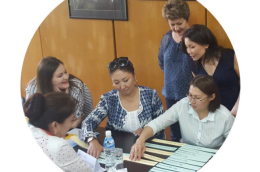
Gender equality is fundamental to responsive and accountable democratic societies. Women’s representation in elected institutions in equal proportion to men is key to the credibility and legitimacy of parliaments, national assemblies and local governments. Yet, globally, just over a fifth of members of parliament are women.
To combat discriminatory legislation and policies and improve gender equality outcomes in policymaking, elected representatives in countries in the region have established structures and strategic plans to improve women’s political participation and gender equality. UNDP has facilitated the creation of such structures in many countries, recognizing the important role they play in empowering women as parliamentary representatives, supporting the emergence of gender-sensitive parliaments, and adopting gender-sensitive policy and legislative frameworks. The UNDP Gender Equality Strategy 2014-2017 highlights the critical importance of gender equality and women’s participation in decision-making to sustainable development, and calls for the empowerment of women as voters, political actors and decision-makers.
This paper examines UNDP’s parliamentary assistance programming and support to existing gender equality initiatives in political participation, in particular, the role and impact of parliamentary structures for gender equality in the ECIS region. It illuminates existing and planned UNDP parliamentary assistance initiatives, highlights good practice and identifies entry points for replication or scaling up. Its findings are intended to assist members of parliament and parliamentary institutions as well as civil society organizations and international organizations in advancing gender equality in parliamentary practices. Click here for more information.
Extensive research shows that when women run for office, they perform just as well as men. Yet women remain severely under-represented in our political institutions. In this report, we argue that the fundamental reason for women’s under-representation is that they do not run for office. There is a substantial gender gap in political ambition; men tend to have it, and women don’t.
The results put forward in this report are based on the Citizen Political Ambition Panel Study, a research project the authors Richard L. Fox and Jennifer L. Lawless have been conducting over the course of the last seven years. In 2001, they surveyed more than 3,700 lawyers, business leaders and executives, educators, and political activists about whether they ever considered running for office. They re-surveyed more than 2,000 of these individuals in 2008. Because they surveyed well-matched pools of men and women who work in professions that most typically precede a political candidacy, they could provide the first comprehensive investigation of the process by which women and men decide to enter the electoral arena. They could also determine the extent to which political ambition has changed over time.
The authors offer clear and compelling evidence that women, even in the highest tiers of professional accomplishment, are substantially less likely than men to demonstrate ambition to seek elected office. These results hold regardless of age, partisan affiliation, income and profession.
The authors link the persistent gender gap in political ambition to several factors. Women are less likely than men to be willing to endure the rigors of a political campaign. They are less likely than men to be recruited to run for office. They are less likely than men to have the freedom to reconcile work and family obligations with a political career. They are less likely than men to think they are “qualified” to run for office. And they are less likely than men to perceive a fair political environment.
In the end, this report documents how far from gender parity we remain, as well as the barriers and obstacles we must still overcome in order to achieve it. But the results also offer guidance to organizations and individuals seeking to increase the number of women in elected positions. Recruiting women candidates, disseminating information about the electoral environment and working with women to quell their anxiety about campaigning can help narrow the gender gap in political ambition and increase women’s numeric representation.
Access the report here.
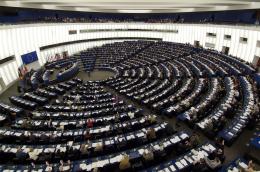
Gender mainstreaming has been embraced internationally as a strategy towards realizing gender equality. Gender mainstreaming has a double dimension: it requires both integrating a gender perspective to the content of the different policies, and addressing the issue of representation of women and men in the given policy area. Both dimensions – gender representation and gender responsive content - need to be taken into consideration in all phases of the policymaking process.
Equality between women and men is recognized by the EU as a fundamental right, a common value of the EU, and a necessary condition for the achievement of the EU objectives of growth, employment and social cohesion. Since 1996, the Commission committed itself to a “dual approach‟ towards realizing gender equality. This approach involves mainstreaming a gender perspective in all policies, while also implementing specific measures to eliminate, prevent or remedy gender inequalities. Both approaches go hand in hand, and one cannot replace the other. Within the European Parliament, the Committee on Women’s Rights and Gender Equality (FEMM Committee) is the main body in charge of promoting gender equality and gender mainstreaming in all the EP‟s policy and legislative processes. Click here to access the report of the Committee on Women’s Rights and Gender Equality on gender mainstreaming in the work of the European Parliament for 2015.