Parliaments & Representatives

Morocco’s significant progress in ensuring women’s full and equal participation and representation in political and decision-making spheres was showcased by the Interministerial Delegation for Human Rights (DIDH) during an event held Thursday in Geneva, on the sidelines of the 59th session of the UN Human Rights Council (HRC).
Speaking at the second preparatory political dialogue of Glion XI, Fatima Barkan, Secretary-General of the DIDH, highlighted the impact of constitutional and legislative reforms that have substantially increased women’s representation in elected assemblies and positions of responsibility in public administration.
Following the parliamentary, regional, and municipal elections of September 8, 2021, the proportion of women elected to prefectural and provincial councils rose to 35.6%, compared to only 4.5% in 2015. Similarly, the House of Representatives increased its female representation from 81 members (20.5%) in 2016 to 96 (24.3%) in 2021, she said.
Full article available here.

A UNITED NATIONS committee has highlighted the low representation of woman in the Dáil and at Cabinet as “priority issues” that must be addressed by the state.
The Irish Human Rights and Equality Commission stated that it welcomed the findings of the UN Committee, which is tasked with “the Elimination of Discrimination against Women”.
The Irish Commission had previously provided submissions to the UN Committee on the issue and communicated its concerns. Today, the Committee has recommended that the government amend the Electoral (Amendment) (Political Funding) Act 2012 to require 50% gender parity in the quota on political party candidate selection.
At present, political funding available to parties is dependent whether the party meets the gender quota for candidates. Payments are reduced by 50% unless at least 40% of the candidates whose candidatures were authenticated by the party at the preceding general election were women, and 40% were men.
Full article available here.

In a video address to the Committee on Gender Equality, which is currently reviewing an initiative to increase the quota for the underrepresented gender in the electoral law from 30% to 40%—with the additional requirement that at least one out of every three candidates on electoral lists be from the underrepresented gender—Prime Minister Milojko Spajić expressed his full support.
I fully support raising the quota for the underrepresented gender from 30% to 40% in the electoral legislation, said the Prime Minister in his message to the Chair and members of the Committee.
Spajić stated his belief that Europe Now Movement (PES) is already living this principle, noting that 40% of the PES ministers in the current Government are women who, as he emphasized, lead their respective ministries with great competences – often outperforming their male counterparts.
Full article available here.

During a motion of no confidence in March 2025, opposition member of parliament Fuiono Tenina Crichton heckled Samoan Prime Minister Fiame Naomi Mata’afa, saying that her ‘leadership would have been remarkable’ if only she ‘had gotten married’ and had someone to ‘advise’ her.
Fiame defeated the motion comfortably by 32 votes to 19. The episode did not directly result in a prime ministerial resignation, but within three months, Samoa’s Head of State, His Highness Tuimaleali’ifano Vaaletoa Sualauvi II, dissolved Fiame’s minority-held parliament.
Though not new anywhere in the world, it remains important to consider the manifestations of, and motivations behind, these kinds of deliberately provocative, sexist statements in politics. Is there something peculiar to the expression of sexism in Pacific politics?
To unpack this, we must understand Samoan voter sentiment, the legacy advantage Fiame has always had and the purpose of sexist discourse in politics.
In a 2021 survey of over 1300 Samoans, 88 per cent expressed support for women’s involvement in politics. Even before Fiame was promoted to the highest office, 85 per cent of survey respondents agreed that a woman should become prime minister. At the local level, while 37 per cent agreed with the sentiment that women should not speak in village councils, 63 per cent disagreed.
These figures show that the Samoan community purports to be extremely welcoming of female political leadership. In 2021, Fiame became Samoa’s seventh prime minister, leading the newly established Faʻatuatua i le Atua Samoa ua Tasi party to a historic democratic victory. She was the first female Head of Government in the Pacific, following Hilda Heine’s lead as the region’s first female Head of State.
Plus, Samoa is the only sovereign country in the Pacific to institute a gender quota at the national level, ensuring that women hold a minimum of 10 per cent of parliamentary seats. Public contestation — both in parliament and in the courts, including public calls for clearer wording of the reform — over this quota following the 2021 election demonstrates local support.
Full article available here.
Extract
The 2024 elections made US history in numerous ways. Vice President Kamala Harris became the first Black and South Asian woman to be nominated by a major party for the presidency. Former president Donald Trump made history by becoming the oldest person and the first convicted felon to become president. 2024 marked the first presidential election following the historic Dobbs v. Jackson Women’s Health Organization decision in 2022.
The 2024 elections made US history in numerous ways. Vice President Kamala Harris became the first Black and South Asian woman to be nominated by a major party for the presidency. Former president Donald Trump made history by becoming the oldest person and the first convicted felon to become president. 2024 marked the first presidential election following the historic Dobbs v. Jackson Women’s Health Organization decision in 2022.
We asked leading experts in the field to reflect on the gender and racial dynamics of the 2024 election cycle and consider which aspects of the election are illuminated by gender scholarship. We asked what theories help explain the dynamics of the campaigns, voting behavior, and the outcome, as well as which election aspects were unanticipated. We asked about the larger lessons and challenges for the study of gender, LGBTQ+ identities, race/ethnicity, elections, and politics. As Politics & Gender celebrates its 20th anniversary, we wanted to know what new questions should be addressed and whether new theories about gender and US elections are needed.
Full article available here.

OpenAI has banned a network of ChatGPT accounts originating from the Philippines that used its platform to generate social media comments praising President Ferdinand Marcos Jnr as the crackdown highlights how artificial intelligence (AI) could be misused to conduct influence operations.
The US-based AI pioneer said it had identified the accounts using ChatGPT to generate short comments in English and Filipino, which were later posted on Facebook and TikTok. It dubbed the operation “High Five” because many of the comments included emojis, according to a report released on June 5.
“The comments this operation generated and posted online were brief but partisan. Typically, they praised President Marcos and his initiatives, or criticised [Vice-President Sara Duterte-Carpio],” OpenAI wrote in its report.
Full article available here.
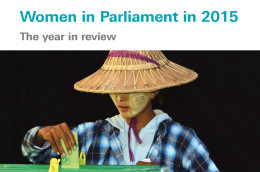
The number of women Speakers of Parliament reached an all-time high by the end of 2015 at 49 (or 17.9% of the total number of Speakers), reports the Inter-parliamentary Union (IPU) in “Women in Parliaments in 2015: The year in review”. That is up from 43 at the beginning of the year. Elections in Argentina, Denmark, El Salvador, Finland, Lesotho, San Marino, Switzerland and Trinidad and Tobago resulted in the appointment of women Speakers. Women also became Speakers for the first time ever in Namibia, Nepal and the United Arab Emirates. Despite the significant increase in the number of women Speakers of Parliament, the number of women parliamentarians globally rose by a mere 0.5% from 2014. Bigger improvements were seen in the Americas (+0.8%), sub-Saharan Africa (+0.7%) and Europe (+0.4%); but those were tempered by timid increases in the Arab States (+0.3%), Asia (+0.1%) and the Pacific (+0.1%). The Americas remain in the lead in terms of regional averages, with women’s parliamentary representation standing at 27.2%. There was a slight decrease in the Nordic countries (-0.4%), which have now stagnated at 41.5%. It was also reported that in elections where quotas were legislated in 2015, women took almost a quarter of the parliamentary seats available. More women appear to have won seats where political parties adopted voluntary quotas. Only 13.6% of seats were won by women in countries without quotas. Click here to see the report.
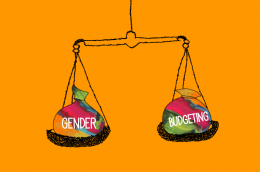
Gender mainstreaming and gender budgeting are fixtures of the debates and documents of the international women’s movement. Politically active women all over the world have developed gender mainstreaming as a strategy to enable them to emerge from their powerlessness, both real and perceived, in relation to political actors. The purpose of these new strategies is to eliminate injustices in gender relations and to get rid of all forms of discrimination based on gender.
Gender mainstreaming and gender budgeting are strategies to be implemented by organisations and institutions, such as administrations. They lead to changes in decision-making processes in these organisations. The strategies are therefore not confined to special projects for women but rather to an organisation’s everyday operations. Such operations are scrutinised in terms of gender equality. This involves systematic procedures inside organisations ordered by management and implemented by all employees. The analysis of all operational domains and measures, all products and every part of an organisation forms the core of gender mainstreaming. Implicit in the concept of gender is that gender relations are culturally and socially determined and constantly reproduced. The question of how social structures contribute to the incessant reproduction of certain assignments and life situations for men and women is decisive. Gender analyses concern the production and specific characteristics of life and work situations in which men and women differ. A gender analysis, therefore, not only enquires about the differences between men and women in a particular group, but also about how these differences are produced and what contribution is made by the measures one is investigating. Gender budgeting is the application of the principle of gender mainstreaming to financial and budget policy: in other words, to public revenues and expenditures. The European Council defines gender budgeting as follows: Gender budgeting is the application of gender mainstreaming in the budgetary process. Gender budgeting means a gender-based assessment of budgets and incorporates a gender perspective at all levels of the budgetary process and restructuring revenues and expenditures in order to promote gender equality. Gender budgeting does not mean reserving a specific budget for women or for men, but investigating the effects of all budget decisions on gender relations and gearing those decisions to the aims of gender policy.
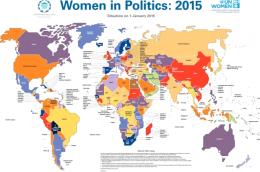
The Map, which presents latest data and global rankings for women in politics, reveals a mixed picture on gender equality in executive government and in parliament at regional and national levels.
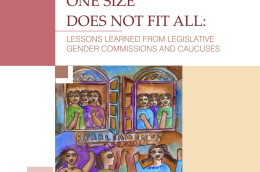
This guide demonstrate that women’s collective efforts in the legislature are crucial not only because of their impact on public policies that effectively respond to citizens’ demands and interests, but also because of their effect on the consolidation and progress of women’s leadership. Nonetheless, cross-party work within the legislative branch faces many challenges: building consensus while maintaining equilibrium between commitment to gender issues and party visions; keeping gender issues on the public agenda; and creating a sustainable critical mass of women legislators committed to advancing a gender equality agenda.
Women in legislatures worldwide have used diverse practices to make progress on priority issues and decrease the gender gaps in their countries. This should serve as an incentive to increase the number of women in parliaments and support their efforts so they can propose actions that ensure the continuation of the achievements of their predecessors.