Women's Leadership

Last Saturday, March 8th, marked International Women’s Day, when the international community celebrates the social, economic, cultural, and political accomplishments of women. In post-communist societies, where this day is often a public holiday, there is still a lot left to do to ensure better representation of women in political institutions—but the contribution of women to democracy-building efforts is undeniable.
Meet four exceptional female leaders who are shaping Eastern European politics today and learn more about women of the region fighting against war and autocracy.
Read here the full article published by the Wilson Center on 10 March 2025.
Image by Wilson Center

As the world celebrates the International Women’s Day, the women in Azerbaijan continue to drive progress and developments in politics, business, science, education, and entrepreneurship.
Azerbaijani women have long been pioneers in securing their rights and advancing in various spheres of society. They were the first in the Islamic world to gain the right to vote, achieving suffrage in 1918 – a milestone that placed them ahead of many of their European and American counterparts at the time.
While the US and some Western European countries were still contemplating women’s participation in elections, the Azerbaijan Democratic Republic leadership granted unrestricted suffrage to women in 1918.
Azerbaijan, thus, became one of the first countries in the world – and the first Muslim majority nation – to grant women political rights equal to men.
It was two years later, in 1920, when the US granted women the right to vote. The Benelux countries afforded the same rights in 1919, while France and Italy followed in 1945.
This progressive step laid the foundation for the continuous empowerment of women in Azerbaijan, which today stands as the wealthiest nation in the South Caucasus. Currently, Azerbaijan has a workforce of over five million people, with women making up almost half of this economically active population.
The entrepreneurial landscape in Azerbaijan has seen increasing strides by women, who contributed to transformation by actively engaging in business ventures.
Read here the full article published by Caspian News on 8 March 2025.
Image by Caspian News

The webinar focused on the challenges and opportunities for women politicians in the digital space. Speakers discussed key issues such as online harassment, technology-facilitated gender-based violence, and misinformation/disinformation, all of which hinder women's participation in politics. The discussion also emphasized the importance of digital literacy, legal safeguards, and creating safer online environments for women in politics. Additionally, speakers highlighted the need to engage men in these discussions and support women at the grassroots level.
The invited speakers were:
-
Chikas Kumle (Nigerian politician, Women Political Activist)
-
Gloria Anderson (Founder & Executive Director at TEDI, Tanzania)
-
Juliane Muller (Associate Programme Officer, Digitalization and Democracy, International IDEA)
Key Takeaways and Next Steps
Several action points were identified for different stakeholders.
-
Electoral commissions should raise awareness among their staff about the challenges women face in digital political spaces, collaborate with civil society organizations and political parties to better understand and address these challenges, and advocate for and participate in policy reforms to protect women online.
-
Political parties need to develop actionable policies and legal frameworks to support and protect female candidates. They should also publicly condemn online abuse against women and take disciplinary action against perpetrators within their parties.
-
Women’s rights organizations play a crucial role in advocating for stronger support for women in politics by political parties and electoral bodies. They should also push for digital literacy programs that incorporate a gender perspective.
-
Digital platforms must implement and enforce gender-sensitive community guidelines to protect women in political spaces.
-
iKNOW Politics in collaboration with civil society organizations should continue organizing webinars and discussions on women’s political participation in the digital age while actively engaging in the development of online safety guidelines and policies for women politicians.

Women’s participation in politics and leadership remains low in African countries due to various factors, including online harassment and a patriarchal system that hinders their involvement.
This was highlighted during a workshop attended by journalists from Sub-Saharan African countries, held in Nairobi, Kenya and spearheaded by International IDEA https://www.idea.int/ and WYDE.
Speaking at the workshop, Josephine Mwangi, the Program Manager for the Women’s Political Participation Project in Africa and West Asia from IDEA, stated that the limited participation of women in politics is driven by multiple factors, including the way media portrays women.
The African Barometer report, published in November 2024, revealed that women’s representation in African parliaments stood at only 27% in 2024. Additionally, the report showed that the increase in women’s political participation in Africa has stagnated, with only a 1% rise recorded between 2021 and 2024.
The workshop also highlighted that one of the key barriers to women’s representation in politics is the threats and harassment they face, both when participating in politics and when using social media platforms.
Read here the full article published by WinoTz on 21 February 2025.
Image by WinoTz
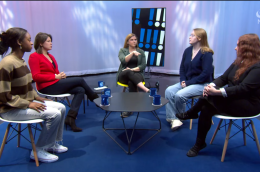
Young women in America have seen two female presidential candidates lose to President Donald Trump during some of the most formative years of their lives.
Four young voters on the GBH News video series “Politics IRL,” debated whether the glass ceiling is breakable, and if the country is making progress toward one day seeing a woman in the oval office in wake of Trump’s latest victory.
“The fact that we’re nominating female candidates is least a move in the right direction,” said 26-year-old independent Leandena Dankese.
She noted former South Carolina Gov. Nikki Haley’s 2024 run for president. “It was admirable to see women in office actually trying to reach for the presidency and getting closer and closer each time.”Jaclyn Corriveau, a 34-year-old Republican, said Kamala Harris’ candidacy is a bad case study for female candidates, considering her “forced nomination.”
“We need to think about how Hillary Clinton and Kamala Harris came into their nominations. I think Hillary came up through a much more democratic process. Kamala Harris was anointed,” Corriveau said.
Read here the full article published by GBH News on 4 February 2025.
Image by GBH News

COLOMBO, Sri Lanka – It was a brief remark during a mundane session of parliament. But to Harini Amarasuriya, Sri Lanka’s prime minister, it was the moment she realized that her country, wrecked not long ago by strongman leaders and their populist politics, had entered a potentially transformative moment for women.
A male colleague (and “not a very feminist” one, as Amarasuriya described him) stood up to say that the island nation could not get more women into the formal workforce unless it officially recognized the “care economy” – work caring for others.
To Amarasuriya, it was “one of the biggest thrills” to hear language in government that had long been confined to activists or to largely forgotten gender departments. “I was like, ‘OK, all those years of fighting with you have paid off,’” she said with a laugh during an interview in December at her office in Colombo, the capital.
Two years after Sri Lankans rose up and cast out a political dynasty whose profligacy had brought economic ruin, the country is in the midst of a once-in-a-lifetime reinvention.
Read here the full article published by The Spokesman-Review on 4 February 2025.
Image by The Spokesman-Review

This brief summarizes challenges and recommendations of the impact of the recent pandemic of COVID-19 in Tunisia on gender-based violence, access to justice, women and health, and women’s leadership and political participation. It makes recommendations to be considered by all sectors of society in order to prevent and respond to violence against women and girls, to facilitate access to justice and social care. It also includes data and trends regarding the impact of the pandemic of the COVID-19 on women and girls in Tunisia.
Click here to see the report (in French).
Background Pandemics and outbreaks have differential impacts on women and men. From risk of exposure and biological susceptibility to infection to the social and economic implications, individuals’ experiences are likely to vary according to their biological and gender characteristics and their interaction with other social determinants. Because of this, global and national strategic plans for COVID-19 preparedness and response must be grounded in strong gender analysis and must ensure meaningful participation of affected groups, including women and girls, in decision-making and implementation. 1 WHO calls on its Member States and all global actors to guide investments in quality and gender-sensitive research on the adverse health, social and economic impacts of COVID-19. Countries are advised to incorporate a focus on gender into their COVID-19 responses in order to ensure that public health policies and measures to curb the epidemic take account of gender and how it interacts with other areas of inequality.
Click here to see the advocacy brief.
As the impact of COVID-19 intensifies globally, we have curated a selection of resources and information on gender-sensitive responses and women’s leadership in times of pandemic. You will find a list of relevant resolutions, useful tools, virtual meetings, and calls and stories from the frontlines of the institutional and policy responses to the pandemic and its effects.
This page will be regularly updated with new resources from our partners and other institutions providing gender-sensitive support and guidance.
Resolutions
- The European Parliament adopted a resolution addressing EU coordination on the COVID-19 pandemic response calling the European Commission and Member States to prioritize aid and crisis-mitigation measures for the most vulnerable citizens, women in particular. Click here to see it.
- The Latin American Parliament (Parlatino) adopted a resolution calling for gender mainstreaming in response to the COVID-19 pandemic and ensuring participation of women in decision-making at all levels. Click here to see it.
Useful tools
- We recently hosted an e-Discussion on women's leadership in the COVID-19 response in Arabic, English, French, and Spanish to raise awareness on the importance of including women's voices and of gender-sensitive responses to the crisis and to collect good practices and recommendations from members of our network. Click here to see the e-Discussion in English and here to read the summary.
- The UN Secretary-General issued a policy brief that explores how women and girls’ lives are changing in the face of COVID-19, and outlines suggested priority measures to accompany both the immediate response and longer-term recovery efforts. Click here to see it.
- UN Women is working with partners to bridge the gender data gap and deliver a more accurate picture of the gender dimension to the COVID-19 response so that it can be more effective for women and girls. Click here to see the data.
- This UN Women issue brief highlights the impact of the current global pandemic on violence against women and girls and makes recommendations to prevent and respond to this phenomenon, at the onset, during, and after the public health crisis. Click here to see it.
- The Inter-parliamentary Union published a guidance note for parliaments that includes recommendations on women’s participation and leadership in parliamentary decision-making on COVID-19, gender-responsive COVID-19 legislation, and government action oversight on the pandemic from a gender perspective. Click here to see it.
- The UN Women office for the Americas and the Caribbean developed an informative brief with recommendations on how to incorporate women and gender equality in the crisis management response. Click here to see it.
- The UN Committee on the Elimination of Discrimination against Women (CEDAW Committee) has issued a detailed guidance note on a range of measures that governments should take to uphold women’s rights as they respond to the COVID-19 pandemic. Click here to download it.
Virtual meetings
- Talk on “Gender and Covid-19”: Why do more men die from the virus than women? And why isn’t this fact impacting research into a vaccine in the U.S.? Hosted by Francesca Donner, gender director at The Times and editor of the Times newsletter In Her Words, this talk provides answers to these pressing questions with Caroline Criado Perez, author of the award-winning book "Invisible Women” and Alisha Haridasani Gupta, gender reporter for In Her Words. Listen to the conversation here.
- Talk on “Leadership in a Time of Crisis”: What does good leadership in crisis look like? In this time of unprecedented challenge related to COVID-19, what can we learn from the great leaders of the past? In this webinar conversation, experts explored these and other key questions about leading in a time of crisis. Click here to access the recording.
- Talk on “Why We Need to Make Women Visible”: Fawcett Society hosted on 7 April an online conversation with prominent gender equality advocates and leaders about how Coronavirus is affecting women and girls in the UK and why we need to make their experiences more visible. Click here to watch it.
- Upcoming conversation with Former President of Ireland Mary Robinson and Halla Tómasdóttir on 16 June 2020 at 9:30 AM – 10:30 AM EDT: The COVID-19 pandemic is an extraordinary test of leadership, and women in global leadership positions are rising to meet the challenge. This session will feature former President of Ireland Mary Robinson and Halla Tómasdóttir — a former candidate for President of Iceland, CEO and entrepreneur — in a dynamic discussion on Leadership in Times of Crisis: Lessons From Women World Leaders. To learn more about the event and to register, please go here.
- Upcoming seminar entitled “Leadership in crisis: What do we expect from leaders during the Covid-19 pandemic?” on 25 June 2020 at 10:30 AM – 11:30 AM EDT: It’s rapidly becoming clear that Covid-19’s effects are gendered in complex ways, in ways that can either reinforce or challenge existing inequalities. Leadership is one of the most visible arenas for observing this. This seminar focuses on leading, leaders, and leadership, asking questions and looking for hope. To learn more about the event and to register, please go here.
Calls and news
- The United Nations Secretary General António Guterres urged governments “to put women and girls at the centre of their efforts to recover from COVID-19,” reminding them that women’s leadership and equal representation and decision-making power is key. Click here to learn more.
- Thirty-six women leaders from all over the world signed a letter to the President of the United Nations Security Council José Singer Weisinger urging for global action in response to the greatest peacetime challenge that humanity has faced. Click here to learn more.
- The Secretary General of the Inter-parliamentary Union Martin Chungong and the Secretariat of the International Gender Champions co-published an opinion piece reflecting on the gendered implications of the current COVID-19 pandemic and proposing solutions to counter the negative effects on women and girls. Click here to read it.
- The Socialists and Democrats, together with the leaders of the Party of European Socialists and its women’s organization PES Women sent a letter to the European Commission President Ursula von Der Leyen, calling for a proactive gender-sensitive response to the crisis. Click here to learn more.
- Dubravka Šimonović, the United Nations Special Rapporteur on violence against women, its causes and consequences, issued a call to receive information on the increase of gender-based violence against women and domestic violence in the context of the COVID-19 pandemic. Click here for more information.
- The CEDAW Committee calls on governments and multilateral institutions to ensure women’s equal representation in formulating responses to COVID-19 and strategies to recover from the crisis. Click here to download the statement.
- With an open letter, Deliver for Good, a network of more than 500 supporting organizations committed to championing gender equality, calls on governments to apply a gender lens and put girls, women, and gender equality at the center of COVID-19 preparedness. Click here to learn more.
- What do countries with the best coronavirus responses have in common? Women leaders, answers Forbes in a recent article. From New Zealand to Iceland, women leaders are showing a novel way of dealing with a crisis. What are they teaching us? Click here to find out.
- How to prepare and respond to COVID-19? Leaders of cities, states and countries faced an unprecedented test. The ones who passed this test with flying colors are disproportionately women. This is despite the fact that they make up only 7% of heads of state. Click here to learn more.
-
“Rise for All” is a new initiative that brings together women leaders to mobilize support for the UN Recovery Trust Fund and the UN roadmap for social and economic recovery, as laid out in the new United Nations Framework for the immediate socio-economic response to COVID-19. Click here to see their video message.
For more resources and news on COVID-19 and gender equality, please go here.

The COVID-19 pandemic is causing untold human suffering and is likely to heighten gender-based inequalities around the world. As economic activity comes to a halt, women who face disadvantage in access to decent work will suffer the most. What's more, health pandemics can make it more difficult for women and girls to receive treatment and health care. There is also a growing concern that violence against women and girls is intensifying as women with violent partners find themselves isolated from the people and resources that can help them.
UN Women has been closely following the political and economic response to COVID-19 and how it is impacting women and girls. We are working with partners to bridge the gender data gap and deliver a more accurate picture of the gender dimension to the response so that it can be more effective for women and girls. As more gender data is produced and disaggregated, UN Women will make it available.
It is our job to support governments to uphold the rights of women and girls – something that is even more urgent in times of crisis.
Click here to see the data.
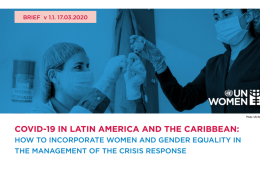
Crisis management or emergency situations such as COVID-19 can have serious impacts on the lives of women and girls, if gender dimensions are not considered. Issues such as care work, economic autonomy, physical or sexual violence, women's participation in decision-making, disaggregation of data by sex, gender analysis, and irregular migration are just some of the areas of concern that must be part of an effective response to the health crisis that the world is going through right now.
The UN Women office for the Americas and the Caribbean has developed the informative brief “COVID-19 in Latin America and the Caribbean: how to incorporate women and gender equality in the management of the response to the crisis”.
This document indicates different impacts and a series of recommendations so that decision makers can integrate the gender perspective as the key for an effective response to COVID-19 that integrates the needs of women and girls in Latin America and the Caribbean.
Click here to see the informative brief.

This year’s report looks back at 25 years of women in parliament on the occasion of the 25th anniversary of the Beijing conference and its groundbreaking action plan for gender equality.
IPU analysis shows that gender parity is possible. The overall percentage of women in parliaments has reached 24.9 per cent in 2020, up from 11.3 per cent in 1995. In four countries (Rwanda, Cuba, Bolivia and the United Arab Emirates) women now account for 50 per cent or more MPs in their lower or single chambers compared with 1995 when no parliament had reached gender parity.
The IPU has tracked women’s participation in parliament for decades, allowing it to monitor historical trends, progress and setbacks.
Click here to see the report.