Women's Leadership
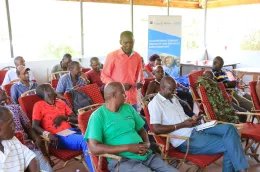
In the remote yet strikingly beautiful Nguruman Escarpment of Kajiado County, Kenya, a transformative initiative is unfolding. Here, in a traditionally patriarchal Maasai community, a group of men—known as the Men Champions—has become crucial allies in the fight for gender equality in leadership. These men are part of a broader effort to challenge deep-seated cultural barriers, offering crucial support for women seeking political leadership in a county where progress has been slow.
Despite Kenya’s constitutional requirement that no more than two-thirds of elective or appointive positions be held by the same gender, Kajiado County remains a striking example of gender disparity. In the 2022 general elections, not a single woman won a political seat beyond the legally mandated women representative position, reflecting the powerful cultural and financial barriers women face when attempting to enter the political arena.
Men as Allies: Supporting Women’s Leadership in Politics
The Expanding Spaces for Women's Political Participation in Kenya project, implemented by Uraia Trust with support from UN Women and Global Affairs Canada, is actively addressing these challenges. One of the most significant elements of the program is the engagement of men in supporting women's leadership aspirations. These Men Champions—community gatekeepers and respected elders—are leading peer-learning forums that bring together male and female gender champions to discuss how to create pathways for women to participate in politics and governance.
For generations, leadership in this region has been male dominated, with powerful clans selecting political aspirants. However, as Paul Ole Koisaba, a prominent elder in Nguruman, explains, “We cannot continue to make decisions that exclude half of our population. Our women have the skills and the vision to lead, and we must stand behind them.”
By challenging the traditional norms that have held women back, these men are setting the stage for women to run for office with the full backing of their communities. In doing so, they are not just supporting women—they are building a future where leadership is more inclusive and representative of all voices.
Read here the full article published by UN Women Africa on 5 October 2024.
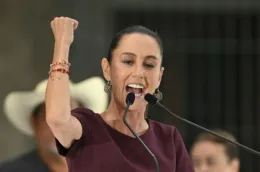
Claudia Sheinbaum leads a groundbreaking team of women in Mexico's government, achieving significant gender parity in leadership roles across the country.
Mexico has taken a significant step towards gender parity in leadership, marking a historic milestone with the inauguration of its first female president, Claudia Sheinbaum. As she assumes office, the country stands out as a leader in gender representation, surpassing the United States in this regard. Sheinbaum's administration features a cabinet comprised of 50% women and a Congress that is evenly split between men and women.
Claudia Sheinbaum, 62, elected on June 2 with nearly 60% of the vote, is not only the first female president but also Mexico's first Jewish president. She grew up in a politically engaged family, with her mother, Annie Pardo, being a prominent biologist. After earning a PhD in energy engineering from the National Autonomous University of Mexico (UNAM), Sheinbaum became active in politics, serving as head of the environment department under then-Mayor Andrés Manuel López Obrador. She later won the mayorship of Mexico City in 2018.
In a recent statement, Sheinbaum asserted, "Never again should we hear the statement, 'You're prettier when you stay silent.' Those days are over in our country."
Read here the full article published by The Latin Times on 6 October 2024.
Image by The Latin Times
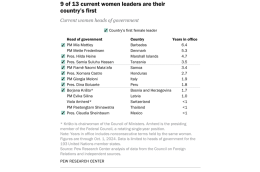
Women currently serve as the head of government in just 13 of the 193 member states of the United Nations. This includes Mexico, where President Claudia Sheinbaum was sworn in as the country’s first female executive this week.
Mexico is one of nine countries where the current woman head of government is the country’s first, according to a Pew Research Center analysis.
Overall, 60 UN member states (31%) have ever had a woman serve as head of government. The first was Sri Lanka, then called Ceylon, where Sirimavo Bandaranaike began her first term as prime minister in 1960. Two other countries – India in 1966 and Israel in 1969 – saw their first women leaders during that decade.
Worldwide, the number of countries that have had women leaders has risen steadily since 1990. The biggest single-year increase occurred in 2010, when five countries – Australia, Costa Rica, Kyrgyzstan, Slovakia, and Trinidad and Tobago – were led by a woman for the first time.
60 countries have ever had a woman leader
Mia Mottley, the prime minister of Barbados, is the longest serving woman currently in office. Mottley has been in power for more than six years.
The title of longest-serving woman head of government in modern history is held by former Bangladeshi Prime Minister Sheikh Hasina. Hasina spent more than 20 total years in power but resigned and fled Bangladesh earlier this year, when mass protests against a quota system for government jobs turned into a more violent movement against her government. (She was also the oldest woman leader, according to a separate Pew Research Center analysis.)
Read here the full article published by the Pew Research Center on 3 October 2024.
Image credits: Pew Research Center
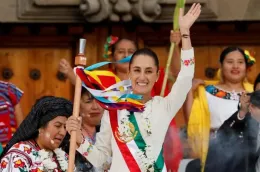
The passing of the presidential sash every six years is always an important and symbolic occasion in Mexico.
But on Tuesday, when it was placed over the shoulder of Claudia Sheinbaum - the first woman to hold the highest office in the country - it was truly an historic watershed moment in more than 200 years of modern Mexican history.
It has been a long road which led the first female mayor of Mexico City to break the glass ceiling in Mexican politics again, this time at national level.
To huge cheers of “Presidenta!” ringing out both inside and outside the congressional chamber, she raised her fist in victory, savouring the moment.
She began her first speech as president by thanking her political mentor and predecessor in the top job, Andrés Manuel López Obrador, calling him “the most important political leader and social warrior in Mexico’s modern history".
He leaves office, she said, with “the greatest love of his people".
On that point, she is not wrong. López Obrador is deeply beloved by his supporters and his popularity ratings in his final days in office were higher than those of any other president in Mexican history.
Read here the full article published by the BBC on 2 October 2024.
Image credits: BBC
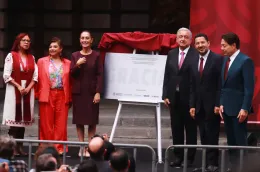
MEXICO CITY — Mexico inaugurated its first female president on Tuesday, reaching the milestone before its northern neighbor. Even if the United States elects Kamala Harris as president in November, it will lag well behind this traditionally macho country on broader gender parity.
The new president, Claudia Sheinbaum, will govern with a cabinet that is half female and a Congress evenly divided between men and women. Women head the Supreme Court and central bank and run top federal ministries.
Read here the full article posted by The Washington Post on 01 October 2024.
Image by The Washington Post
First of a series
MASS and social media have recently been inundated by a slew of news, "tsismis" and fake news involving Filipino women of diverse status, political color, different persuasions and atypical motivations. But these women have several distinctive traits in common. The first cluster is strong-willed and wields political influence either by fiat as occupying a singularly powerful elective post, as in Vice President Sara Duterte, or the first lady Liza Araneta-Marcos, unelected, nonetheless in a position of vast influence and potential for manipulation by virtue of being married to a perceived weak spouse. Some of these women maneuver around the periphery of power and are themselves powerful but refuse to brandish the same, like Sen. Imee Marcos, in whom many among those who lived and survived the martial law regime of the dictator see the traits of the father. For bad or good, those nostalgic for the old regime regret the Filipino voter's choice of the wrong Marcos. And then there are women who have been unseated from power through the whims of dysfunctional government institutions like the fugitive and suspected Chinese sleeper agent Mayor Alice Guo of Bamban, Tarlac.
The other category is women who, by their notoriety and their strategic personal relations, took advantage of their 15 minutes of fame, attempting to tear to shreds the reputations of the powerful and the mighty as in the disgruntled paramour revealing juicy tidbits about her former Davao politico-businessman lover who has long been removed from power and tale-telling distasteful exposés about the Malacañang "polvoron"-snorting crowd. And these anecdotes are given credence through female internet personalities who rule social media, providing pulpits through their YouTube video blogs. These "Marites" with thousands of followers lap up any scraps of gossip thrown their way, propelling the same to go viral. This is gossip in the fringes providing entertainment to the inane. These women of the second cluster are not the subjects of this column ("The spy and the paramour," The Manila Times, Aug. 14, 2024).
Read here the full article published by The Manila Times on 25 September 2024.
Image credits: The Manila Times
Violence against women in politics is increasingly recognized around the world as a significant barrier to women’s political participation, following a troubling rise in reports of assault, intimidation, and abuse directed at female politicians. Yet conceptual ambiguities remain as to the exact contours of this phenomenon. In this article, they seek to strengthen its theoretical, empirical, and methodological foundations. The article proposes that the presence of bias against women in political roles—originating in structural violence, employing cultural violence, and resulting in symbolic violence—distinguishes this phenomenon from other forms of political violence. The authors, Mona Lena Krook and Juliana Restrepo Sanín identify five types of violence against women in politics—physical, psychological, sexual, economic, and semiotic—and three methodological challenges related to underreporting, comparing men’s and women’s experiences, and intersectionality. Inspired by the literature on hate crimes, we develop an empirical approach for identifying cases of violence against women in politics, offering six criteria to ascertain whether an attack was potentially motivated by gender bias. They apply this framework to analyze three cases: the assassination of Benazir Bhutto, the impeachment of Dilma Rousseff, and the murder of Jo Cox. They conclude with the negative implications of violence against women in politics and point to emerging solutions around the globe.
Click here to see the academic article.
Inclusive decision-making is necessary in terms of both legitimacy and good policy outcomes. Recognizing this, closing persistent gender gaps in public life has emerged as a critical policy issue as countries increase their efforts to foster inclusive growth and build trust and confidence in public institutions while working towards the SDGs. The public administration determines the manner in which political and economic decisions are implemented and how budgets are planned and spent. Additionally, it is a primary employer for women in many developing countries – particularly in the Arab world. In some countries, women have in fact surpassed parity in terms of public administration employment but still lag far behind the 30% target in leadership positions. Balanced total employment among women and men is important but it is equally important to have women dispersed throughout all the different sectors of administrative governance, as well as equitably represented in all levels of decision-making. Women tend to outnumber men in general positions and decrease significantly in number further up the grade ladder. In addition to the glass ceiling that women face in the public sector, there also appears to be a strong trend of horizontal profiling: "glass walls". Women in the public sector are primarily involved in the traditionally feminized sectors of health, education and social services and almost absent from other sectors such as security and foreign affairs. The status quo represents a challenge to achieving SDGs 5, 8 and 16 and the biggest impediment to adjusting the situation is the absence of relevant data. This paper will examine the gender gap in the public administrations of Arab countries; analyze trends and policy with the ultimate aim of contributing to the development of tracking mechanisms for gender equality in the public administration.
Click here to see the academic article.
The goal of the survey consists in analyzing perceptions and experiences of civil servants in central administration with regard to the level of corruption, its forms, transparency of the decision-making process and impact of these phenomena on the career development practices among men and women.
Click here to see the survey.
Women and girls with disabilities, who make up almost one-fifth of the world’s population of women, face significant barriers to accessing justice, due to discrimination on the basis of both gender and disability, accessibility barriers to the justice system, and lack of reasonable accommodations throughout judicial proceedings. Compared to both men with disabilities and women without disabilities, women with disabilities are disproportionately excluded from legal protection and are more likely to have their credibility questioned, owing to harmful gender and disability stereotypes. Women with disabilities also encounter barriers to attaining positions as lawyers, judges, and other officials in the justice system, and may be excluded from serving on juries. Such barriers not only limit the ability of women with disabilities to use the justice system, but also limit their ability to contribute to the administration of justice to society as a whole. Access to justice is interdependent with a number of fundamental rights. Effective access to justice is essential for challenging human rights violations, such as discrimination in employment or deprivation of parental rights. Lack of access to justice can reinforce vulnerability to rights violations, particularly where perpetrators may feel emboldened when they know the justice system is unlikely to respond to complaints by women with disabilities. Access to justice also depends on the fulfilment of other rights—realization of the right to accessibility, for instance, will often determine whether women with disabilities have effective access to the justice system.
Click here to see the factsheet.
By Ruth Igielnik and Kim Parker,
As moms across the United States celebrate Mother’s Day this weekend, five of the six women vying for the Democratic residential nomination are themselves mothers.
These women, all seeking the same high political office, became mothers at different points in their careers – some while they were starting out in politics and others long before that.
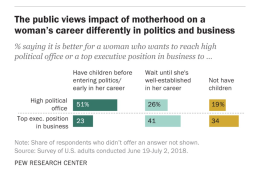
Roughly half of Americans (51%) say it’s better for a woman who wants to reach high political office to have children before entering politics, according to a 2018 Pew Research Center survey on gender and leadership. About a quarter (26%) say it would be better to wait until she is well-established in her political career, while 19% say it would be better for a woman not to have children at all if she plans to seek higher office.
Click here to read the full article published by the PEW Research Center on 9 May 2019.
Public approval is a crucial source of executive power in presidential systems. Does the public support female and male presidents similarly? Combining insights from gender and politics research with psychological evidence, this study theorizes sex-based differentials in popularity based on more general expectations linking gender stereotypes to diverging performance evaluations. Using quarterly analyses of eighteen Latin American democracies, South Korea and the Philippines, the analyses compare the levels, dynamics, and policy performance of macro-approval for male and female presidents. As expected, female presidents are less popular, experience exaggerated approval dynamics and their approval is more responsive to security and corruption (though not economic) outcomes. These findings have clear implications for our understandings of mass politics, political accountability and presidentialism.
Click here to see the report.