Women's Leadership
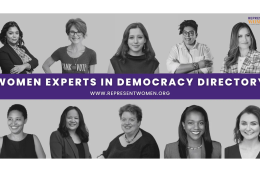
There are too many accomplished women in the democracy reform movement whose voices go unheard—which perpetuates misrepresentation in U.S. politics. RepresentWomen, an organization dedicated to creating gender-balanced representation in elected and appointed government positions, maintains a database that aims to change this.
Their Women Experts in Democracy Directory is meant to help organizations and media outlets connect with women in politics to ensure their meaningful representation in today’s important political conversations. It allows users to search almost 100 women by their location and area of expertise.
The directory was born out of RepresentWomen’s annual convening of women experts, the Democracy Solutions Summit, a three-day online conference that brings together hundreds of women experts, advocates and elected officials to share solutions to creating a stronger, more representative democracy.
“The Women Experts in Democracy Directory is a one-of-a-kind directory for finding qualified and knowledgeable women experts in the democracy reform space for various events, conferences and more,” said Victoria Pelletier, national partnerships director at RepresentWomen. “With the existence of so many manels [all-male panels], it’s an incredible resource to make sure women’s voices, experiences and expertise are part of all conversation.”
Read here the full article published by Ms. Magazine on 23 July 2024.
Image by Ms. Magazine
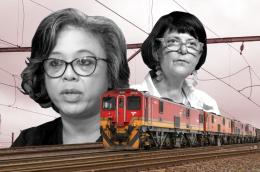
Transport Minister Barbara Creecy and Transnet CEO Michelle Phillips will be critical in changing the direction of South Africa’s economy.
Transnet’s inefficiencies have seriously inhibited growth in South Africa, with manufacturers, miners, and farmers struggling to move their goods.
In 2023, South Africa recorded historically low coal and iron-ore exports due to logistics troubles, specifically rail.
According to the consultancy research group Gain, the issues at Transnet’s Freight Rail (TFR) led to a projected loss of R353 billion in 2023, roughly 4.9% of GDP – in line with the National Logistics Crisis Committee’s estimates.
The picture is not much better when goods reach the coast.
The Cape Town port was also named the worst port in the world in the recent 2023 Container Port Performance Index (CPPI), coming 405 out of 405.
However, Ngqura (404), Durban (398), and Port Elizabeth (391) also ranked incredibly poorly.
Exporting is not the only issue, with importers struggling to access goods across the country.
For instance, Woolworths previously said that its Fashion, Beauty and Home business was impacted by poor availability, primarily caused by the late arrival of certain summer ranges arising from congestion at Transnet’s ports.
Amid these struggles, Creecy and Phillips will be heavily responsible for the performance of the economy.
Read here the full article published by Business Tech on 22 July 2024.
Image by Business Tech
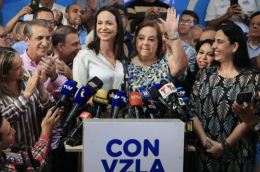
After the double blocking of the unitary candidates in March—first of María Corina Machado and then professor Corina Yoris—the initially provisional candidacy of Edmundo González, who is currently leading the polls, was accepted by the National Electoral Council. Hours before, a meeting between Machado, Zulia governor Manuel Rosales and the parties of the Unitary Platform had concluded in the unanimous designation of González as the opposition ‘s candidate. But the meeting’s composition was an unprecedented milestone of Venezuelan politics: five of the ten member parties of the Platform –not counting Machado’s Vente– were being represented by women.
The scene seemed to go against the trend set in the 2021 regional elections, which registered a decline in the number of women candidates and elected officials and resulted in a gender gap exceeding 90% in governorships and 80% in mayoralties. And it’s not an isolated event, as women seem to be taking the reins of opposition politics in the race towards the July 28th presidential elections.
Read here the full article published by the Caracas Chronicles on 24 July 2024.
Image by Caracas Chronicles
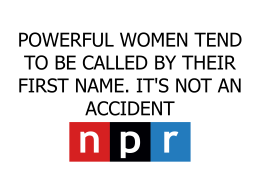
NPR's Ari Shapiro talks to University of Houston's Mirya Holman about why women in political leadership tend to be referred to by their first names more often than their male counterparts.
ARI SHAPIRO, HOST: A moment from four years ago might feel familiar to any woman in a position of authority.
(SOUNDBITE OF ARCHIVED RECORDING)
SUSAN PAGE: Kamala Harris - Senator Harris, I mean - I'm sorry.
KAMALA HARRIS: That's fine. I'm Kamala.
PAGE: No, no, no...
HARRIS: (Laughter).
PAGE: ...You're Senator Harris to me.
SHAPIRO: That was the vice presidential debate in 2020, where moderator Susan Page slipped and called Senator Harris by her first name. Research shows that this happens to women in positions of power all the time, whether they are authors, professors or even vice president of the United States. So if you've noticed people referring to Trump, Biden and Kamala, it's not your imagination.
Mirya Holman studies gender in American politics at the Hobby School of Public Affairs at the University of Houston, and I asked her whether this first-name gender gap is simply evidence of a bias against women.
MIRYA HOLMAN: One of the pieces that I think is going on here is that women are not seen as the norm in politics. They're unusual. And so people think about who they are in a different way. I do actually think it is a sign of disrespect in an environment where you have multiple candidates, and you're referring to one by her first name and then all of the men by their last name. You are making her the exception and not giving her that very small piece of respect that we give people in positions of power.
Read here the full interview published by NPR on 24 July 2024.
Image by NPR
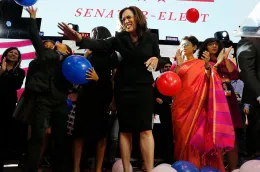
President Joe Biden’s decision to end his reelection bid and endorse Vice President Kamala Harris to replace him in the campaign has upended the presidential race and shined a renewed spotlight on Harris.
Her career path from prosecutor to politician has been defined by many firsts: She was the nation’s first Indian American senator and California’s first female and South Asian attorney general. Harris is the first woman to become vice president, as well as the first Black or Asian American person to hold the office.
Now, as momentum builds to position her as the Democratic Party’s 2024 presidential nominee, Harris could be on the cusp of becoming the country’s first female president.
Here’s what to know about Harris’ life and the moments that defined her in politics.
Read here the full article published by CNN on 22 July 2024.
Image by CNN
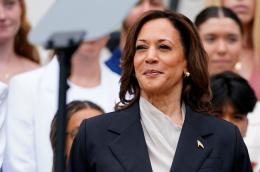
WASHINGTON (AP) — She’s already broken barriers, and now Kamala Harris could shatter several more after President Joe Biden abruptly ended his reelection bid and endorsed her.
Biden announced Sunday that he was stepping aside after a disastrous debate performance catalyzed fears that the 81-year-old was too frail for a second term.
Harris is the first woman, Black person and person of South Asian descent to serve as vice president. If she becomes the Democratic nominee and defeats Republican candidate Donald Trump in November, she would be the first woman to serve as president.
Biden said Sunday that choosing Harris as his running mate was “the best decision I’ve made” and endorsed her as his successor.
“Democrats — it’s time to come together and beat Trump,” he wrote on X, the social media platform formerly known as Twitter. “Let’s do this.”
Harris described Biden’s decision to step aside as a “selfless and patriotic act,” saying he was “putting the American people and our country above everything else.”
“I am honored to have the President’s endorsement and my intention is to earn and win this nomination,” Harris said. “Over the past year, I have traveled across the country, talking with Americans about the clear choice in this momentous election.”
Read here the full article published by PBS News on 22 July 2024.
Image by PBS News
By Juliana Menasce Horowitz, Ruth Igielnik and Kim Parker,
Two years after Hillary Clinton became the first woman to win the presidential nomination of a major U.S. political party, and with a record number of women running for Congress in 2018, a majority of Americans say they would like to see more women in top leadership positions – not only in politics, but also in the corporate world – according to a new Pew Research Center survey. But most say men still have an easier path to the top and that women have to do more to prove their worth. And the public is skeptical that the country will ever achieve gender parity in politics or in business.
Republicans and Democrats have widely different views about where things stand today and what factors are holding women back. Democrats and Democratic-leaning independents are more than twice as likely as Republicans and those who lean Republican to say there are too few women in high political offices (79% vs. 33%). And while 64% of Democrats say gender discrimination is a major reason why women are underrepresented in these positions, only 30% of Republicans agree.
Click here to see the report.
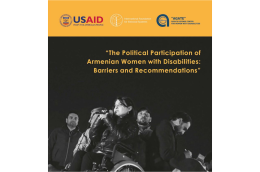
The Agate Rights Defense Center for Women with Disabilities, with the support of the International Foundation for Electoral Systems (IFES) and the United States Agency for International Development, has published new research on the barriers to and opportunities for political participation of women with disabilities in Armenia. The Political Participation of Armenian Women with Disabilities: Barriers and Recommendations provides insights into the challenges that hinder participation of Armenian women with disabilities and identifies the means to address them. To conduct the research, Agate utilized IFES’ Intersectionality Assessment Framework, organizing participatory focus group discussions with men and women with disabilities and their peers from urban and rural areas of Armenia.
Armenian women with disabilities identified various attitudinal, communication, environmental and institutional barriers to participation in formal political spaces and in the recent demonstrations that led to a change of political leadership. For example, when asked if they thought their right to vote was ensured by the state, 58 percent of women with disabilities in the focus groups answered “strongly disagree” or “rather disagree”, compared to 24 percent of other respondents, revealing a lack of implementation of the law. Women with hearing disabilities noted that they did not participate in political campaigns because they did not have access to information about candidates and the process.
The report found that women with disabilities are not participating in formal political spaces equally with their peers. The attitude of the public, Armenian patriarchal society and family indifference also increase the likelihood of women with disabilities becoming marginalized from political processes. Even so, it revealed that building confidence in women with disabilities and raising awareness of rights would provide a critical foundation to overcoming their inner fears and building their capacity to participate as voters, candidates, observers, and other leaders in political life. Finally, when women with disabilities have the opportunity to detect and assess discrimination, government stakeholders should involve them in policymaking and legislation that concerns them.
Click here to see the report.
Maternal mortality, defined as the death of women within 42 days of childbirth, remains a looming global health problem well into the 21st century. It is estimated to account for 830 deaths per day, and more than 216 deaths per 100,000 live births globally (Ceschia and Horton, 2016). Maternal mortality is only the tip of an iceberg, the mass of which is maternal morbidity. In sub-Saharan Africa, the maternal mortality ratio (MMR) exceeds the rate in developed countries a century ago (Alkema et al., 2016; Loudon, 1992).1 Although maternal mortality has declined rapidly in the last two decades, it was a late start, and there was massive variation in rates of decline.2 We leverage this variation to investigate the hypothesis that political will plays a significant role, and that women have greater political will for maternal mortality reduction. Since 1990, not only has MMR fallen by 44%, but the share of women in parliament has risen from under 10% to more than 20% (Figure 1a). We study whether these trends are causally related.
Click here to read the full Academic paper published by Navarra Center for International Development on 1 May 2018.

List as of 7 June 2018.
Spain joins a handful of countries where women hold at least half of ministerial portfolios.
1. Spain
The new government of Spain includes 11 women ministers and five men in addition to Prime Minister Pedro Sanchez. After the announcement of the cabinet on 6 June 2018, Sanchez said it is the first time since Spain returned to a democratic system in the 1970s that there are more women minsters than men. Key ministries such as those of justice, economy, defense and education went to women. See more here.
2. France
Fulfilling a campaign promise, President Emmanuel Macron named a gender-balanced cabinet in May 2017 with 11 of 22 posts taken by women. Women took on the portfolios of defense, justice and sports, among others – areas usually dominated by men. See more here.
3. Sweden
Sweden has the world’s first self-proclaimed feminist government and is the only other country, besides Spain, that has a majority of female ministers with 12 women and 11 men. See more here.
4. Canada
Qualifying it as a “cabinet that looks like Canada,” Prime Minister Justin Trudeau formed in November 2015 a young and ethnically diverse cabinet with 15 women and 15 men who are mostly aged under 50. See more here.
The global average for women holding ministerial positions is 18.3% (as of January 2017). See UN Women and the Inter-parliamentary Union’s 2017 Map on Women in Politics for more information.
Did we miss something? Please let us know at connect@iknowpolitics.org.
The rapid expansion of electoral gender quotas in the past few decades has been met with considerable scholarly and public attention. Despite this, there has been little empirical work examining the global legislative consequences of gender quotas over time. Developing a unique time-series cross-sectional data set from 139 states during the peak period of quota adoption and implementation (1995–2012), we test whether and how quotas are associated with subsequent changes in government spending priorities. We find that substantial quota shocks—those associated with a large increase in women’s parliamentary representation—are followed by increased government expenditures toward public health. Further, we find that increases in health spending are offset by relative decreases in military spending and other spending categories. Our findings provide strong evidence that quota policies influence government priorities in historically feminized policy areas but principally when they are complied with and have substantial numerical consequences.
Click here to see the report.
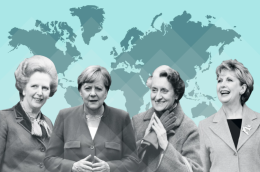
One hundred years ago, on February 6 1918, the UK Parliament passed an act that granted the vote to women over the age of 30.
They had to meet certain qualifications - such as being householders, the wives of householders, occupiers of property with an annual rent of £5, or graduates of British universities - but it was a start that allowed 8.4 million women to vote, after a decades-long fight.
Later that year, Parliament passed another act that meant women could be elected to the House of Commons.
But even now, a century later, we still don't have full female representation in Parliament. Just 208 of the UK's MPs are women - under a third of the 650 who sit in the Commons.
Around the world, things aren't much better. The UK ranks 38th for female representation in each countries' respective Parliaments, according to the World Economic Forum's data for 2017.
Click here to read the full article published by The Telegraph on 5 February 2018.