Women's Leadership

While there have been important advances in women’s leadership in politics, as of November 1 2017, women make up only 7.2% of Heads of State and 6.2% Heads of Government. Data on women representatives in local government, including as mayors, heads of villages and towns, is not well collected and analyzed. The adoption of an SDG indicator on women’s representation in local government is a great step forward in tracking progress on gender balance, allowing for the systematic collection and analysis of data on women in local government. Women’s access to and continued role in leadership positions is challenged by a range of barriers, including discriminatory laws and practices, as well as social norms that prescribe traditional roles and attitudes towards women’s participation in leadership and decision-making roles. Proactive gender-equality policies within political parties and local government structures, including quotas and special temporary measures, gender-sensitive approaches to electoral processes, support networks, mentoring, training, and engagement of male champions, can all help promote women’s role in political leadership. 

Show on Home Page
Yes
Image
Icon
Banner Image
March 8, 2022
Statement on International Women’s Day

By Ashim Steiner

March 8, 2022
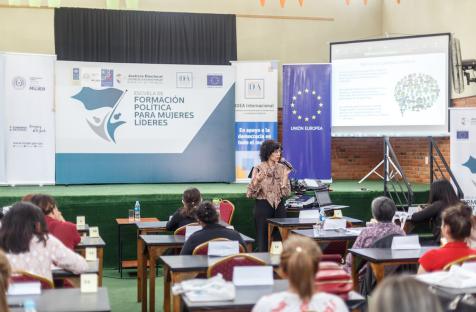
Paraguay: Political training for women helps reduce the representation gap

In a region that has seen the greatest progress in political gender equality in the last two decades, Paraguay stands out, but for the wrong reasons: it has the third-lowest percentage of women in parliament in the Americas, with 17.5%, roughly half the regional avera

March 7, 2022
Enhancing women's political participation in Africa

Enhancing Women's Political Participation in Africa (Women in Political Participation (WPP) is a Pan-African gender project on the different facets of Women and Politics in Africa.

Biden nominates Ketanji Brown Jackson to become first black woman on supreme court - The Guardian
February 28, 2022
Biden nominates Ketanji Brown Jackson to become first black woman on supreme court

Joe Biden on Friday nominated Judge Ketanji Brown Jackson to the supreme court, seeking to elevate a Black woman to the nation’s highest court for the first time in its 232-year history.

The impact of COVID-19 on women’s political participation

Back
February 23, 2022

The impact of COVID-19 on women’s political participation

The regional electoral assistance project hold the 9th webinar about the impact of Covid-19 on women’s political participation.

The regional electoral assistance project hold the 9th webinar about the impact of Covid-19 on women’s political participation.

Promoting women's political participation: From quotas to parity

Back
February 22, 2022

Promoting women's political participation: From quotas to parity

This guide is designed to increase the understanding of the legal obligations of countries in the West and Central Africa (WCA) region to achieve gender equality in decision-making.

This guide is designed to increase the understanding of the legal obligations of countries in the West and Central Africa (WCA) region to achieve gender equality in decision-making.

Revenge of the patriarchs: Why autocrats fear women

Back
February 21, 2022

Revenge of the patriarchs: Why autocrats fear women

The pantheon of autocratic leaders includes a great many sexists, from Napoléon Bonaparte, who decriminalized the murder of unfaithful wives, to Benito Mussolini, who claimed that women “never created anything.” And while the twentieth century saw improvements in wome

The pantheon of autocratic leaders includes a great many sexists, from Napoléon Bonaparte, who decriminalized the murder of unfaithful wives, to Benito Mussolini, who claimed that women “never created anything.” And while the twentieth century saw improvements in wome

February 18, 2022
Mongolia now has a record number of women ambassadors

The achievement is part of a long trek toward gender equality in Mongolia’s foreign policy.