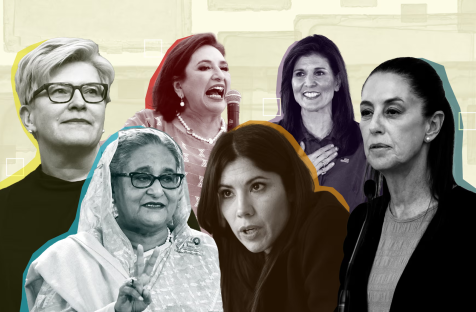
There’s a scenario in which the presidents of the EU’s main institutions could all be women.
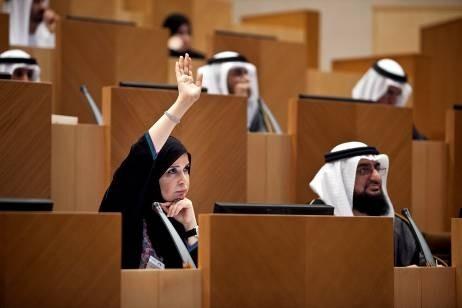
Democracy and the equal participation of men and women in the political arena are closely intertwined. No parliament or any decision-making body can claim to be representative without the participation of both men and women. As stated in the Universal Declaration on Democracy adopted by the Inter-Parliamentary Union’s Member Parliaments in 1997, "The achievement of democracy presupposes a genuine partnership between men and women in the conduct of the affairs of society in which they work in equality and complementarity, drawing mutual enrichment from their differences."
Recent years have seen a steady increase in the number of women in parliament, though the world average of less than 22 percent remains far from the goal of parity between women and men. The election of women to the highest positions of state and government in several countries has also contributed to the changing face of politics.
While the road to election is a difficult one, the challenges for women do not stop there. Once women enter parliament or other bodies, they are faced with many new challenges. Parliament is traditionally a male-oriented domain where the rules and practices have been written by men. It is, therefore, an ongoing challenge to transform parliament into a gender-sensitive environment, to ensure that actions are gender-sensitive and to guarantee that gender is mainstreamed throughout the legislature.
There’s a scenario in which the presidents of the EU’s main institutions could all be women.
In 2024, 1.5 billion people are expected to vote in national elections in what will be a record year for democracy, with elections happening in at least 64 countries and the European Union.
In November 2023, an online video showed Prime Minister Sheikh Hasina in Medina, Saudi Arabia, being greeted with slogans of "Bhua, bhua." The original footage of the prime minister's Medina visit had no such sounds in the background, and the audio was fou
A Qualitative Study on Violence against Women in Politics in Türkiye, prepared in cooperation with UN Women and Terra Development Cooperative, was introduced at an event organized in Ankara.
“I PROMISE IT won’t be victim porn.”
Although two women — Sheikh Hasina and Khaleda Zia — served as prime ministers of Bangladesh for 31 out of 33 years since 1991, the representation of women in national politics is still negligible.
A Glimpse into the Life of a Women in Politics: CEMR Unveils First Data Coming from 31 Countries
Women’s political representation in Indonesia may fall for the first time since the 1999 election, even before the voting starts.
The Standing Committee on State Structure of the Parliament, in cooperation with the UN Promoting Gender Equality and Women's Participation in Decision-making project, organized the First Conference of Women Parliamentarians on September 7, 2022.