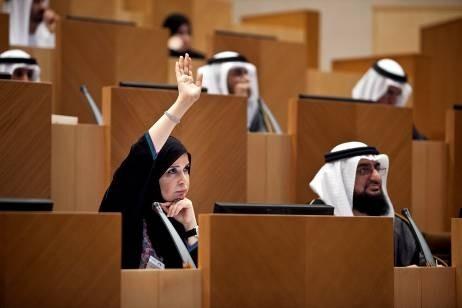
Women in government or representation of women in Parliament are often quite hard for many to accept in this country, however since the national general election is just around the corner, it is the right time to give it a focus again.
Parliaments and Representatives
Democracy and the equal participation of men and women in the political arena are closely intertwined. No parliament or any decision-making body can claim to be representative without the participation of both men and women. As stated in the Universal Declaration on Democracy adopted by the Inter-Parliamentary Union’s Member Parliaments in 1997, "The achievement of democracy presupposes a genuine partnership between men and women in the conduct of the affairs of society in which they work in equality and complementarity, drawing mutual enrichment from their differences."
Recent years have seen a steady increase in the number of women in parliament, though the world average of less than 22 percent remains far from the goal of parity between women and men. The election of women to the highest positions of state and government in several countries has also contributed to the changing face of politics.
While the road to election is a difficult one, the challenges for women do not stop there. Once women enter parliament or other bodies, they are faced with many new challenges. Parliament is traditionally a male-oriented domain where the rules and practices have been written by men. It is, therefore, an ongoing challenge to transform parliament into a gender-sensitive environment, to ensure that actions are gender-sensitive and to guarantee that gender is mainstreamed throughout the legislature.
While President Barack Obama's State of the Union speech on Jan. 28 fell short of the peroration about economic inequality that partisans had either hoped or feared, it did offer women's groups a chance to showcase political and legislative priorities.
Regardless of the role or industry in question, networking is often an essential part of the modern day-to-day job. We all build up an array of contacts during our professional lives and we learn from the people we meet and work with.
More than 50 per cent of candidates nominated by the ruling Cambodian People’s Party and the opposition Cambodia National Rescue Party in the upcoming provincial and district council elections should be women, a coalition of 12 civil society groups said in a letter on Thursday.
Nepali women had much to be proud of as 172 of them were seated in the country’s newest Constituent Assembly on Jan. 22.
While women in Guatemala have slowly been making political gains, a new report by NDI and UN Women shows that a significant gender gap persists.
Tanzania President Jakaya Kikwete has appointed two women to powerful cabinet positions as the country prepares to enact a new constitution.
We are kicking off a big week here at Levo League as it is Women in Politics week!
Pagination
- Previous page
- Page 276
- Next page