February 3, 2014
Afghan Youth Debates: Women's Limited Role in Politics Under Threat
Efforts to boost the participation of women in Afghan politics are in serious jeopardy, an IWPR debate has heard.
Democracy and the equal participation of men and women in the political arena are closely intertwined. No parliament or any decision-making body can claim to be representative without the participation of both men and women. As stated in the Universal Declaration on Democracy adopted by the Inter-Parliamentary Union’s Member Parliaments in 1997, "The achievement of democracy presupposes a genuine partnership between men and women in the conduct of the affairs of society in which they work in equality and complementarity, drawing mutual enrichment from their differences."
Recent years have seen a steady increase in the number of women in parliament, though the world average of less than 22 percent remains far from the goal of parity between women and men. The election of women to the highest positions of state and government in several countries has also contributed to the changing face of politics.
While the road to election is a difficult one, the challenges for women do not stop there. Once women enter parliament or other bodies, they are faced with many new challenges. Parliament is traditionally a male-oriented domain where the rules and practices have been written by men. It is, therefore, an ongoing challenge to transform parliament into a gender-sensitive environment, to ensure that actions are gender-sensitive and to guarantee that gender is mainstreamed throughout the legislature.
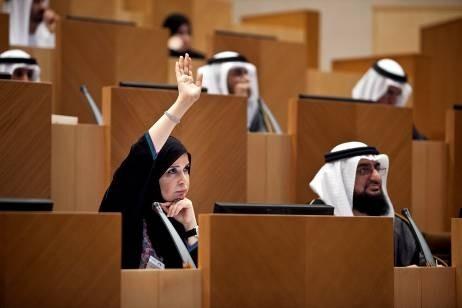
Efforts to boost the participation of women in Afghan politics are in serious jeopardy, an IWPR debate has heard.
Women should have at least 100 of the 444 seats in the next parliament, the National Council for Women said in a statement Thursday.
Japanese women held a record-high ratio of senior positions in the central government, but at 3 percent, they are still well behind their counterparts in other developed nations, government figures showed Jan. 31.
About Senator Kirsten Gillibrand, United States Senator from New York
About Senator Kirsten Gillibrand, United States Senator from New York
Jenny Pierce's recent piece about El Salvador on the Inter-American Development Bank's blog, Sin Miedos, questioned where
The Autonomous Region of Bougainville currently has the Pacific’s only parliamentary reserved seats for women system.
The Autonomous Region of Bougainville currently has the Pacific’s only parliamentary reserved seats for women system.
Women in government or representation of women in Parliament are often quite hard for many to accept in this country, however since the national general election is just around the corner, it is the right time to give it a focus again.
While President Barack Obama's State of the Union speech on Jan. 28 fell short of the peroration about economic inequality that partisans had either hoped or feared, it did offer women's groups a chance to showcase political and legislative priorities.