Parliaments and Representatives

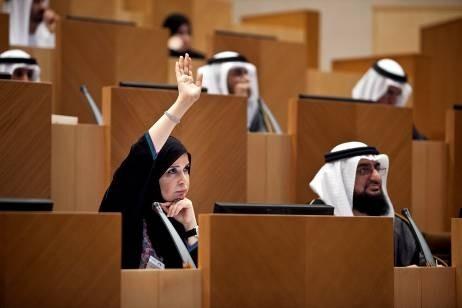
Democracy and the equal participation of men and women in the political arena are closely intertwined. No parliament or any decision-making body can claim to be representative without the participation of both men and women. As stated in the Universal Declaration on Democracy adopted by the Inter-Parliamentary Union’s Member Parliaments in 1997, "The achievement of democracy presupposes a genuine partnership between men and women in the conduct of the affairs of society in which they work in equality and complementarity, drawing mutual enrichment from their differences."

Recent years have seen a steady increase in the number of women in parliament, though the world average of less than 22 percent remains far from the goal of parity between women and men. The election of women to the highest positions of state and government in several countries has also contributed to the changing face of politics.

While the road to election is a difficult one, the challenges for women do not stop there. Once women enter parliament or other bodies, they are faced with many new challenges. Parliament is traditionally a male-oriented domain where the rules and practices have been written by men. It is, therefore, an ongoing challenge to transform parliament into a gender-sensitive environment, to ensure that actions are gender-sensitive and to guarantee that gender is mainstreamed throughout the legislature.

September 23, 2012
Viet Nam: Fewer women in National Assembly

The number of women working for the National Assembly (NA) in Viet Nam has declined in the past ten years, proven by its falling to 44th in the world rankings, according to a United Nations Development Programme study released yesterday.

September 23, 2012
Asia Pacific: Six actions can fast-track women in Asia-Pacific politics - UNDP

It will be 50 years before parliaments in the Asia-Pacific region achieve gender balance if women’s participation remains at its current pace, according to a new report from the United Nations Development Programme (UNDP).

September 23, 2012
India: Girl power in Gujarat: The social worker-turned-politician fighting for Muslim women

A gritty woman in Gujarat is silently taking her fight for empowerment of Muslim women to the political arena.

September 23, 2012
India: IIM-Bangalore offers course to make women ‘professional politicians’

An entrepreneur who turned to politics, Falguni Rajput, 39, felt she wasn’t getting anywhere despite spending five years as a treasurer in the women’s wing of the Nationalist Congress Party (NCP) in Vasai-Virar, Maharashtra.

September 23, 2012
Iraq: Lawmakers Promise Boycott Over Women's Government Role

Iraqi political blocs and parliamentary committees announced that they will boycott parliament sessions in protest of “the marginalization of the role of women in political life, since no seats were allocated to women in the

September 23, 2012
Malawi: Female MPs issue ultimatum on ‘stealing’ of beds: State House explains

Women Parliamentary Caucus members  have strongly demanded Minister of Health Khumbo Kachali, who is also the country’s Vice-President, to return back the  hospital beds from Mponela Hospital where they were snatched to be given to Mzimba for political campaign purposes.

September 23, 2012
South Africa: ‘I go as a servant of Africa’

Parliament on Wednesday paid a fond farewell and tribute to Home Affairs Minister Nkosazana Dlamini Zuma as she heads for Addis Ababa to chair the African Union commission.

September 20, 2012
Hungary: MPs Join Protest for Women’s Rights

Several NGOs staged a demonstration on Kossuth tér on Sunday to draw attention to violence against women and to speak up for women’s rights more generally.

September 20, 2012
Indonesia: Women’s Rights Must Be a Priority: Marzuki

The issues of empowerment and protection of women need to be given greater prominence in light of the high number of women living in poverty, a conference of parliamentarians from across Southeast Asia heard on Monday.