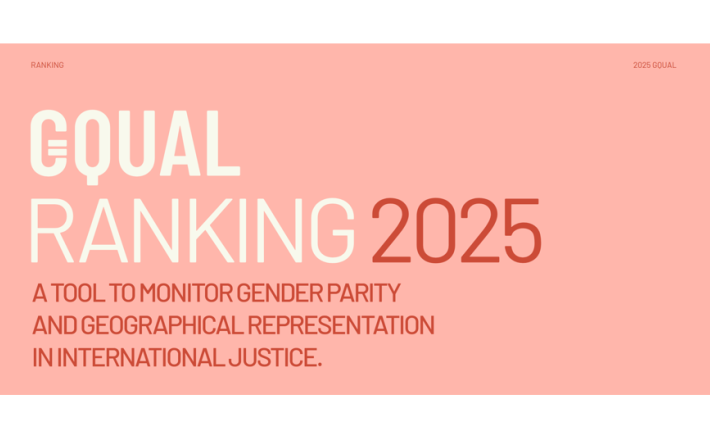
The GQUAL Ranking, released annually, is one of our most powerful advocacy tools. It tracks data from 145 countries whose nationals serve in international bodies and mechanisms tied to the development of international law and justice and disaggregates this information by gender and geographical representation.
The three rankings we produce offer valuable insights into trends in the nomination practices of States and United Nations Regional Groups, as well as into representation records. Together, the Rankings provide a global and regional overview of women’s representation in international bodies at a given point in time, grounded in systematically collected, gender-disaggregated data.
This type of data is essential to advancing gender parity in international decision-making spaces, as it makes visible patterns of inclusion and exclusion that would otherwise remain obscured. The dataset allows for a clearer understanding of where women are being nominated and appointed, which bodies are performing better, and which countries are conducting nomination processes that take gender parity into account. This is critical to shedding light on one of the main obstacles to women’s equal participation in international decision-making: the lack of transparency and the limited consideration of gender parity in nomination and international appointment processes. States rarely track or make public their nomination records, and the information available through international bodies is often fragmented, incomplete, or difficult to access.
The GQUAL Ranking responds to this structural gap by providing the only comprehensive, publicly accessible tool that consolidates this information in a systematic and comparable manner. Its consistent application over the past 9 years makes it possible to identify patterns and trends over time, offering an evidence-based foundation to assess progress, stagnation, or regression in States’ approaches to gender parity in international appointments.
Hear from women leading change in the political space share their experiences and insights.

Explore a wide-range of audio-visual resources on key topics of gender equality.
Hear from a diverse list of panelists and guests as they reflect on critical issues pertaining Women in Politics.