Selon les chiffres obtenus par le Réseau des femmes des Laurentides (RFL), les femmes comptent maintenant pour 33,2 % des élus municipaux, mairesses et conseillères confondues, comparativement à 30,7 % à la suite de l'élection de 2009, soit une légère augmentation.
Parliaments and Representatives
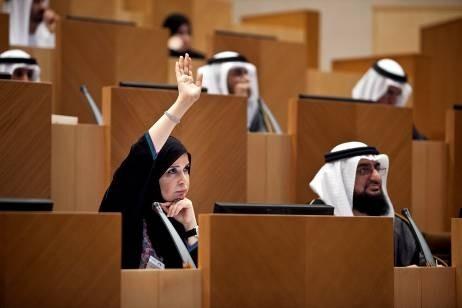
Democracy and the equal participation of men and women in the political arena are closely intertwined. No parliament or any decision-making body can claim to be representative without the participation of both men and women. As stated in the Universal Declaration on Democracy adopted by the Inter-Parliamentary Union’s Member Parliaments in 1997, "The achievement of democracy presupposes a genuine partnership between men and women in the conduct of the affairs of society in which they work in equality and complementarity, drawing mutual enrichment from their differences."
Recent years have seen a steady increase in the number of women in parliament, though the world average of less than 22 percent remains far from the goal of parity between women and men. The election of women to the highest positions of state and government in several countries has also contributed to the changing face of politics.
While the road to election is a difficult one, the challenges for women do not stop there. Once women enter parliament or other bodies, they are faced with many new challenges. Parliament is traditionally a male-oriented domain where the rules and practices have been written by men. It is, therefore, an ongoing challenge to transform parliament into a gender-sensitive environment, to ensure that actions are gender-sensitive and to guarantee that gender is mainstreamed throughout the legislature.
Être une femme en politique peut parfois être plus compliqué qu'il n'y paraît. Comme dans la plupart des territoires, peu de femmes accèdent à des postes à responsabilités au sein des municipalités.
Mme Kassambara Safiatou Diawara, affectueusement appelée Madame KASS, a depuis 1997, choisi de se mettre au service de la communauté.
Après les élections municipales, les femmes occupent 35 pour cent des postes, soit 160 femmes sur 463 places pour la région.
Milouda Hazib membre du BP du PAM a crée l’événement en devenant jeudi 7 novembre la deuxième femme politique du Maroc à présider un groupe de députés.
Le comité des femmes membres du Forum du réseau de la Gauche africaine (ALNEF) est en rencontre d’échanges autour du thème « Participation des femmes en politiques : bilan et perspectives ».
Le Réseau des groupes de femmes Chaudière-Appalaches (RGFCA) tient à souligner la progression des femmes qui s’impliquent dans la gouverne locale des municipalités de Chaudière-Appalaches.
Au lendemain des élections municipales, la Table de concertation du mouvement des femmes de la Mauricie (TCMFM) est déçue de constater une baisse générale du nombre de femmes élues dans la région.
Pagination
- Page précédente
- Page 108
- Page suivante