Parliaments & Representatives

The World Economic Forum (WEF) has released its Global Gender Gap Report 2025, and seven African countries are among the ten lowest-ranked nations worldwide in terms of gender parity.
In this latest edition, Pakistan sits at the very bottom — 148th out of 148 economies covered, with a gender parity score of 56.7 percent. Just above it are Sudan (57.0 percent, 147th), Chad (57.1 percent, 146th), and Iran (58.3 percent, 145th). Other African countries in the bottom 10 include Guinea (59.5 percent, 144th), the Democratic Republic of the Congo (60.1 percent, 143rd), Niger (61.3 percent, 142nd), Algeria (61.4 percent, 141st), and Mali (61.7 percent, 140th).
The Global Gender Gap Index
The Global Gender Gap Index annually benchmarks the current state and evolution of gender parity across four key dimensions: economic participation and opportunity, educational attainment, health and survival, and political empowerment. These four indicators offer a data-driven lens on the structural inequalities women face globally.
In terms of gender gap rankings, Sub-Saharan Africa ranks sixth globally (of eight surveyed regions), with a gender parity score of 68.0 percent. Namibia leads the continent, achieving 81.1 percent gender parity and placing eighth globally. On the other hand, Sudan remains one of the worst performers, with a score of 57.0 percent and one of the world’s lowest levels of female political representation and labor force participation.
Full article published here.

The Maldives, a nation known for its natural beauty and growing economy, has taken meaningful steps toward gender equality. However, wage disparities persist. Women in the Maldives earn approximately 20% less than men, highlighting a gender wage gap that reflects systemic inequality. While policies have improved legal protections, barriers to equal pay and economic opportunity remain widespread. Here is information about the gender wage gap in the Maldives.
Legal Frameworks in Place
The Maldives has implemented legal reforms to support gender equality. The Gender Equality Act (2016) prohibits gender-based discrimination and mandates equal pay for equal work. The Constitution of 2008 affirms equal rights for all citizens, regardless of gender. Additionally, the government introduced a 33% quota for women in local councils to promote female political participation.
Despite these advancements, enforcement remains uneven. Women continue to face limited access to high-level positions in both the public and private sectors. As of 2024, women hold just 5% of seats in the national parliament, highlighting gaps in political representation.
Occupational Segregation and Labor Disparities
According to UNDP, women comprise 45.6% of the labor force, while men account for 77.1%. The employment gap is most evident in high-paying sectors such as construction and tourism, where male workers dominate.
The Ministry of Tourism’s 2022 Employment Survey found that women make up only 11% of resort workers, with Maldivian women representing just 8%. This underrepresentation is compounded by “occupational segregation,” in which women are concentrated in lower-wage, lower-skill jobs, limiting earning potential and career advancement.
Full article available here.

Sir: Since 1999, barely 43 women senators and 119 House members have held elective seats in Nigeria’s National Assembly. Sometimes triumphant but often solitary, their journeys tell stories of structural exclusion, and individual determination. Over 25 years of democracy in Nigeria, women have held 162 out of 3,283 legislative seats. That means women have occupied fewer than 1 in 20 (or 4.9%) seats in Nigeria’s highest law-making body.
This is not symbolic absence, but entrenched structural gap and systemic marginalisation of women in Nigeria’s political landscape.
With women holding less than 5% of seats in the National Assembly, the country ranks among the lowest globally for female political representation. The proposed Reserved Seats Bill, if passed, aims to change that trajectory, even if modestly.
The Bill offers access to formal political power, reserving 111 extra seats for women in the National Assembly, granting women a legally mandated political presence—a foot in the door. This signals constitutional recognition that gender exclusion is real. Although it could inspire a new generation of female political aspirants, critics regard it as a temporary structural fix because it’s not permanent—it designed to expire after 16 years.
Full article available here.

Morocco’s significant progress in ensuring women’s full and equal participation and representation in political and decision-making spheres was showcased by the Interministerial Delegation for Human Rights (DIDH) during an event held Thursday in Geneva, on the sidelines of the 59th session of the UN Human Rights Council (HRC).
Speaking at the second preparatory political dialogue of Glion XI, Fatima Barkan, Secretary-General of the DIDH, highlighted the impact of constitutional and legislative reforms that have substantially increased women’s representation in elected assemblies and positions of responsibility in public administration.
Following the parliamentary, regional, and municipal elections of September 8, 2021, the proportion of women elected to prefectural and provincial councils rose to 35.6%, compared to only 4.5% in 2015. Similarly, the House of Representatives increased its female representation from 81 members (20.5%) in 2016 to 96 (24.3%) in 2021, she said.
Full article available here.

A UNITED NATIONS committee has highlighted the low representation of woman in the Dáil and at Cabinet as “priority issues” that must be addressed by the state.
The Irish Human Rights and Equality Commission stated that it welcomed the findings of the UN Committee, which is tasked with “the Elimination of Discrimination against Women”.
The Irish Commission had previously provided submissions to the UN Committee on the issue and communicated its concerns. Today, the Committee has recommended that the government amend the Electoral (Amendment) (Political Funding) Act 2012 to require 50% gender parity in the quota on political party candidate selection.
At present, political funding available to parties is dependent whether the party meets the gender quota for candidates. Payments are reduced by 50% unless at least 40% of the candidates whose candidatures were authenticated by the party at the preceding general election were women, and 40% were men.
Full article available here.

In a video address to the Committee on Gender Equality, which is currently reviewing an initiative to increase the quota for the underrepresented gender in the electoral law from 30% to 40%—with the additional requirement that at least one out of every three candidates on electoral lists be from the underrepresented gender—Prime Minister Milojko Spajić expressed his full support.
I fully support raising the quota for the underrepresented gender from 30% to 40% in the electoral legislation, said the Prime Minister in his message to the Chair and members of the Committee.
Spajić stated his belief that Europe Now Movement (PES) is already living this principle, noting that 40% of the PES ministers in the current Government are women who, as he emphasized, lead their respective ministries with great competences – often outperforming their male counterparts.
Full article available here.

The annual report provides an update and analysis of progress made and setbacks encountered by women in parliament further to elections and renewals held over a year. Produced every year on the occasion of International Women's Day (8 March), it presents data on women in national parliaments, regional and world trends, information on women presiding officers and women candidates. It also analyses mechanisms aimed at supporting women's access to parliament. The report is short and easy to read, providing a snapshot on the situation of women in parliaments worldwide.
Click here to see the report.
In January 2018, the Government Equalities Office (GEO) commissioned this rapid evidence review, the two broad aims of which were to identify: a) barriers to women’s participation in local and national government; and b) evidence of policies and practices, sometimes referred to as Positive Action Mechanisms, which have increased their levels of participation.
An established way of examining the barriers that women face to widening their political representation is to explore supply and demand issues. For the purposes of this review, supply and demand barriers have been collapsed into a typology comprising three overall themes: social and cultural barriers; structural and institutional barriers; and knowledge and information barriers.
Much of the literature and research suggests that gender quotas are the most effective method for increasing numbers of women and quantitative analysis has pointed to their broader impact for political engagement as they encourage more women to stand for election, and incentivise political parties to target women’s votes. However, although quotas increase the number of women elected, the evidence points to the fact that they do not necessarily ensure the success of women once elected, as quotas do not tackle the gendered practices of political institutions. The literature emphasises the need for quotas to be accompanied by a broader array of measures.
Click here to read the report.

The importance of having women serving in Congress is still not fully appreciated or understood. In order to document women’s contributions to governing and understand how women are navigating the contemporary environment of party polarization, the Center for American Women and Politics, with support from Political Parity, embarked on a major research study of the 114th Congress.
Click here to read the report.
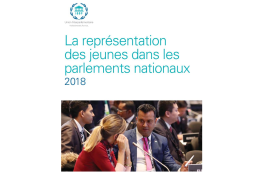
Promoting the participation of young people in political life is becoming a higher priority worldwide. Over one third of the 169 targets established as part of the United Nations Sustainable Development Goals (SDGs) relate to young people and the importance of their empowerment, participation and well-being. Twenty targets across six SDGs – relating to hunger, education, gender equality, decent work, inequality and climate change – specifically focus on youth.
In 2014, recognizing the absence of systematic data and information on youth representation in parliaments, the IPU designed a first-of-its-kind database on the subject, to collect the relevant data through parliaments. The result was the first report on youth participation in national parliaments, which was published in October 2014 and updated in 2016. This 2018 report provides updated information on the percentages and genders of parliamentarians under the ages of 30, 40 and 45, as well as the latest information on special mechanisms designed to encourage or enhance the participation of young people in national parliaments.
Some key findings:
- Young people under age 30 constitute just over 2 per cent of the world’s parliamentarians.
- 15.5 per cent of the world’s MPs are under age 40 – up from 14.2 per cent in 2016, an increase of 1.3 percentage points.
- 28.1 per cent of the world’s MPs are under age 45 – up from 26 per cent in 2016, a 2.1 percentage point increase.
- The global proportion of MPs under age 30 has increased by only 0.3 percentage points since 2016 (from 1.9% to 2.2%).
- 2.2 per cent of the world’s MPs are under age 30 – up from 1.9 per cent in 2016, a slight increase of 0.3 percentage points.
- Male MPs continue to outnumber their female counterparts in every age group.
- The gender imbalance is less pronounced among the youngest MPs in each parliament, for whom the male/female ratio is approximately 60:40. Encouraging signs
Click here to see the report.
This regional study seeks to take the initial findings of a 2016 IPU report further, focusing specifically on the situation in parliaments in Europe. It is the result of close collaboration between the IPU and the Parliamentary Assembly of the Council of Europe (PACE), and is the first in a series of regional studies that the IPU wishes to conduct on the subject. The study also broadens the scope of the research to include harassment and violence against female parliamentary staff.
Based on interviews with 123 female MPs and parliamentary staff in Council of Europe member States, the survey continues the work already carried out to provide figures and document a range of sexist and violent behavior against women in parliaments. It also seeks to assess the extent and highlight the particular forms of such abuse in Europe. The study therefore aims to break the silence and persistent taboos and to contribute to the fight against gender-based behavior and violence wherever they occur.
Click here to see the report.
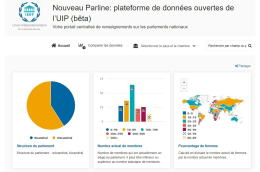
IPU launched New Parline, a new version of its online open data platform on national parliaments. The platform is intended for MPs, academics, civil society, the media, and all those interested in parliaments as the core institution of democracy.
The IPU has been collecting data on parliaments since its inception in 1889, including information on women’s participation in politics since 1945. Through New Parline, the IPU has pooled all of its data into one hub, allowing the user to see trends over time, as well as compare progress or regression between different regions of the world.
New Parline contains information on the structures of parliament’s working methods, including the representation of women and youth. Much of the data is unique. Most of the information on the platform comes from national parliaments directly. The IPU updates it regularly to take into account changes that result from elections and other circumstances. The data covers a wide range of themes; for example, the number of chambers, the number of women MPs, the number of laws initiated by parliament and the average age of MPs.
Click here to see the database.