Parliaments & Representatives

Sexism, harassment and violence against women are rife in parliaments across the Asia-Pacific region, according to a damning report published on Tuesday that lays bare the scale of abuse faced by women in politics.
Based on interviews with 150 female MPs and parliamentary staff across 33 countries across the region – including Australia, Mongolia, India, Indonesia, Laos, Fiji and Micronesia – the study found that 76% of MPs and 63% of staff had experienced psychological gender-based violence, with 60% of MPs saying they had been targeted online by hate speech, disinformation and image-based abuse. An equal number of women were interviewed from each country.
One in four women reported having experienced sexual violence, with more than half of the harassment against female MPs taking place on parliamentary premises and committed by male parliamentarians. Two respondents said they had been sexually assaulted.
Read here the full article publiished by The Guardian on 25 March 2025.
Image by The Guardian

Women in dozens of parliaments across the Asia-Pacific are experiencing significant levels of abuse, violence and harassment, a new report has found, with online abuse a key issue.
The Inter-Parliamentary Union (IPU) interviewed 150 female MPs and staff, finding that 76 per cent of MPs and 63 per cent of staff had experienced gender-based violence.
The women worked in parliaments in 33 countries in the region, including in Australia, China, Indonesia, Thailand, India and the Philippines.
Sixty per cent of respondents said they had been the target of hate speech, image-based abuse and disinformation online — the highest recorded by the IPU since they began studies of this kind around the world.
One in four reported having experienced sexual violence, with more than half of the incidents taking place within parliamentary grounds and committed by male MPs.
Two women reported being sexually assaulted.
IPU Secretary General Martin Chungong said violence and sexism against women in parliamentary workplaces "is a direct assault on democracy itself".
"Parliaments must be sanctuaries for healthy debate and law-making," Mr Chungong said.
Read here the full article published by ABC News on 26 March 2025.
Image by ABC News

A female Japanese politician has received about 8,000 emails containing death threats after proposing free sanitary pads in public toilets – a wave of online abuse that experts say reflects a deeper pattern of gender-based harassment aiming to silence outspoken women.
Ayaka Yoshida, a 27-year-old member of the Mie prefectural assembly and the Japanese Communist Party, sparked the backlash after posting on social media on March 25: “Like toilet paper, I want sanitary pads to be provided everywhere.”
The message quickly provoked angry responses, with one message sent to the secretariat of the Mie assembly stating, “At her age, she should know to carry emergency sanitary napkins.”
The responses soon became more threatening, however, with the assembly receiving nearly 8,000 emails – about one a minute for nearly four days from 8pm on March 28.
Read here the full article published by the South Morning China Post on 3 April 2025.
Image by South China Morning Post
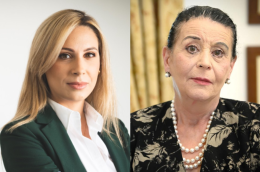
When Myriam Spiteri Debono was pregnant with her third child and campaigning for a national election, a fellow party member actively discouraged voters from supporting her because she was too busy as a mother and breadwinner to serve the public effectively.
The incident might sound like a matter of the past. But it’s still happening today as recounted by Nationalist MP Rebekah Borg who is pregnant with her second child and who admitted often faces the comment: "How will you manage and find the time?"
The President of the Republic and the MP were among those sharing their stories during a seminar titled 'Women, Politics and Violence', organised by the Gender Equality and Sexual Diversity Committee in collaboration with the Gender and Sexualities Department within the Faculty for Social Wellbeing.
Read here the full article published by the Times of Malta on 10 April 2025.
Image by Times of Malta
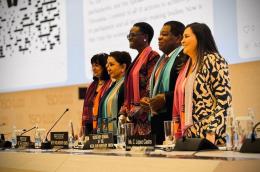
The Inter-Parliamentary Union (IPU) is pleased to announce its new gender campaign for 2025, Achieving gender equality, action by action.
This initiative marks a pivotal year, in which the Beijing Declaration and Platform for Action, the global blueprint for gender equality, is marking its 30th anniversary.
The campaign aims to mobilize the global parliamentary community to accelerate progress in achieving gender equality in politics and society.
With progress on women’s representation in parliaments stalling, as detailed in the IPU’s recent report Women in parliament 1995-2025, and a concerning rollback of women’s rights in some countries, the campaign emphasizes the urgency of immediate action.
The campaign promotes 10 key actions structured around three key thematic areas:
-
Promoting parity in parliament and politics
-
Encouraging gender-sensitive institutions
-
Combating gender-based violence and discrimination
40 years of bringing women MPs together
The campaign was launched at the 150th IPU Assembly in Tashkent, Uzbekistan, coinciding with the 40th anniversary of the IPU Forum of Women Parliamentarians.
Initially formed in 1985 as an informal global women’s caucus, the first of its kind, the Forum of Women Parliamentarians has since evolved into a powerful platform for women MPs worldwide, driving significant advancements in gender equality and women's empowerment.
For example, the Forum has played a key part in parliamentary efforts to address violence against women, with 104 countries now having comprehensive laws addressing domestic violence.
The Forum provides an opportunity for women MPs to learn about how other countries are addressing gender inequality and to share good practices.
More recently, male MPs have also participated in the Forum, underlining the shared responsibility of both men and women in achieving gender equality.
Read here the full article published by the IPU on 7 April 2025.
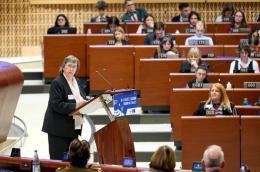
On March 25, after marking the arrival of the art installation “Thinking of you” in Strasbourg, a tribute to women who have suffered conflict-related sexual violence, the Congress held its debate on violence against women in politics. Those gathered in the Hemicycle heard a series of harrowing testimonies, but also glimmers of hope that the Congress could bring about real change in the political culture of its member states to protect and encourage women-elected representatives, without whom democracy has no future.
Opening the debate, Congress President Marc Cools pointed out that in 2024 the “Mayors under pressure” debate had drawn attention to the vulnerability of women mayors and local councillors who have suffered daily harassment and physical and verbal abuse, particularly via social media. This is a growing trend that discourages women in Europe from embarking on political careers.
Jaqueline McLaren, Lord Provost of the city of Glasgow in the United Kingdom, confirmed that the figures for women's participation in politics were not reassuring. Moreover, during her time as a local councillor and mayor of Glasgow, she herself had encountered violence. Threatened, among other things, with tarring and feathering, she had felt the helplessness and anxiety that many women politicians had experienced, were experiencing or would experience. Hence her motivation to invest in mutual aid, mentoring and solidarity programmes between elected representatives, such as Eurocity. She called on Congress members to take action and to get involved, also citing the Cartier initiative which sought to build mutual support between women entrepreneurs and leaders around the world, as well as Sophie's Stop, an app created by women for women to combat gender-based violence.
Read here the full article published by the Council of Europe on 26 March 2025.
Image by Council of Europe
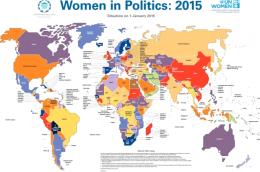
The Map, which presents latest data and global rankings for women in politics, reveals a mixed picture on gender equality in executive government and in parliament at regional and national levels.
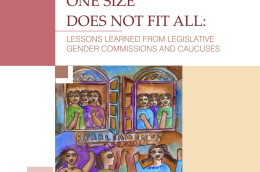
This guide demonstrate that women’s collective efforts in the legislature are crucial not only because of their impact on public policies that effectively respond to citizens’ demands and interests, but also because of their effect on the consolidation and progress of women’s leadership. Nonetheless, cross-party work within the legislative branch faces many challenges: building consensus while maintaining equilibrium between commitment to gender issues and party visions; keeping gender issues on the public agenda; and creating a sustainable critical mass of women legislators committed to advancing a gender equality agenda.
Women in legislatures worldwide have used diverse practices to make progress on priority issues and decrease the gender gaps in their countries. This should serve as an incentive to increase the number of women in parliaments and support their efforts so they can propose actions that ensure the continuation of the achievements of their predecessors.