Parliaments & Representatives

A report found that Instagram left up 93 percent of violent comments toward female candidates—the kind of online abuse that has led them to not seek office.

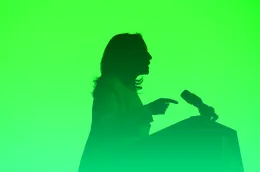
Pinned on vice president and Democratic presidential nominee Kamala Harris’ official Instagram page is a post featuring her alongside her running mate, Minnesota governor Tim Walz. In the comments, along with praise, criticism, and more than one “Trump 2024,” are several comments asking if Harris had offered Walz oral sex, with one calling her “Kamel toe.”

Harris has long been the subject of online abuse, which is likely to intensify as her campaign wears on. But a new report from the Center for Countering Digital Hate (CCDH), a nonprofit that tracks hate speech and misinformation online, found that Instagram failed to remove 93 percent of the 1,000 hateful and violent comments it flagged to the platform targeting both Republican and Democratic female politicians, including Harris.

In doing so, Imran Ahmed, CEO of CCDH, says that the platform is helping to create an environment that discourages women from seeking political office. “It’s an unconscionable, regressive barrier to women’s participation in politics,” he says.

Read here the full article published by Wired on 14 August 2024.

Image by Wired


As elections unfold throughout this super election year, much of the discussion has revolved around the advanced age of some candidates running for office. However, what about the younger voices that are adding fresh perspectives and energy to the political arena?

The IPU has been meticulously tracking the average age of parliamentarians at national, regional and global levels for many years, becoming the authoritative data reference on youth in parliament. 

According to IPU data, the three parliamentarians  below are currently the youngest serving MPs. 

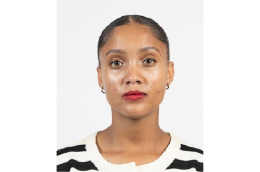
Cleo Wilskut (20), South Africa: Ms. Wilskut of the Patriotic Alliance made history as the youngest member of the National Assembly elected just a few weeks ago in June 2024.

Eve Borg Bonello (21), Malta: Ms. Bonello of the Nationalist Party became an MP in 2022, becoming  the youngest person to be elected to the House of Representatives of Malta in the country’s history.

Hana-Rawhiti Maipi-Clarke (21), New Zealand: Ms. Maipi-Clarke, a member of the Te Pāti Māori Party, was elected in 2023 as one of the youngest MPs in New Zealand's history.

On the other end of the scale, the three oldest parliamentarians in the world are the following:

Salah Goudjil (93), Algeria: Mr. Goudjil serves in the Council of the Nation, the upper house of the Algerian Parliament.

Augusto Gómez Villanueva (95), Mexico: Mr. Gomez represents a circonscription of Mexico City in the Mexican National Assembly.

Guillermo García Frías (96), Cuba: Mr. García, a veteran of the Cuban Revolution, serves in the National Assembly.

Read here the article published by the Inter-Parliamentary Union on 7 August 2024.


The world’s longest-serving female leader was, according to her son, “in good spirits, but disheartened and disappointed in the lack of gratitude of the people of Bangladesh”.

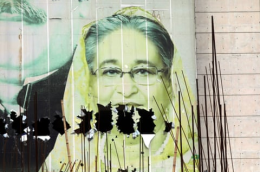
After weeks of protests, more than 300 deaths and increased international criticism of her government’s slide into autocracy, the long rule of Sheikh Hasina ended on Monday as she fled the country she had led for a combined total of more than 20 years.

The daughter of Sheikh Mujibur Rahman, Bangladesh’s first president who led his country to independence in 1971, Hasina flew to India, where she was born in 1947 and where she was granted asylum in 1975, after a military coup caused the deaths of most of her family.

It was 49 years ago this month that her father, mother, young brothers and 15 others were shot dead in what were called the midnight murders. Hasina, her husband and her sister Sheikh Rehana were travelling in Germany at the time and so survived.

Ironically for a woman deposed by a student uprising, while at Dhaka University studying literature, Hasina built a reputation as a student leader and feminist. Her political bent resumed when she returned to Bangladesh from a six-year exile in India in 1981, after being elected leader of her late father’s Awami League (AL) party.

Read here the full article published by the Guardian on 06 August 2024.

Image by Guardian


Google is joining the growing number of companies standing up to sexually explicit deepfakes.

The Alphabet division has made it easier for users to report nonconsensual imagery found in search results, including those made by artificial intelligence tools. While it was previously possible for users to request the removal of these images prior to the update, under the new policy whenever that request is granted, the company will scan for duplicates of the nonconsensual image and remove those as well. Google will also attempt to filter all explicit results on similar searches.

“With every new technology advancement, there are new opportunities to help people—but also new forms of abuse that we need to combat,” product manager Emma Higham wrote in a blog post. “As generative imagery technology has continued to improve in recent years, there has been a concerning increase in generated images and videos that portray people in sexually explicit contexts, distributed on the web without their consent.”

Read here the full article published by the Fast Company on 31 July 2024.

Image credits: Fast Company


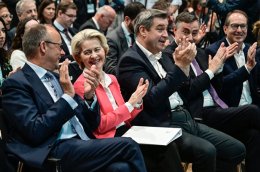
The new European Parliament hasn’t only tilted right-wing, it’s also even more male-dominated.

Only 277 of the new Parliament’s 719 confirmed EU lawmakers are women: 38.5 percent, down from about 40 percent in the previous hemicycle. It’s the first-ever decline in the proportion of women in the Parliament, which had been on a consistent upward trajectory since 1979.

A cursory comparison with the Parliament’s previous terms suggests that political groups’ gender ratio has actually remained fairly stable — with one exception: the right-wing European Conservatives and Reformists, led by a prominent female politician in Italian Prime Minister Giorgia Meloni, slipped from a 30 percent proportion of female MEPs across the previous term to under 22 percent: Just 17 of its 78 MEPs are women today.

Women’s rights campaigners have reacted with disappointment at the decreased representation.

“This is worrying, especially considering that quite a significant proportion of MEPs sit within political groupings that are known to be hostile toward women’s rights and gender equality,” Jéromine Andolfatto, policy and campaign officer for the European Women’s Lobby, said in written comments.

An analysis of the gender balance within Parliament’s groups reveals a clear divide.

Liberal and left-leaning groups boast shares of women lawmakers above the Parliament’s average, ranging from 43 percent in the Socialists and Democrats group to 51 percent of the Greens.

Read here the full article published by POLITICO on 29 July 2024.

Image by Politico
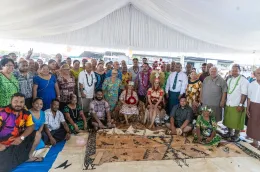
 

The Speaker of the House Papalii Lio Masipau made a bold statement about why he thinks gender inequality exists in politics. He views the matai system and customs as prohibiting women from traditional governance impacting their chances to run for office.

Papalii just returned from touring the parliament in New South Wales, Australia. It was an eye-opening experience for him to see more women involved in politics and at a policy level. He must have thought hard before making this bold statement.

He may not be off the target. He is right in saying that the village setting is proving to be a difficult hurdle faced by women wanting to enter the political arena.

“Our matai system should treat women equally as men so that we don’t need to have the 10 per cent requirement…there is no equality in our matai system and some village setups don’t allow our mothers to participate or sit in village councils,” Papalii said.

According to the Speaker, the Legislative Assembly is made up of 51 representatives from the districts and the reason for extra seats is to meet gender equality in the House.

He added the constitutional requirement to have 10 per cent women representation in the House would not be needed if mothers were treated equally within villages. 

Read here the full article published by Samoa Observer on 22 July 2024.

Image by Samoa Observer