Women's Leadership

MI6 will be led by a woman for the first time in the foreign intelligence service's 116-year history.
Blaise Metreweli, who joined the Secret Intelligence Service in 1999, will become the 18th chief of the organisation and take over from Sir Richard Moore later this year.
She is currently responsible for technology and innovation at the service and said she was "proud and honoured" to have been asked to lead.
Prime Minister Sir Keir Starmer called the appointment "historic" at a time "when the work of our intelligence services has never been more vital".
MI6 is tasked with gathering intelligence overseas to improve the UK's security, with its core aims being to stop terrorism, disrupt the activities of hostile states and bolster cyber-security.
Its chief, commonly referred to as "C", is the only publicly named member of the service.
Ms Metreweli, 47, is currently Director General "Q" - head of the crucial technology and innovation division that aims to keep the identities of secret agents secret, and come up with new ways to evade adversaries like China's biometric surveillance.
"MI6 plays a vital role - with MI5 and GCHQ - in keeping the British people safe and promoting UK interests overseas," she said.
"I look forward to continuing that work alongside the brave officers and agents of MI6 and our many international partners."
Full article published by the BBC.
Image by BBC
Overview
In 2025, the global community is commemorating the thirtieth anniversary of the Fourth World Conference on Women and adoption of the Beijing Declaration and Platform for Action (1995). In this vein the sixty-ninth session of the Commission on the Status of Women took place at United Nations Headquarters in New York from 10 to 21 March 2025. The main focus of the session was on the review and appraisal of the implementation of the Beijing Declaration and Platform for Action and the outcomes of the 23rd special session of the General Assembly. The review assessed ongoing challenges hindering the realization of gender equality and women's empowerment and examined how these efforts contribute to achieving the 2030 Agenda for Sustainable Development. At CSW69 countries adopted the Political Declaration recommitting to the global agenda of gender equality and empowerment. In addition, various side events organized by CSOs and partners addressed some of the most critical issues on gender inclusion,empowerment and representation.
In this vein iKNOW Politics held three webinars in Arabic (09/05/2025), English (29/04/2025) and Spanish (25/04/2025) on the topic of ‘From Words to Action – Reviewing the CSW69’. These webinars explored the following key questions stemming from the discussions and outcomes of CSW69.
-
What were the salient themes discussed during the CSW69 that address some of the most pressing issues for Women in Politics?
-
What are the salient features of the Political Declaration that has been adopted?
-
Reflections/Impressions on the sessions by speakers of the webinar.
-
There is a significant global backlash against democracy and gender equity. Do you think the perspectives/commitments you heard at CSW69 meet the challenges of our time?
-
Strategically speaking, what were your key lessons learnt, and how can they be implemented in your context.
-
What was missing in the discussions, what direction can future agendas of CSW take?
-
What lies ahead for Women’s Political Participation based on the commitments at the CSW69?
Key Takeaways
-
Declarations Must Lead to Action: High-level declarations alone are not enough. There must be concrete national and multilateral frameworks, budgets, and accountability mechanisms to drive real change that are cross-cutting to drive grass-root change. The difficult negotiation process at CSW69, particularly considering emerging anti-gender rhetoric and its impact on previously agreed language within the UN frameworks was also highlighted.
-
Effective Youth Inclusion is Essential: For sustainable change, the lived experiences and voices of youth must take center stage at events like CSW. Moreover, the intergenerational aspect of the CSW must be expanded to ensure dialogue in all spaces is representative of experience and representation of different generations of stakeholders.
-
Funding Challenges: The current wave of political regression concerning gender equality is creating unprecedented funding challenges for women’s rights CSOs and forcing many to rethink their future strategies and operational models.
-
Realigning Power & Responsibility: The movement must shift from organization-driven mandates to people-centered responsibility. Activism should reflect the realities of those most impacted.
-
Engaging Men and Boys: Fostering a supportive environment for women’s political participation demands a shift in cultural attitudes by engaging men and boys in discussions on gender equality, leadership, and respectful public discourse.
Click here to view the full Arabic session.
Click here to view the full English session.
Click here to view the full Spanish Session.

We are happy to share that Wanja Maina, participant of the Eastern Africa Young Women's Empowerment Academy organised in the framework of the WYDE Women's Leadership project, has been nominated among the 50 most influential women in Kenya in 2025 by Africapitol Ventures!
Wanja’s work in media, gender equality, disability rights, and community engagement is truly inspiring — and this recognition is a testament to her dedication to creating meaningful change.
It also shows how initiatives like the Young Women's Empowerment Academies can be a positive step in young women’s leadership journeys, supporting them to reflect and work on their development plans and elevate their voices and impact.
Wanja is committed and looks forward to work regionally and globally on issues of public finance, gender equality, disability rights and political participation of special interest groups.
Wanja Maina "Honoured to Be Named Among Kenya's 50 Most Influential Women 2025 🏆✨"
I was pleasantly surprised to receive information from Africapitol Ventures that I am among the 50 most influential women in Kenya for 2025.
This recognition has truly uplifted my spirits and fills me with gratitude. 🙏💖
I believe in a better Kenya, and I have extensively engaged on Kenyan media on issues affecting ordinary Kenyans, which gives me great joy.
Through my media work, I've been able to amplify the voices of everyday people and bring attention to the challenges they face.
Beyond media engagement, I have been involved in many activities that have improved the welfare of women and girls, including program designing, community engagements, and other gender equality projects in partnerships with different entities. 👩👧👦💪
This work has been incredibly fulfilling as I've seen firsthand how collaborative efforts can create meaningful change in communities.
This recognition has encouraged me to do my best, reminding me that "there is someone who is always watching." 👀 It motivates me to continue pushing forward, knowing that dedication and genuine commitment to improving lives doesn't go unnoticed.
Looking ahead, I would love to partner and work with all like-minded people in the coming days on areas of public finance, gender equality, feminisms, disability rights, political participation of special interest groups, and other critical issues affecting our society. 🤝⚖️.
I would also love to work regionally and globally on these important issues. 🌍
I believe that by working together, we can create the lasting change that Kenya needs. 💫
I'm excited to share this news and connect with others who share this vision for a better future. 🌟
"We should always be like a hummingbird. I may be insignificant, but I certainly don’t want to be like the animals watching the planet goes down the drain. I will be a hummingbird, I will do the best I can"- Wangari Maathai
Despite all the progress that has been made toward gender equality globally, many are still tempted to view armed conflict as primarily the domain of men. Women often prove decisive in such settings, including combat, non-combat roles, and leadership positions. Nonetheless, they are routinely sidelined in formal peace processes and post-conflict governance. This pattern reflects a moral and practical failure.
During armed conflicts, women become more vulnerable to genocide, trafficking, slavery, and sexual violence, with all the associated health risks and psychological trauma. This alone earns them the right to participate in peace processes. But women are not only passive victims of conflict, as we have seen in Ukraine. They make profound wartime contributions on the battlefield, as well as in civil society and as advocates for peace.
Full article published by Addis Fortune here.
Image by Addis Fortune
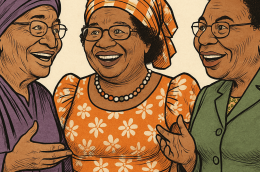
For decades, African politics has been a domain dominated by men, with women often relegated to the sidelines of decision-making. But a growing number of countries how now experienced female leadership, including Liberia, Malawi and most recently Namibia. With President Netumbo Nandi-Ndaitwah becoming the country’s first female head of state and assembling a cabinet where women hold the majority of ministerial positions, Namibia has set a historic precedent. This moment signifies much more than symbolism; it signals a broader and hopeful shift in the continent’s political landscape, one that may pave the way for future gender equality in governance. Could Namibia be a harbinger of a wider trend across Africa? Let’s take a closer look at the evidence.
Namibia is not alone in challenging the traditional power structures that have long kept women out of high political office. In recent years, countries like Tanzania and Ethiopia have also seen women rise to top leadership roles. Tanzania’s President Samia Suluhu Hassan, who took office in 2021 after the death of President John Magufuli, has already made significant strides in reshaping the country’s political and economic trajectory. However, it is important to note that she, like Malawi’s former President Joyce Banda, assumed office not through an electoral mandate but through constitutional succession. This pattern raises important questions about the actual commitment of ruling parties to gender equality when women are not fielded as primary candidates.
Full article by Democracy in Africa.
Image by Democracy in Africa

Ulaanbaatar, May 22, 2025 /MONTSAME/. The “We Women” Forum, jointly organized by the Secretariat of the State Great Khural, the United Nations, and the Korea International Cooperation Agency (KOICA), opened on May 21, 2025, at the State Palace.
Speaker of the State Great Khural of Mongolia Amarbayasgalan Dashzegve delivered opening remarks, stating, “Last year, amendments were made to the Law on Parliamentary Elections, adopting a mixed electoral system and legislating that no less than 30 percent of the candidate list of political parties and 50 percent of candidates in constituencies must be women. As a result, of the 1,341 candidates in the 2024 Parliamentary Election, 38.7 percent, or 520 candidates, were women, a historic high, and 32 women were elected to the State Great Khural, bringing women’s representation in Parliament to 25.4 percent, also a record.”
Full article published by Montsame on 22 May 2025.
Image by Montsame

Women Political Leaders and Kantar came together in 2018 to create the Reykjavík Index for Leadership– the first measure of perceptions of women and men in terms of their suitability for leadership. The initial findings revealed significant, complex, and deep-seated prejudice towards women – where women were not seen as equally suitable to lead.
When the Reykjavík Index was launched, we acknowledged that progress in equality for women was far from guaranteed. Across the G7 group of countries, and in multiple areas of economic activity, many of the 2018 Index scores fell short of the target score of 100, which indicates a consensus across society that women and men are equally suited for leadership. Nevertheless, we fully hoped at that time to witness improvements in perceptions in the years to come, with scores of countries and sectors approaching the target score of 100.
Unfortunately, in 2020, the third year of Index results, we can only note a striking absence of progress. Indeed, this year cannot be called a period of advancement.
The Reykjavík Index for Leadership 2020-2021 presents findings drawn from the attitudes of over 20,000 people across ten countries – the G7 nations (comprising Canada, France, Germany, Italy, Japan, the United Kingdom, and the United States) along with India, Kenya, and Nigeria. We believe that the addition of new countries to the G7 nations will allow us to better observe whether progress is being made, where stereotypes endure, and where public policy or private sector intervention is making a difference.
A look at the average score for the G7 countries, which we can now track across three years, shows very little change: it remains a 73. This can be regarded as the gap between the ‘birthright’ of equality for men, and the everyday reality of women’s experiences with inequality across the world.
Click here to see the report.
This study applied a conceptual framework that uses a comparative and gendered approach to estimate the cost of politics, using a set of pre-identified variables regularly incurred by both candidates seeking political office and elected representatives while in office. This consideration was in line with the notion that analysis of election delivery and management should not be looked at in the realm of an event but rather as a cycle. The conceptual framework enabled the research team to arrive at both statistical and qualitative evidence regarding the cost of politics in Uganda.
Click here to see the report.
Are elected officials more responsive to men than women inquiring about access to government services? Women face discrimination in many realms of politics, but evidence is limited on whether such discrimination extends to interactions between women and elected officials. In recent years, several field experiments have examined public officials’ responsiveness. The majority focused on racial bias in the USA, while the few experiments outside the USA were usually single-country studies. We explore gender bias with the first large-scale audit experiment in five countries in Europe (France, Germany, Ireland, Italy, and Netherlands) and six in Latin America (Argentina, Brazil, Chile, Colombia, Mexico, and Uruguay). A citizen alias whose gender is randomized contacts members of parliament about unemployment benefits or healthcare services. The results are surprising. Legislators respond significantly more to women (+3% points), especially in Europe (+4.3% points). In Europe, female legislators in particular reply substantially more to women (+8.4% points).
Click here to see the report.

More than 2.5 billion women and girls around the world are affected in multiple ways by discriminatory laws and the lack of legal protections. In response, UN Women, the African Union, the Commonwealth, Inter-Parliamentary Union, Organisation Internationale de la Francophonie, and Secretaría General Ibero-Americana have jointly issued “Equality in law for women and girls by 2030: A multistakeholder strategy for accelerated action” in close collaboration with the Office of the United Nations High Commissioner for Refugees, the United Nations Office on Drugs and Crime, Equality Now, Global Citizen, Global Campaign for Equal Nationality Rights, International Association of Women Judges, International Development Law Organization, Muslims for Progressive Values, and Women’s Learning Partnership to tackle persisting discrimination in law.
Between 2019 and 2023, the strategy seeks to fast track the repeal of discriminatory laws in six thematic areas—comprehensive reforms, women’s economic empowerment, minimum age of marriage provisions, nationality rights, discriminatory rape laws, and family and personal status laws—in 100 countries and is expected to address the legal needs of more than 50 million women and girls.
Click here to see the report.
Our report, with U.S.-based National Democratic Institute (NDI), outlines a new framework for understanding how disinformation is being used online to exclude women from public life, in the first major study into this threat to democracy.
The report has found that online spaces are being systematically weaponised to exclude women leaders and to undermine the role of women in public life. Attacks on women which use hateful language, rumour and gendered stereotypes combine personal attacks with political motivations, making online spaces dangerous places for women to speak out. And left unchecked, this phenomenon of gendered disinformation, spread by state and non-state actors, poses a serious threat to women’s equal political participation.
In this research, we investigated state-aligned gendered disinformation in two countries, Poland and the Philippines, through an analysis of Twitter data. The research found evidence of disinformation campaigns which attacked women and used gendered narratives to undermine women who oppose or criticise the state.
For the first time, researchers identified core themes of gendered disinformation, and common strategies used by those engaged in it, finding that campaigns relied not just on false information, but used highly emotive content to try to undermine their targets politically.
The report found that gendered disinformation is parasitic on news events, existing rumours, and underlying social stereotypes, and can be extremely successful in reaching a broad audience to reshape public discourse in a way that harms women.
Demos is calling for systematic improvements to be made to how platforms operate in facilitating, promoting and moderating online speech. Existing responses to disinformation, such as fact-checking, while important, are ineffective in solving this problem.
Click here to access the report.
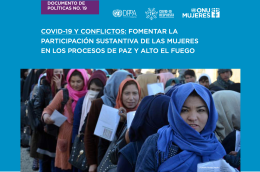
COVID-19 and conflict: Advancing women’s meaningful participation in ceasefires and peace processes
This brief addresses the importance of women’s full, equal, and meaningful participation to an effective pandemic response and to peacemaking efforts, and how the women, peace and security (WPS) agenda can provide a critical framework for inclusive decision-making and sustainable solutions. While efforts to flatten the pandemic’s curve unfold around the globe, violent conflict remains a deadly reality for far too many people.
In March 2020, the UN Secretary-General called for a global ceasefire to allow the world to address COVID-19. Since the outbreak of the pandemic, women have been at the forefront of effective COVID-19 prevention and response efforts—from frontline service delivery to the highest levels of decision-making. With women’s participation central to achieving sustainable solutions, the pandemic has brought into sharp relief how critical the WPS agenda is to inclusive and effective decision-making.
This brief recognizes the vital role of women’s civil society organizations in mobilizing support for an urgent cessation of hostilities, inclusive ceasefire processes, and comprehensive peace talks. It also provides a preliminary analysis of the impact of COVID-19 on women’s participation in ceasefires and peace processes and offers a series of recommendations, including on “building back better”.
Click here to see the report.