Women's Leadership

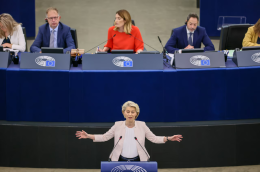
STRASBOURG — The European Parliament elected Ursula von der Leyen for another five years as European Commission president, choosing stability and continuity for the EU’s most powerful institution and the bloc.

Von der Leyen, who hails from the centre-right European People’s Party, won 401 votes in a secret ballot, well above the 361 votes she needed to be elected. There were 284 votes in opposition, 15 abstentions and 7 votes declared invalid.

Von der Leyen had the backing of the three mainstream, pro-EU groups — the center-right European People’s Party, the Socialists and the liberals of Renew. In the weeks and months leading up to the vote, some lawmakers within those centrist groups said they would not vote for her, forcing her to look for support from outside her current coalition, including among the left-leaning Greens. 

Now that von der Leyen has the support of both the European Council and the European Parliament, she will begin to assemble her new European Commission. 

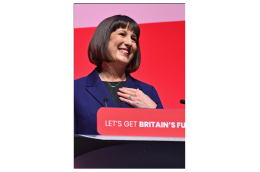
Read here the full article published by Politico on 18 July 2024.

Image by Politico


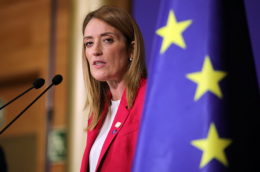
STRASBOURG — Roberta Metsola has been reelected as president of the European Parliament.  

First elected to the post in January 2022, the Maltese European People’s Party (EPP) politician will remain in the role for 2.5 more years after gathering the support of a majority of the newly elected 720 members of the European Parliament, with 562 votes in her favor.

She was widely expected to be reelected as she ran virtually unopposed. Only The Left’s Irene Montero, Spain’s former minister of equality, symbolically submitted her candidacy against Metsola. Montero got 61 votes.

The Parliament president’s five-year mandate has been traditionally split in two between the center-left Socialists and Democrats (S&D) and the center-right EPP.  

When it comes time for the S&D to pick a successor to Metsola, options include Spain’s Iratxe García, leader of the S&D group in Parliament, or a leading figure within Italy’s Democratic Party, which is the largest force in the S&D.

Read here the full article published by POLITICO on 16 July 2024.

Image by POLITICO


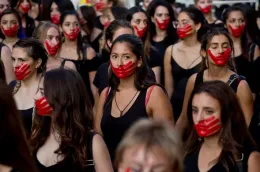
Despite progress in codifying women’s rights into law, advances in gender equality around the world have been halting, at best. This, despite the additional attention that the #MeToo movement brought to incidents of sexual assault and harassment in parts of the Global North—and increasingly in the Global South.

In South Africa, President Cyril Ramaphosa made news in 2019 when he appointed a Cabinet that included as many women as men. Later the same year, the European Commission also achieved the European Union’s self-imposed goal of gender parity. The thinking behind gender parity in government is that with greater levels of representation, women policymakers and legislators will pay more attention to issues that are often ignored by men, like gender-based violence or inheritance laws that discriminate against women.

But where quotas are used, they have failed to achieve parity for women in all but a few cases. Nor are they a panacea. Even with increased representation, policymakers must figure out how to turn good intentions into change on the ground, so that removing restrictions on education, to take one example, actually leads to improved school attendance rates for girls and young women.

Read here the full article published by the World Politics Review on 16 July 2024.

Image by World Politics Review


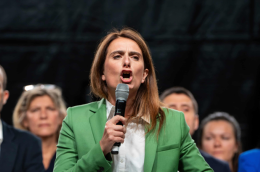
"I really like these angry green women,” a French friend said recently, as the assembly elections approached. It’s a funny phrase, redolent of She-Hulk, but I knew exactly what – and whom – she meant.

It’s impossible to overstate my crush on Marine Tondelier, the French Green party leader. Tondelier has been a revelation in the past few feverish, fretful weeks; she has cut through French politics like a hot knife through butter. Forensically, forcefully articulate and unafraid to show her emotions, she is “cash”, as the French say – frank, funny and down-to-earth.

Tondelier comes across as a real (albeit brilliant) person, not a cautiously on-message robot. She talks, to paraphrase the musical Hamilton, like she is running out of time. I have watched endless clips of her verbally demolishing opponents with off-the-cuff zingers, relished her clinically detailing of the worst National Rally candidates and been moved by her obvious distress when a centre-right politician refused to commit his party to blocking the far right.

Read here the full article published by the Guardian on 14 July 2024.

Image by Guardian


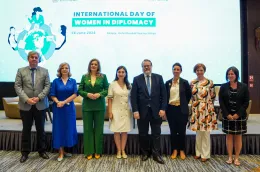
Skopje, North Macedonia, 24 June 2024 – UN Women in North Macedonia, for a second consecutive year in partnership with the Ministry of Foreign Affairs, marked the International Day of Women in Diplomacy with a high-level panel discussion highlighting the pivotal role that women play in international relations and diplomatic efforts.

By commemorating this day, we as UN Women, reaffirm our commitment to gender equality and highlight the importance of inclusive policies that encourage women’s participation in all levels of foreign policy.

A diverse panel of ambassadors spoke at the event, sharing their experiences and insights on how their countries support gender-inclusive policies and empowerment programmes for feminist foreign policy, and advocating for the advancement of women’s roles in foreign policy in North Macedonia.

“Women are still largely excluded from positions of power and diplomacy, globally only 20.54% of all ambassadors are women. This day is a call to recognize critical contribution of women and their indispensable role in diplomacy, and we all, every day shall support equal opportunities for all women in all fields of life, including in diplomacy,” said Vesna Ivanovikj-Castarede, Head of the UN Women Office in North Macedonia.

The outgoing Deputy Minister for Foreign Affairs, Fatmire Isaki, in her opening address underlined that “women are ambassadors of peace, they have the wisdom to soften the temper through their calmness and gentleness, speaking with their kindness. Peace reigns in their spirit and their intellect produces warmth. Therefore, it is in our collective responsibility to continue to uplift and empower women-who are the change makers across the globe. It has been proven time and time again that without the involvement of women, sustainable peace and security cannot be achieved.”

A relatively recent development in international politics, ‘feminist foreign policy’ is the result of a growing recognition of gender issues. From development policy, the gender focus has gradually extended to human rights, security, conflict resolution, and now foreign policy.

Read here the full article published by UN Women on 27 June 2024.


Another election, another round of politicians who tout the same ideas, speak the same way, wear the same suits and, possibly, the same aftershave. Another round of politicians who, a little too often, claim to represent women’s interests, or be outraged on the basis of familial connections – being a “father of daughters”, a “husband of a wife”.

Maybe I’m being cynical here, but women’s interests aren’t yet adequately represented in British politics. This under-representation can partially be attributed to a pervasive culture of misogyny, which continues to shape modern politics. It is a culture that bleeds into both women’s personal and professional lives, a culture in which former Home Secretary James Cleverley can “joke” about spiking his wife’s drink, where women are labelled, as Theresa May was, “bloody difficult”, and threats and intimidation are endemic.

Read here the full article published by Vogue on 5July 2024.

Image by Vogue


iKNOW Politics expert Farida Jalalzai submitted the following article to be published on International Women’s Day 2017.

Few social changes have been as dramatic and rapid as women’s increased political representation worldwide. Simultaneously, nowhere do women hold equal power to men in influencing and exercising political authority worldwide. This story of huge gains and shocking barriers plays out daily in our news, and for good reason. These are all threads of a compelling story – women’s global political empowerment. Changes that were fuzzy and uncertain at first can no longer be ignored. The UN has declared women’s empowerment as the third of its Millennium Development Goals (http://www.un.org/millenniumgoals/). Within this broad charter, political empowerment is one of a variety of areas, often less fully articulated and studied in comparison to economic indicators. Yet, gains in women’s political empowerment directly decrease the role of gender inequality as an obstacle to incorporation as social and economic equals, and open, rather than close, the political domain to all members of society. Indeed, as the largest group today that worldwide encounters current and historical barriers to political incorporation, women’s political empowerment is a fundmental process of transformation for benchmarking and understanding more general empowerment gains across the globe. Thus, women’s political empowerment is a political public good insofar as progress legitimates and strengthens a larger committment to equal political incorporation generally.

What is women’s global political empowerment? In 2015, we began a cross-national and inter-disciplinary discussion of these concepts and are publishing resulting work in an edited collection Alexander, Bolzendahl, and Jalalzai (forthcoming)[1]. As we have continued to develop these ideas, we define women’s global political empowerment as the enhancement of assets, capabilities, and achievements of women to gain equality to men in influencing and exercising political authority worldwide. This definition builds from important previous work on gender, empowerment, and development (Kabeer 2005). First, empowerment denotes a process of transformation from a position of no or limited agency to one of greater agentic opportunity and effectiveness. This captures the transformative essence of empowerment processes writ large. Importantly, it incorporates the systematic marginalization of women as a group from access to and achievement of equal levels of political influence, representation, and integration. Second, we focus on the fact that women’s political empowerment is achieved as part of a political process, not at one particular moment (e.g., women reaching 50% of the legislature). Political empowerment goes beyond the power enjoyed by particular individuals by shedding light on power configurations positioning groups, and recognizes political authority as the legitimate access to state mediated power.  Third, women’s political empowerment distributes power more evenly between men and women and undermines entrenched patterns of gender inequality across a broad range of economic, familial, and social institutions.

While the challenges are steep, there is a great deal of positive momentum toward expanding measures of women’s political empowerment worldwide. Data from sources such as the World Bank, the Inter-Parliamentary Union (www.ipu.org); and the UN Women program (www.unwomen.org) are slowly prioritizing measures related to gender, women’s empowerment, and politics. Mirroring the construction of gender as a social structure with individual, interactional, and institutional levels, measures of women’s empowerment must consider women’s individual capacities and opportunities (e.g., political knowledge, access, rights), community-based factors (e.g., political mobilization, campaigning, local representation), and broader arenas (e.g., women’s election nationally, women’s lobbies and political organizations, women’s power and leadership in office). While the bulk of available information relates to women’s formal political power (i.e., election to national office), our collection of research will expand this, for example in including cross-national measures of women’s election to local council, approaches to include women’s committee and caucus memberships, frameworks for linking women’s rights and emancipative values in survey research, broadening international data on women’s executive leadership, and  measures of the intersection of gender and minority status worldwide. Moving forward on these measurement issues requires collaboration across disciplines and a commitment by organizations and their resources to prioritize the collection of such data and share it widely.

We argue that we need to still better understand women’s elite involvement and influence.  The majority of prior work on elites charts cross-national and longitudinal trends in women’s presence in national legislatures.  While women’s presence in legislatures has grown over time, women still remain vastly underrepresented in most countries worldwide.   Comparative research on cross-level trends in women’s office-holding also shows that women’s incorporation varies considerably (Bolzendahl 2014). Thus, women’s presence at the national level should not be taken for granted as an indicator of similar achievements in other levels of office-holding. As a point of comparison, we briefly analyze women holding national executive positions (prime ministerships, presidencies, or equivalent posts).

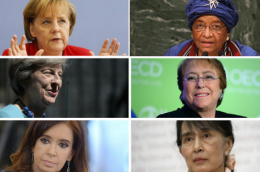
While the current world average of women in parliaments is 23 percent (www.ipu.org) and thus still quite low, compare this to the percentage of women holding executive office. A mere six percent of all executives in power in 2017 worldwide are women.  A record year for women would only require 20 women to hold power simultaneously. Even in this scenario, women would comprise less than eight percent of all executives. More stunning is that the numbers of women leading their countries is actually declining rather than increasing[2].  While quantities can indicate some important aspects of political empowerment, we must also account for quality of position and influence of the country. Women, compared to their male counterparts, more often ascend to relatively weak executive posts and gain offices through appointment as opposed to popular election (Jalalzai 2013).  Even with high profile female executives such as German Chancellor Angela Merkel (consistently ranked as the world’s most powerful female leader by Forbes Magazine) women still rarely lead more visible countries on the world stage. No doubt, media interest in women in executive power increased as Hillary Clinton’s election as the first woman president of the United States seemed likely. Given her loss and other setbacks for women including the impeachment of two sitting female presidents--Dilma Rousseff of Brazil and South Korea’s Park Guen-hye--it is fair to say that 2017 has not started out as a banner year for women executives.  Focusing only on women in national legislatures, therefore, neglects key alternative arenas where women gain in decision-making authority that may be even more influential, including women’s presence including executive positions, but also positions of party leadership, in the courts and security forces.

Our work also suggests the need to incorporate more work on political empowerment of average female citizens since this may strongly influence elite behavior, such as the provision of entitlements, especially those supporting gender equality (Alexander and Welzel 2011). Therefore, average female citizens’ level of political motivation and participation as well as the strength of women’s advocacy networks are fundamental to women’s political empowerment.

Overall, our research on identifies a number of key conceptual issues and opportunities for further developing definitions of women’s political empowerment worldwide. In particular, we see that a critical mass of scholarship exists that provides the launching point for research to expand globally and rethink conclusions across geo-political areas. Through continued work and data collection, a broad theoretical framework can emerge to understand how women have gained fuller access to political power and where challenges toward equality remain. 

References

Alexander, Amy C. and Christian Welzel. 2011. “Explaining Women’s Empowerment: The Role

of Emancipative Beliefs.” European Sociological Review 27(3): 364-384.

Alexander, Amy, Catherine Bolzendahl, Farida Jalalzai. Measuring Women’s Political Empowerment

across the Globe- Strategies, Challenges and Future Research. New York: Palgrave Macmillan (forthcoming).

Alexander, Amy, Catherine Bolzendahl, Farida Jalalzai. 2016. “Defining Women’s Global

Political Empowerment: Theories and Evidence.” Sociology Compass.

Jalalzai, Farida. 2013. Shattered, Cracked and Firmly Intact: Women and the Executive Glass

Ceiling Worldwide. Oxford: Oxford University Press.

Kabeer, Naila, 2005. "Gender Equality and Women's Empowerment: A Critical Analysis of the

Third Millennium Development Goal 1." Gender & Development 13:13-24.


[1] We thank the Thyssen Foundation for support of our conference in Cologne, Germany, 2015.

[2] Currently, only 15 women hold executive posts. In the previous year, 19 women held executive power.  Excluded from analysis women occupying positions not conforming to presidential or prime ministerial office such as collective executives (as in San Marino or Bosnia etc.).Leaders of non-autonomous countries are also omitted since ultimate authority lies with another government.  Since Taiwan’s independence from China is contested, President Tsai is excluded. A small number of women served in both prime ministerial and presidential capacities in the same country. Others led officially as interim leaders prior to securing more permanent appointments. Since the unit of analysis is the woman leader, they are not considered separate cases. In instances where the same woman held two different types of executive positions, they are analyzed in the position they held longer. Farida Jalalzai compiled cases of women leaders from the Worldwide Guide to Women in Leadership, Zarate’s Political Collection and different media articles.


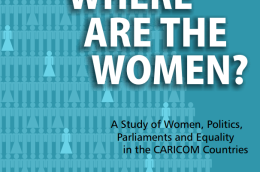
In 2013-2014, a study was undertaken by UNDP to explore the presence of women in decision-making positions in the countries of the Caribbean Community1,2 (CARICOM), as well as the link between their presence in politics and institutions and the national advances on gender equality, i.e. the link between descriptive and substantive representation. The initial hypothesis for the study was that there is a relationship between women’s political presence and the positive effects it might have through the inclusion of gender and other related inequality issues into the legislative and executive agenda — thereby establishing women as important agents of change for development. A similar study was in process in Latin America, but limited to the legislative agenda. This study was conducted as a desk review, during which available information and data on women, parliaments, and gender equality were collected and analysed from existing reports, documents, and other resources. While the aim of the research was to analyse the data on women’s political participation at the local and national levels for the period between 2000 and 2013, data for the period before were incorporated wherever it was available. This was done in order to paint as complete a picture of women’s political participation as possible and thereby capture key historic milestones and precedents that continue to have significant impact. 

The women, peace and security UN Security Council resolutions poster provides a helpful overview of each of the eight resolutions, and pulls out key provisions for each resolution. The poster is an informational resource which can be used by experts and non-experts alike to help explain and highlight the meaning and intention of each resolution on women, peace and security.

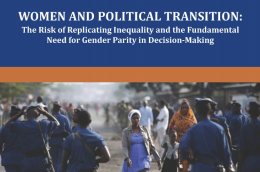
The International Foundation for Electoral Systems (IFES) includes gender equality and women’s empowerment programming as a key facet of its democracy-building work in countries transitioning from violent conflict to more stable political processes. IFES has programs on the ground in flashpoint countries such as Libya, Burkina Faso, and Syria, as well as countries striving to end the cycle of conflict such as Côte d’Ivoire and Myanmar. These countries represent a critical cohort of transitional states, which need tailored conflict and political transition interventions well in advance of credible, transparent and inclusive elections. Research has shown that gender equality is a bulwark for democracy – ensuring the resilience of democratic institutions that represent the needs of all their constituencies –and IFES works with partners to ensure women and men from all segments of society are part of the political and electoral process.

Work in conflict and unstable democratic settings will continue for the foreseeable future and a commitment to inclusive democracy will be challenged by these settings in unique ways. The legal framework for elections and political processes are often shaped, drafted, or reformed during peace processes and political transitions. IFES is committed to programming that integrates gender equality and women’s empowerment into all political and electoral technical assistance, including evolving and complex transitional contexts. This is critical for two reasons:

Excluding women from the nascent stages of conflict resolution is a missed opportunity to have all voices influence the blueprint for peace and democracy in their countries, and

Excluding women from political transition processes risks replicating gender inequality in new structures and perpetuating it in societal attitudes.

This briefing paper by IFES Senior Gender Specialist Jessica Huber outlines IFES’ gender-specific programming, which examines and responds to points along the continuum of crisis, political transition and stable democracy.

Click here to access the briefing paper. 

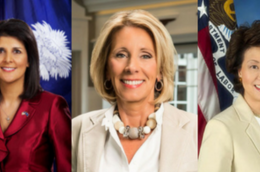
With many positions left to fill, President-elect Trump has already tapped several women for important positions in his administration. They include: Governor Nikki Haley as U.N. ambassador and charter school advocate Betsy DeVos as secretary of education (The Washington Post); former labor secretary Elaine Chao as secretary of transportation (The New York Times); Fox News commentator K.T. McFarland as deputy national security advisor (The New York Times); and health care consultant Seema Verma to lead the Centers for Medicare and Medicaid Services (NPR). 

Seven women currently serve in the Obama administration in cabinet or cabinet-level positions. Forty-eight women have held a total of 54 cabinet or cabinet-level appointments in the history of the United States. Of the 48, 30 had cabinet posts, including two who headed two different departments. Three more women held both a cabinet post and a position defined as cabinet-level, and one held two cabinet-level posts. Thirty-one of these women were appointed by Democratic presidents and 17 by Republicans. Ten presidents (four Democrats and six Republicans) have appointed women to their cabinets.

Want to know how many women past presidents have appointed? See CAWP's fact sheet about women in presidential cabinets.    

This mapping is made for the benefit of researchers who want to learn about Gender Studies in the Nordic countries Denmark, Finland, Iceland, Norway and Sweden on the theme of women/gender in public life. Most of the research literature - especially from the first decades of Nordic Women’s Studies/Gender Studies - was published in the native languages, and is therefore not included in this mapping. But with the development of Gender Studies, an increasing number of publications are available in English. Click here to access the full list.