Women's Leadership
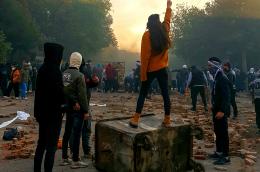
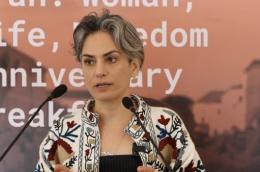
The act was a forceful symbol of her support for the movement and condemnation of the Iranian regime. “We cannot remain silent against the killing of women and girls like Mahsa (Jina Amini) or Armita (Geravand) who were killed merely because of their hijab,” she says.
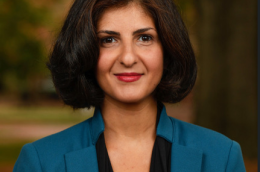
Other prominent women, including celebrities, had removed their hijabs in public acts of defiance against Iran’s mandatory hijab laws during the protests. But Vasmaghi’s unveiling held particular significance. Until then, her public persona was that of a deeply pious scholar who consistently observed the hijab in a strict sense without showing any hair—even while lecturing in Europe on her expertise in Islamic fiqh (jurisprudence). What Vasmaghi clearly opposed was not veiling itself but its compulsory nature: Just months before her public unveiling, she had drafted an open letter to the Supreme Leader challenging the Islamic justification for forcing women to cover their hair. In it, she asked pointedly: “How can the Islamic Republic justify such strict enforcement of mandatory veiling when even the Quran does not explicitly require women to cover their hair?
Abstract
Much of the literature on women’s-rights activism in the Muslim world presents such activism as employing discourses either of egalitarianism (secular) or of complementarianism (religious). This article analyzes the recent framing of demands for women’s right to political office by elite Islamic women in Iran and Turkey in terms outside this dichotomy. Drawing on data gathered from personal interviews as well as on careful study of public statements and publications by elite women, or those backed by state institutions, this article demonstrates the inadequacy of understanding women’s activism in Muslim contexts as employing either an egalitarian or a complementarian approach by highlighting a more nuanced conceptualization of women’s-rights framing and organizing in accordance with shifting contexts and political ideologies. Specifically, it shows how Islamic women’s-rights activists who are closely affiliated with their governments at times strategically adopt a “gender justice” framing, as opposed to “gender equality,” to appeal to more conservative sectors of their society. This strategy can have important policy implications and lead to shifts in political discourse about women and politics. However, elite women’s backing from and affiliation with conservative ruling elites can lead some groups, particularly secular feminists, to perceive their use of gender justice discourse differently and to be dismissive of their efforts
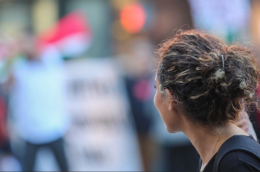
Women of Iran, similar to those across many parts of the region, benefit from a long history of feminist activism. Refusing to remain silent to discriminatory laws, practices, and behaviors, women have been struggling for equality, freedom, and justice through grassroots mobilization against conservative religious rule.
The latest spark of feminist resistance on a mass level occurred in September 2022 over the killing of Kurdish-Iranian Mahsa Jina Amini from injuries she sustained while in police custody for allegedly violating Iran’s conservative hijab laws. Under the banner of, “woman, life, freedom,” women led vast street protests for months in demand for basic rights and liberties, risking their lives and freedoms in the face of a violent state crackdown. Building on decades of women’s rights organizing, women across Iran rose to express their frustrations from systemic gender discrimination codified in Iran’s laws, as well as their intentional marginalization from politics.
In this latest wave of protests, large sections of the population, regardless of gender, region, ethnicity, age, and religious identity, also joined in—recognizing that women’s demands for equality and freedom form the foundations of broader demands for democracy, human rights, and justice.
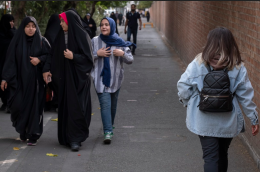
Large-scale protests that erupted in 2022 across Iran, centering on women’s rights, captured the world’s attention.
Iranians peacefully protested in the streets of places ranging from Tehran to small towns across the country, chanting, “Woman, life, freedom.” The protests reflected many Iranians’ growing frustration with the political regime in power since 1979 – and its ongoing violation of citizens’ basic rights, especially those of women and other historically marginalized groups.
While the latest wave of street protests dwindled by the first few months of 2023, nonviolent protests for freedom, democracy and equality have a long history in Iran and continue today.
The Nobel Peace Prize committee granted its 2023 prize to Narges Mohammadi, a prominent and currently imprisoned women’s rights advocate in Iran. This recognized popular resistance to Iran’s authoritarian regime.
As a scholar of women’s rights in Muslim cultures, I have documented women’s political activism in Iran and other Middle Eastern countries. My research shows that even when women are not demonstrating en masse in the streets, they consistently fight against gender discrimination, often at their own peril.
What do you think motivated Israel to attack Iran?
This conflict can’t be understood without looking at the decades-long tensions between Israel and Iran. Both are authoritarian and patriarchal regimes that use each other to justify repression at home. Iran relies on anti-western and anti-Israel narratives to silence dissent, while Israel invokes security threats from Hamas in Gaza or Iran’s nuclear programme to justify its actions. Each fuels the other’s hold on power.
Iran engages in so-called ‘unconventional wars’ to expand its regional influence and distract from internal crises just as Israel uses the conflict to divert attention from its domestic problems, including its treatment of Palestinians. Neither has an interest in genuine peace as they both benefit from a state of ongoing confrontation and constant sense of crisis.
During the recent phase of conflict, military targets were hit, and Iran’s intelligence services used the moment to crack down harder on activists and union workers. Daily life in Iran continues to be shaped by corruption, poverty and repression, particularly in regions that are rich in resources but lack basic services.
Some Iranians hoped the conflict might lead to regime change, but it quickly became clear this wouldn’t happen. Instead, the conflict helped both governments strengthen their grip on power. The war is unlikely to end, and will likely continue in unconventional forms, allowing both sides to maintain control under the guise of an ongoing existential threat.
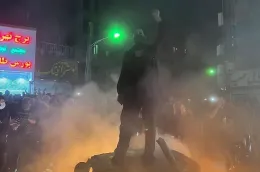
Mahsa Amini, a 22-year-old Kurdish girl, traveled to Tehran on a family holiday. She never returned. She died in the custody of Iran’s morality police, a wing of police that enforces mandatory hijab on Iranian women. Since her death on September 16th, there has been ongoing protest across the country. Mahsa was yet another heartbreaking example that in the Islamic Republic of Iran being a woman is a crime.
Mahsa is not the first woman to lose her life simply because they are born a woman in Iran. Countless women have lost their lives Some were victims of honor killing like Mona Heidari, others, died escaping rape like Schiler Rasouli, and others, took their own lives simply because they wanted to watch a football match in the stadium and were not allowed or are jailed to be executed only because they wanted to live their lives as who they are. The list is long.
But now Iran is at a turning point in its modern history. Since the disputed presidential election in 2009 (popularly known as the green movement), Iranian society has experienced significant shocks on several fronts: the effects of systemic corruption started to show and as a result, the traditional ecosystem of the regime’s cronies started to change. Some lost their stake in the game and turned into opposition while others moved the wealth they had accumulated to Europe and/or North America. Images of their children on social media indicate that they lead lives that counteract those advocated by their parents for the rest of society. They drink, dance, wear no hejab, mingle with the opposite sex freely, and their lifestyle contradicts the Islamic Republic’s values.

UN Women and ESCWA conducted in-depth interviews with seven Lebanese women in politics who were all ‘first’s’ in different ways. They include the first female Minister of Interior in Lebanon and the Arab world, the first female Minister to have a child, the first female independent Member of Parliament, the first female Secretary-General of a political party represented in Parliament and the first female Head of party.
This report analyses the set of interviews and explores the stories of each - the barriers they faced to political participation and the opportunities they leveraged.
The report aims to offer policy makers and practitioners a better understanding of the challenges and opportunities that exist when women seek political office in Lebanon.
Click here to access the report.

How to Include the Missing Perspectives of Women of All Colors in News Leadership and Coverage — a new report from Luba Kassova.
From Outrage to Opportunity: How to Include the Missing Perspectives of Women of All Colors in News Leadership and Coverage is a solutions-focused sequel to the award-winning independent reports, The Missing Perspectives of Women in News/COVID-19 News, authored by Luba Kassova and commissioned by the Bill & Melinda Gates Foundation. It examines the harsh realities facing women of all colors in news leadership and coverage in India, Kenya, Nigeria, South Africa, the UK, and the USA.
In both editorial leadership roles and in news coverage, women continue to be significantly under-represented in an industry persistently dominated by men. While women in news have it hard, women of color have it even harder. In countries with multi-racial populations, women of color experience greater exclusion in the news industry.
Click here to access the report.

With the support of UNESCO, the International Center for Journalists (ICFJ) has published a groundbreaking, book-length global study on online violence against women journalists, documenting alarming trends and offering solutions to this pernicious problem.
The Chilling: A global study of online violence against women journalists is the most geographically, linguistically and ethnically diverse research ever published on the theme. Publication of the 300-page book, concludes a three-year research project originally commissioned by UNESCO in 2019.
Click here to access the report.

Violence against women in all its forms is perceived by the OSCE as one of the most pervasive impediments to women’s full, equal and effective participation in political and public life and as a threat to human security. Yet, it is prevalent across the OSCE region, and it is especially, but not exclusively, affecting young, disabled, ethnic minority women. Women are targeted with violence not only for their political views but also to prevent current and aspiring women politicians from engaging in politics and decision-making altogether. Violence is not a price women should have to pay in order to enjoy their political and civil rights. In addition to individual suffering and violation of women’s rights, this violence weakens democratic governance, political pluralism and the inclusivity of public institutions. This toolkit provides recommendations for legislators, governments, parliaments and political parties as well as guidance for civil society and women politicians affected by violence. It consolidates existing definitions and compiles examples of promising practices on preventing violence against women in politics from a variety of States. The toolkit is based upon international standards and OSCE commitments.
Click here to access the report.

This paper proposes replacing the United Nations Development Programme’s (UNDP) Gender Inequality Index with two new gender indexes: the Global Gender Parity Index (GGPI) and the Women’s Empowerment Index (WEI).
The proposal builds on a review of concepts of gender equality in the capability approach that underpins UNDP’s human development paradigm and the international policy frameworks of the Convention on the Elimination of All Forms of Discrimination against Women, the Beijing Platform for Action, and the 2030 Agenda for Sustainable Development. It also implements current proposals for reform, which emphasize measuring gender inequality in capabilities (rather than institutional inputs or resources that enable or constrain these capabilities) and measuring gaps in achievements between women and men and the level of women’s potential for empowerment by different indexes.
Evaluating the options for measurement, the paper identifies several Sustainable Development Goal indicators and novel data as potentially useful in translating the selected capabilities into new indexes. The first index, the GGPI, is a relative measure of well-being, which encompasses the dimensions of health, education, decent standard of living and decision-making. The second, the WEI, focuses solely on women and measures freedom from early motherhood, reproductive choice, and freedom from intimate partner violence as well as women’s capabilities to seek education, pursue science, technology, engineering, and math degrees, have voice in national and local governing bodies, and hold economic leadership positions.
Click here to access the report.

UCC research, carried out on behalf of Cork City Council’s Women’s Caucus, has recommended that gender quota legislation be introduced before the next local government elections to help increase the number of female councillors around the country.
Gender quotas are in place for national elections but not at local government level. The authors called for legislation to introduce a 40% gender quota for the 2024 elections so that Ireland is in line with other European countries. At present any gender quotas are informal, as agreed by individual political parties.
The authors of ‘Women’s Voice in the Council Chamber’ Dr. Aodh Quinlivan, Dr Fiona Buckley, Olajumoke Olumwaferanmi Igun and John Ger O’Riordan, also recommended that maternity leave and paternity leave be extended to councillors, that of the three councillors nominated by each local authority to the Association of Irish Local Government (AILG), that at least one should be a woman. They also called for a specific mentoring programme for newly elected women councillors and community-based education around the role of local government and the councillors.
Click here to access the report.