Building Bridges: Women And Youth at the 151st IPU Assembly
“Let us turn these experiences into guidance, transforming barriers into bridges,” urged Ms. Gabriela Morawska-Stanecka, IPU Vice-President, in her opening address at the 151st Inter-Parliamentary Union (IPU) Assembly, held on 19–23 October 2025 in Geneva, Switzerland. She highlighted how women, youth, and other marginalized groups continue to face discrimination, exclusion, and structural obstacles, and emphasized that their lived experiences can inform the creation of more inclusive and effective political systems.
These themes resonated throughout the Assembly, shaping discussions across the Standing Committees on Peace and International Security, Sustainable Development, Democracy and Human Rights, and United Nations Affairs. The Committee to Promote Respect for International Humanitarian Law also engaged with these issues, particularly during its open session on safeguarding humanitarian action in times of armed conflict.
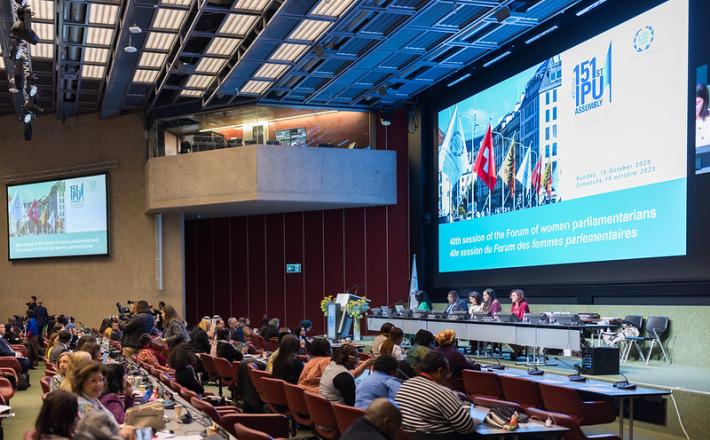
The Forum of Women Parliamentarians and the Forum of Young Parliamentarians advanced these conversations further through focused sessions on transforming social norms to promote and ensure the meaningful participation and representation of women in politics. The outcomes of these sessions were incorporated into the Assembly’s broader work on leadership transformation and the parity debate, featuring men and women MPs advocating for gender equality.
Together, the Vice-President’s remarks and the deliberations across these bodies set the tone for five days of dialogue centred on women’s empowerment, youth inclusion, intersectional equality[1], and the broader goal of building political systems that leave no one behind.
Ms. Morawska-Stanecka also reaffirmed the IPU’s commitment to inclusive representation and participation, recalling General Recommendation #4 on the Equity and Inclusive Representation of Women in Decision-Making and referencing the Plan of Action for Parity in Parliament, adopted earlier this year at the Global Conference of Women Parliamentarians in Mexico. She expressed hope that the IPU Governing Council would soon adopt this plan to ensure that gender equality remains central to political participation worldwide. She also introduced the new IPU campaign, “Achieving Gender Equality: Action by Action,” designed to translate high-level commitments into meaningful, measurable progress for women and girls.
As part of the Assembly’s commitment to inclusive representation, the Forum of Women Parliamentarians focused on empowerment and advocacy initiatives to strengthen the meaningful participation and representation of women in politics. The session provided an opportunity to review progress, identify persistent gaps, and share good practices from across regions. Delegates heard testimonies highlighting ongoing harassment, institutional sexism, and the rise of online gender-based violence targeting women in politics. Speakers noted that such attacks, including trolling, coordinated disinformation campaigns, and threats of physical harm, are increasingly used to silence women leaders and discourage their active participation in public life.
Special emphasis was placed on GBV in the Asia-Pacific region, where many women parliamentarians report facing higher levels of digital hate, culturally driven stigma, and limited institutional protection. Delegates also explored collaborative initiatives with UN Women and the Government of Australia on e-safety training, self-protection protocols, secure communication practices, and digital defense strategies that help women legislators respond to online abuse while maintaining their public roles.
The Assembly underscored that these tools and trainings must be tailored to the real, lived needs of women lawmakers particularly those from marginalized communities or working in polarized political environments who are often the most frequent targets of online attacks. Participants were encouraged to consult the IPU’s report on sexism and violence against women in parliaments in Asia, which documents patterns of abuse and provides concrete recommendations for institutional reform, with similar studies planned for the Americas and the Caribbean to strengthen evidence-based responses globally.
2025 marks significant milestones for the global women’s movement: the 15th World Conference of Speakers of Parliament, the 30th anniversary of the Beijing Platform for Action, 25 years of the UNSC Resolution 1325 on Women, Peace, and Security, and the 40th anniversary of the Forum of Women Parliamentarians. Yet discussions revealed worrying trends: global progress in women’s parliamentary representation is stagnating, and in some cases, rolling back. The Plan of Action for Parity in Parliament seeks to address these trends through concrete measures, monitoring, and regional collaboration, with the next Women Parliamentarians’ Conference scheduled in Serbia.
The Assembly also featured two side-event consultations on social norms under the EU-funded WYDE Women’s Leadership Initiative. These discussions centred on transforming harmful gender norms, including the pervasive belief that “men must dominate and women must serve.” Participants examined the role of technology facilitated gender-based violence and discrimination, stressing that genuine transformation requires not only legal reforms but also shifts in societal narratives and cultural practices.
A second consultation focused on women’s leadership, youth engagement, and intersectional inclusion. Discussants from Turkey and Switzerland highlighted the need to address intersectional discrimination, including barriers faced by women with disabilities, women of colour, and women navigating multiple forms of marginalization. Researchers present emphasized that inclusive parliaments are more stable, more legitimate, and better equipped to address issues that might otherwise be overlooked.
Across the sessions, several key recommendations emerged: adopting and implementing the IPU Plan of Action for Parity, institutionalizing intersectional equality including disability representation, combating online harassment with policy and training, mobilizing resources for women’s political participation, using parliamentary diplomacy to tackle gender injustices, and challenging harmful social norms through education, mentorship, and inclusion.
The 151st IPU Assembly was more than a meeting of policymakers, it was a renewed declaration of commitment. From Vice President Gabriela Morawska-Stanecka’s call to turn obstacles into bridges, to the lived experiences shared by MPs from every region, one message resounded clearly: gender equality is not merely a goal; it is the very foundation of democracy. The Assembly’s deliberations offered both inspiration and direction, charting a path toward a future in which women and youth are not only included in democratic life but shape and strengthen it as essential leaders.
[1] The notion of intersectional equality acknowledges that women can face multiple, overlapping forms of discrimination and seeks to address these intersecting barriers.

Hear from women leading change in the political space share their experiences and insights.

Explore a wide-range of audio-visual resources on key topics of gender equality.

Hear from a diverse list of panelists and guests as they reflect on critical issues pertaining Women in Politics.