Parliaments & Representatives
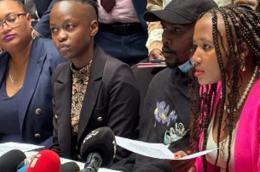
Kenyan women are at the forefront of defending their democracy. Their recent leadership reflects a long history of pivotal contributions, both to women’s rights and the rights of all Kenyans. In a context of democratic backsliding, rising levels of gender-based violence (GBV), and accelerating human rights abuses in the lead-up to elections in 2027, women’s leadership is needed more than ever.
However, research shows that women’s leadership, especially in conflict or crisis, is often met with violent pushback. In Kenya and worldwide, violence targeting women in politics is deterring some women from seeking public office and punishing those who do run. This problem is not new to Kenya, but the dichotomy between the achievements of Kenyan women leaders and the lack of accountability for their attackers, online and offline, is starker than ever.
The United Nations, African Union, and government of Kenya are taking steps to analyze the problem and offer recommendations, but tangible implementation lags. Meanwhile, bilateral partners that used to support women’s participation in politics and fund efforts to prevent election-related GBV have pulled back. Despite the risks and limited tangible support, Kenyan women are pressing forward, but many fear the costs they are asked to bear are unsustainable, not to mention unconscionable.
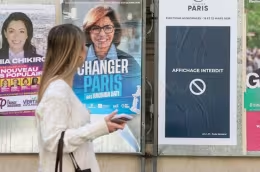
When election time comes around, campaign posters feature candidates with a determined look in their eye, their local promises, well thought-out slogans in full view, and a smile – which particularly among women politicians has become something of a quiet, political prerequisite.
In 2016, during the Democrat National convention Hillary Clinton was commented more on supposedly not smiling or lacking warmth than on her electoral manifesto. Some years later Élisabeth Borne, who was then Prime Minister of France, was described several times as being “cold” and “stiff.” Recounting her twenty months spent at Matignon in a book (2024), she explains how her attitude was more harshly judged than if she had been a man. She appears on the cover of her book with a frank smile. In both cases, it was her appearance and allure that was being held against her rather than her ideas.
Women often get criticised for not smiling. But does this expectation have an impact electorally speaking? In other words, does choosing not to smile cost women more votes than it does men?
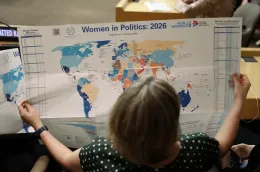
New York - Across the world, women remain vastly under-represented in political leadership, with the most powerful decisions still overwhelmingly made by men. In 2026, only 28 countries are led by a woman Head of State or Government, while 101 countries have never had a woman leader, according to the latest data released by Inter-Parliamentary Union (IPU) and UN Women.
When women are shut out of political leadership, decisions that shape peace, security, and economic priorities are made without half of the world's experience at the table. The new global data reveals stagnation, and in some cases regression, in women's political leadership, particularly in executive government.
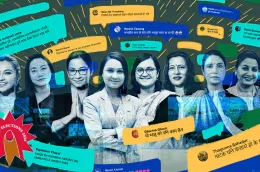
ON 7 FEBRUARY, Nisha Adhikari, a first-past-the-post (FPTP) candidate in Nepal’s 2026 general election from the Gatisheel Loktantrik Party, posted a Twitter thread detailing the kinds of derogatory messages and comments she had been receiving on social media. Alongside a collage of sexist and often sexualised remarks, Adhikari shared her thoughts:
“The hateful and derogatory words used against female candidates do not reflect the status of women; rather, they mirror the deeply rooted misogynistic mindset in our society. Such language is not disagreement. This is not debate. It is violence born out of power and fear, aimed at driving women out of public life, making them afraid, and silencing them. These comments are not just directed at me; they target all women in politics, in leadership, who dare to speak out.”
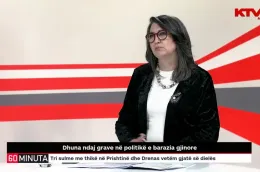
Gusia added that female politicians are an easier target for threats.
"This is because of gender stereotypes and cultural norms where there is a tendency for men with a patriarchal mentality to think that by threatening women in politics, they can influence them to turn back," she added.
She stated that 90 percent of women who are active in the political scene in Kosovo today have at some point been victims of misogynistic attacks and hate speech.
She said that despite having sufficient legal basis, the response to hate speech and threats must be immediate.
"There is a sufficient legal framework and the cases must be brought to justice," she added.
She said that Kosovo's gender equality program is a legal obligation, adding that the Government of Kosovo is obliged by the Law on Gender Equality to have the program. designed.
Gusia said that the employment rate among women leaves much to be desired and still remains low.
He stated that there is still a gender wage gap, adding that the difference stands at 10.9 percent, for the same work.
Women in politics face more hostility and intimidation from the public, both online and offline. 76% of women parliamentarians say they are intimidated by the public compared with 68% of men – a trend that deters women from seeking office and slows progress toward equal political power, according to new data from the Inter-Parliamentary Union and UN Women.
“Across the world, women remain vastly under-represented in political leadership, with the most powerful decisions still overwhelmingly made by men”, the organisations say in a report.
In 2026, only 28 countries are led by a woman Head of State or Government, while 101 countries have never had a woman leader, according to the data. Image
“The new global data reveals stagnation, and in some cases regression, in women’s political leadership, particularly in executive government.
Global and regional commitments over the last thirty years provide solid support for promoting gender equality in politics. In recent years, the growth of women’s representation has stagnated, and the OSCE region is now witnessing escalating narratives against gender equality, which are having a detrimental effect on women’s political participation. Temporary special measures are being abolished, and no new ones are being introduced. Political polarization is steadily increasing, while sexism and violence against women in politics is pervasive, impacting female politicians’ decisions on whether to run for office, advocate certain policy solutions or leave their elected posts.
In this publication, ODIHR presents a seven-step roadmap for OSCE participating States — their parliaments, governments, political parties and other state agencies — to work towards achieving gender parity. It complements the results of the Inter-Parliamentary Union’s 2025 Global Conference of Women Parliamentarians with its visionary approach to parity as parity in numbers, influence and culture. These steps aim to inspire participating States to draft their own, national roadmaps to gender parity, tailored to their specific circumstances and needs.
Extract
The 2024 elections made US history in numerous ways. Vice President Kamala Harris became the first Black and South Asian woman to be nominated by a major party for the presidency. Former president Donald Trump made history by becoming the oldest person and the first convicted felon to become president. 2024 marked the first presidential election following the historic Dobbs v. Jackson Women’s Health Organization decision in 2022.
The 2024 elections made US history in numerous ways. Vice President Kamala Harris became the first Black and South Asian woman to be nominated by a major party for the presidency. Former president Donald Trump made history by becoming the oldest person and the first convicted felon to become president. 2024 marked the first presidential election following the historic Dobbs v. Jackson Women’s Health Organization decision in 2022.
We asked leading experts in the field to reflect on the gender and racial dynamics of the 2024 election cycle and consider which aspects of the election are illuminated by gender scholarship. We asked what theories help explain the dynamics of the campaigns, voting behavior, and the outcome, as well as which election aspects were unanticipated. We asked about the larger lessons and challenges for the study of gender, LGBTQ+ identities, race/ethnicity, elections, and politics. As Politics & Gender celebrates its 20th anniversary, we wanted to know what new questions should be addressed and whether new theories about gender and US elections are needed.
Full article available here.
ABSTRACT
While gender quotas in politics have received considerable scholarly debate, much of the focus remains on whether quota-elected women are less qualified due to their pre-election background. Far less attention has been given to their actual parliamentary performance and how it compares to their non-quota peers. This study uses UK parliamentary records between 2005 and 2017 to compare the parliamentary activity of Labour women selected via All-Women Shortlists (AWS) with those selected via the traditional Open-List. Parliamentary activity is measured through contributions in spoken debate, rebellion rates, submission of written questions, and vote attendance, alongside an examination of AWS women’s commitment to women’s substantive representation. The results show that AWS women were equally active in most parliamentary channels, but they were more active in submitting written questions and speaking about women’s issues during debates compared to their Open-List counterparts. Consequently, the findings refute claims that AWS women are less active or underperform in Parliament, demonstrating that they perform as well as, or better than, their Open-List counterparts across all measures. These results should encourage the broader adoption of quotas in other UK political parties.
Full article published by Taylor & Francis here.

Americans are deeply divided about the use of quotas in hiring and education, but quotas are used in many countries to assure a balance of power between men and women in legislative bodies. New research co-authored at UC Berkeley finds that when governments are gender-balanced, people believe the political process and policy outcomes are more fair and democratic.
In a major study that included 17,000 people in a dozen countries—in Europe, the Pacific and the Americas—researchers found overwhelming support for a balance of representation between men and women, even when quotas are needed to achieve it. The U.S. and the U.K. don't use such quotas for national office, but even so, respondents in the study saw strong benefit, said Berkeley political scientist Amanda Clayton, the lead author.
The most important finding "is that citizens in democracies around the world strongly prefer women's equality to women's exclusion, regardless of how the equality is achieved," Clayton said in an interview.
Full article published by Phys on 22 May 2025.
Image by Phys

Online Gender-Based Violence (OGBV) has become a pervasive threat in the digital age. It undermines democratic processes, silences marginalised voices, and perpetuates systemic inequality. Harassment, threats, and abuse—both online and offline—have become so common that women and gender-minoritised people often view them as “the cost of doing politics.” As a result, 21 percent of women parliamentarians in Europe said that they did not want to pursue another term in office.
This briefing is part of a series examining OGBV on TikTok in English, German, French and Hungarian. It is part of a project titled ‘Monitoring Online Gender Based Violence Around the European Parliament Election 2024’, funded by the German Federal Foreign Office.
This report summarises ISD’s findings across key issue areas and offers evidence-based recommendations for creating safer, more inclusive online spaces that uphold democratic values. ISD’s findings demonstrate that addressing OGBV requires a holistic approach – one that not only strengthens content moderation but also tackles the underlying social norms and biases that enable online gender-based violence.
Article published by the Institute of Strategic Dialogue on 19 May 2025.
Image by Institute of Strategic Dialogue
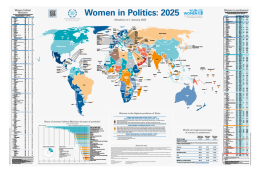
The “Women in politics: 2025” map, created by the Inter-Parliamentary Union (IPU) and UN Women, presents new data for women in executive positions and national parliaments as of 1 January 2025. These data illustrate men’s overrepresentation in decision-making worldwide, thereby slowing down the achievement of equality between women and men in politics.
Women serve as Heads of State and/or Government in only 25 countries and make up 27.2 per cent of Members of Parliament. Globally, fewer than one in four cabinet ministers is a woman (22.9 per cent). The 2025 map shows that, while women lead important human rights, gender equality, and social protection policy portfolios, men dominate policy areas like foreign affairs, financial and fiscal affairs, home affairs, and defence.
Check here the full map by UN Women published on 12 March 2025.