Women's Leadership
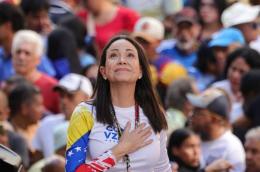
The opposition movement in Venezuela, spearheaded by María Corina Machado, has many allies worldwide.
After last year’s election, the US and the European Parliament formally recognised Edmundo González as Venezuela's President. The UK dismissed Nicolás Maduro’s election win as "fraudulent".
When Machado was briefly arrested during protests ahead of President Maduro’s inauguration, Donald Trump posted a statement saying that she and the "president-elect González" are "peacefully expressing the voices and the WILL of the Venezuelan people with hundreds of thousands of people demonstrating against the regime".
He added that: "These freedom fighters should not be harmed and MUST stay SAFE and ALIVE!"
Both Machado and González were accused of "treason" after the election by the Venezuelan government.
Full article here.
Newswise — Washington, D.C. - October 6, 2025 − As the non-partisan Women & Politics Institute at American University marks its 25th anniversary, a new nationwide survey underscores both the progress women have made in politics and the barriers that remain. The poll, She Leads: Progress and Persistent Barriers for Women in Politics, finds that while voters strongly support electing more women and trust them on key issues, lingering biases and double standards continue to shape the path to the presidency.
The poll of 801 registered voters, conducted September 3–6, 2025, by Breakthrough Campaigns in conjunction with WPI’s Gender on the Ballot project, highlights a paradox in public opinion: progress in attitudes toward women leaders coupled with persistent resistance to a woman in the Oval Office.
“These findings capture both the momentum and the headwinds for women in politics,” said Betsy Fischer Martin, Executive Director of the Women & Politics Institute. “As we mark WPI’s 25th anniversary, the results remind us why our mission matters. Voters clearly value the perspective women bring and want to see more women in office. But when it comes to the presidency, stereotypes and double standards still cast a long shadow. That tension will define the next chapter in women’s political leadership.”
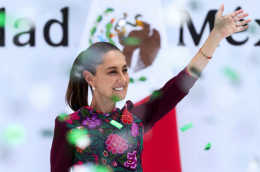
One year on from her inauguration as Mexico’s first female president, Claudia Sheinbaum still commands the sort of popular support many leaders can only wish for.
Roughly 70% of Mexicans approve of her performance, according to an August poll by Buendía & Márquez for the newspaper El Universal.
Although that’s down from 80% in February, it’s still a sharp contrast to US President Donald Trump, whose rating is hovering just over 40% eight months into his second term, according to a CNN poll aggregate.
So, what’s the key to Sheinbaum’s success?
Surveys suggest one of her most popular achievements has been the expansion of social support programs for millions of citizens, including seniors, students, single mothers and women in general. These are in part a continuation of the policies that made her predecessor and mentor, former President Andres Manuel Lopez Obrador, so popular and reflect the slogan that swept him into power: “For the good of all, first the poor.”
Full article here.
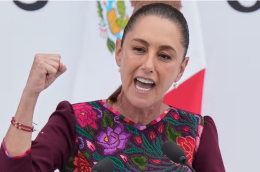
Maria Del Carmen Huber Guevara, 63, travelled in a bus with 60 other people all night just to get the chance to see Mexican President Claudia Sheinbaum in person during a rally Sunday in Mexico City.
Huber Guevara said she left her home in Boca del Rio, in the state of Veracruz, at 11 p.m. local time for the 400-kilometre trip northwest to the national capital where she arrived at 6 a.m.
"[She] is the best because she is the first female president and, the truth is, she is working well for us," said Huber Guevara, sitting on a chair in Constitution Square, which was jammed with tens of thousands of Sheinbaum supporters waiting to hear the president speak from a large white stage to mark her first year in office.
The crowds spilled into the adjacent streets beneath the white flags of Sheinbaum's party, the left-populist National Regeneration Movement, known as Morena, which fluttered among blimp-like white balloons.
Huber Guevara said that Sheinbaum's government had finally given her title to her home where she's lived for over 30 years as part of a neighbourhood that grew on squatted land.
Full article here.
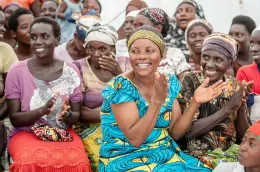
Women in the South East states of Anambra, Enugu and Ebonyi have advocated for equal representation of women in leadership positions in the country.
They spoke to the News Agency of Nigeria (NAN) in separate interviews in Enugu Ebonyi and Awka, as part of Nigeria’s 65th Independence Anniversary.
Speaking, Mrs. Onyinye Mamah, the Executive Director of Heroine Women Foundation, a Non-Governmental Organisation (NGO) based in Enugu, said she had always advocated for the equitable representation of women in leadership.
Mamah stated that women were grossly underrepresented in global political leadership.
She said, “For so many years in Nigeria, we have been hammering on the inclusion of women in politics.
“Here, when few women get involved, it looks like a favour; what we are looking for is a time when women will be properly included in the scheme of things.”
According to Mamah, the reserve seat bill was one of the most beautiful bills one could imagine in recent times.
“This is because it gives room for carved out positions which would be contested for by women only, ” she said.
She, however, said that the inclusion of women in politics was something that would gather a lot of groups, institutions, strength and improvement.
Full article here.
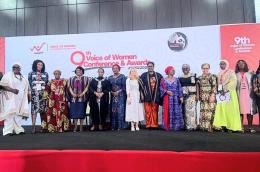
Women leaders, policymakers, and advocates from Nigeria and across Africa at the 2025 Voice of Women Conference & Awards (VOW), have renewed calls for gender equity and inclusive governance.
Speaking at the event held in Abuja, Convener of the Conference and Awards, Toun Okewale-Sonaiya, described VOW2025 as “a platform where women’s voices continue to shape Nigeria’s future”.
She noted that the movement transcends borders and aligns with the African Union’s Agenda 2063 on gender equality and inclusive leadership.
The Convener also stressed the urgency of deepening female political representation through collective action, particularly at the grassroots where women remain the largest and most powerful voting bloc.
“It is time we transform this individual voting strength into a unified force. When women support women across all divides, we become the decisive power that can shape governance,” she said.
Okewale-Sonaiya urged for the swift passage of the Reserved Seats Bill, describing it as vital to Nigeria’s democratic integrity and gender balance.
Full article here.

Gender equality and women’s empowerment are central to the 2030 Agenda for Sustainable Development and the Community Vision 2025 of the Association for Southeast Asian Nations (ASEAN). They are also key to fostering a more sustainable and inclusive region. Providing women with equal access to decision-making power and leadership not only supports their well-being, but also enables their contribution towards regional progress and inclusiveness.
Data, however, shows that substantial progress is needed to empower a new generation of ASEAN women leaders. This factsheet explores, through available official statistics, the various leadership roles that women play in the ASEAN region, and sheds light on areas where improvement is needed.
Click here to access the report.

Latinas are serving in record numbers across levels of elective office, but we are still vastly underrepresented when compared to our numbers in the population.
Data from the 2020 U.S. Census shows that those identifying as Hispanic or Latino accounted for more than half of the country’s population growth in the previous decade, with the greatest increases in Texas, California, and Florida. Latinas are key to that rise. But has representation in elective office kept pace with that population growth? This report helps to answer that question. It provides a review of the current status of Latinas in elective office in the U.S. within a historical context and with attention to what is possible in the 2022 election
Click here to access the report.

This article presents the results of a randomized survey experiment demonstrating that the public evaluates women politicians more highly than men across multiple characteristic assessments. This finding is consistent with a recent wave of research indicating greater preference for women politicians. Which respondents rate women politicians more highly, and why? The survey found that women and younger voters do not account for the greater marks given to women politicians. Instead, respondent partisanship and the presumed partisanship of the politician account for a great deal of the findings, with gender playing a complicating role. Democratic and Republican respondents are apt to project their own partisanship onto politicians, and across both parties, the survey found higher assessments for co-partisan politicians and for women politicians. On the whole, women politicians are evaluated on par with of significantly higher than men politicians across six characteristics, scoring especially well relative to men when politicians are presumed to be members of the opposing party and when traditionally feminine characteristics are assessed.
Click here to access the article.

UNDP’s Gender Equality Strategy 2022-2025, aligned with its Strategic Plan, guides UNDP in its efforts to assist countries in accelerating progress on gender equality and the empowerment of women over the next four years. It aims to move beyond piecemeal efforts and to instead help countries to shift power structures and the economic, social, and political systems that perpetuate discrimination.
Click here to access the document.
After national news coverage of a COVID-19 mask requirement controversy in Dodge City, Kansas in December of 2020, Mayor Joyce Warshaw received numerous threats such as “Burn in hell”; “Get murdered”; and “We’re coming for you.” Fifteen days later, Mayor Warshaw resigned saying that she and her family no longer felt safe.
Four important questions arise from the circumstances in which Mayor Warshaw and other mayors find themselves.
- How prevalent is violence against mayors from the public?
- Are there gender and race-based differences in violent experiences of mayors?
- Is the violence experienced by mayors causing them to rethink their service?
- What are the wider implications to representation of exposing public servants to abuse and violence? Will fewer people, especially women and women of color run, for and stay in office?
This research seeks answers to these questions.
Click here to access the report.
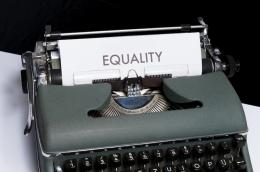
This article is the second in a two-part series examining the impact of gender quotas. The first article discussed the structure of gender quotas and their general impacts.
Gender quotas play a varied and complex role in political life; every country maintains its own reason for their implementation and experiences unique outcomes from their existence. This article aims not to present a definitive case for or against gender quotas. Rather, it explores two very different manifestations of gender quotas and how they concretely impact the political atmosphere of India and Sweden. These two countries help demonstrate how quotas may bring gender equality in name, but not in practice. Both countries suffer from a similar “moral hazard” problem where quotas may encourage complacency in addressing women’s issues, leaving deeper problems unresolved.
Click here to read the full article published by Harvard International Review on 15 August 2022.