Women's Leadership
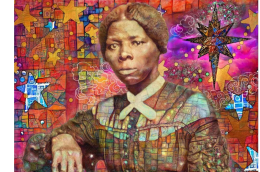
Milestones for notable women this week include birthdays for: Lois Wessel, Amy Poehler, Alexis Bledel, Caroline James, Soledad O’Brien, Nancy Bocskor and Lauren Leader. It’s also the anniversary of the week that Harriet Tubman set herself free in 1849, that Carla Hayden was named the first female librarian of Congress, and Margaret Chase Smith was the first woman elected to the U.S. Senate in her own right.
The 30th anniversary of the Beijing Platform for Action is a moment to reaffirm global commitments to gender equality
2025 is a pivotal year for women and girls. It marks three major milestones: the thirtieth anniversary of the Beijing Declaration and Platform for Action, the twenty-fifth anniversary of United Nations Security Council resolution 1325 on women, peace and security, and the eightieth anniversary of the United Nations. Notable progress on laws, policies and some development outcomes for women and girls has occurred, especially since the adoption of the Sustainable Development Goals (SDGs) in 2015. In the final five-year stretch before the 2030 deadline of the Goals, it is urgent to accelerate action and investment.
The Beijing Declaration and Platform for Action, adopted in 1995 by 189 countries, laid out transformative measures across 12 critical areas of concern, serving as a foundation for progress on gender equality and the SDGs. Drawing on evidence from the thirtieth-anniversary review – including 159 Member State reports and broad consultations – UN Women has developed the Beijing+30 Action Agenda. This bold, forward-looking framework sets out six priority actions to accelerate progress on both the Platform and the SDGs. It positions gender equality at the heart of global development efforts. This section highlights this Agenda noting the investments needed and the benefits not only for women and girls, but at large for societies and economies. The rest of the report assesses gender equality under each of the 17 SDGs, spotlighting actions and investments to accelerate change.
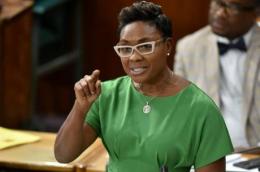
Despite a slight increase in female representation in Parliament, gender advocates warn that Jamaica still falls short in addressing women’s issues at the national level. Judith Wedderburn highlighted ongoing challenges, including securing party backing and meaningful influence in Cabinet-level decisions. Newly re-elected MPs like Juliet Cuthbert-Flynn stressed that women in Parliament must focus on advancing policies affecting women, from domestic violence to support for mothers in difficult circumstances.
Gender advocate spurns tokenism in women’s political participation
Jamaica Gleaner/14 Sep 2025/Karen Madden Sunday/ Gleaner Writer
DESPITE A marginal increase in the number of women that will sit in Lower House when it resumes, at least one gender advocate believes the country is still falling short in its representation of women in the seat of power.
Gender and development practitioner Judith Wedderburn has, however, acknowledged the efforts the leadership of the ruling Jamaica Labour Party (JLP) and the opposition People’s National Party (PNP) have made to bring more women into representational politics.
Of the 189 candidates nominated for the 2025 election, 136 were men and 53 were women. In the new Parliament, 19 women will take their seats – just one more than in 2020 and seven more than in 2016.
Full article here.
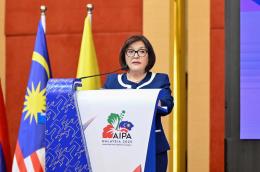
BAKU, Azerbaijan, September 17. Azerbaijani Parliament Speaker Sahiba Gafarova, who is visiting the city of Kuala Lumpur in Malaysia for the 46th General Assembly of the Inter-Parliamentary Assembly (AIPA) of the Association of SoutheastAsian Nations, has delivered a speech at the 2nd Forum of AIPA Women Political Leaders today, a source in the parliament told Trend.
Speaking at the opening of the event, AIPA Secretary General Siti Rozaimeriyanty Dato Haji Abdul Rahman voiced his ideas about the significance of the congregation.
Also, he greeted Gafarova and witnessed appreciation of her participation in the forum.
Full article here.
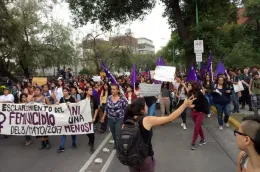
Political scientist Ivabelle Arroyo and director of the Center for Gender Research (UNAM) Amneris Chaparro agree that the key issues in political and social debates, both within and outside feminism, focus more on women’s bodies (motherhood, sexuality, gender identity, micro-violence, femicide, sexual harassment, and abuse) than on addressing the structural causes of gender inequality, which require consistent policies in both the medium and long term.
Conservatism around sexuality and gender roles is surprisingly on the rise within liberal democracies. While this is happening, feminists are divided on issues such as trans women.
Amneris Chaparro: I believe that being a woman is not just about the body, a type of experience, or certain biological signs. The differences within feminism respond to a question with no single answer: what is a woman? Now, there is a historical need to recognize invisible and marginalized subjects, placed in the position of otherness, of being different and seen as inferior, such as trans women, who are linked to the feminine. The tension always has to do with women because, curiously, no one has any problem with trans men; they are not part of the public discourse. What do we do with trans women who come to feminism deeply wounded, victims of violence marked on their bodies seen as feminized? They are not women in the biological sense but because of the cultural construction of gender, of what is socially considered acceptable because of having a body of a certain sex. Feminist positions that exclude them, bordering with transphobia, make biology the only determining factor in being a woman. We need open-mindedness, humility, listening, and the creation of spaces for dialogue and true liberation. Sometimes it is valid to change one’s mind and remember that being a feminist who excludes trans women in some way can be a violation of human rights.
Full article here.
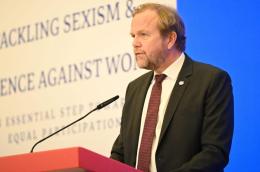
Opening the annual conference of the Gender Equality Commission, the Deputy Secretary of the Council of Europe Bjørn Berge emphasised that “only 27 countries around the world have a woman serving as Head of State or Government and 103 countries have never had a woman in their top executive office. And even where women occupy ministerial roles, they are largely outside of the powerful portfolios such as defence, foreign affairs or finance. There has been, not only a failure to advance, but a regression in gender equality.”
Despite progress in gender equality, women in politics continue to face disproportionate levels of harassment, exclusion, and violence. While gender quotas and anti-discrimination laws have helped increase women’s representation in public life, problems persist. Sexism and violence – both online and offline – continue to deter women from entering or remaining in politics. These threats not only violate human rights but also undermine the foundations of democratic governance.
“Advances in technology and artificial intelligence mean exponential increases in the amount of intimidation, humiliation and disinformation women are subject to. No longer a whisper in a corridor, but an artificially manipulated video or photograph, gone viral in seconds. We cannot say that we have true democracy if half the population does not experience equal access to the public life, experience violence or is effectively silenced,” Deputy Secretary Berge said.
Full article here.
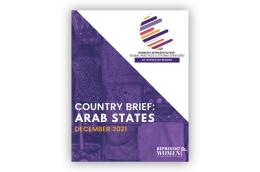
RepresentWomen's Arab State Brief reviews the extent to which women are represented in Arab countries, the history of Arab independence and revolutions - and their impact on women's rights and representation; and country-specific information that covers the history of systems reforms and their impact on women's political rights and representation in the region.
Click here to read the full report.
This article is the first in a two-part series examining the impact of gender quotas. The second article discusses the impact of quotas in Sweden and India.
Gender quotas exist in a shockingly high number of countries. More than 130 nations have modified their constitutions, electoral laws, or party rules to specify a threshold of women to be selected or nominated to a political body.
Quotas have had a massive impact globally on the number of women in politics, explaining the variation in women’s political representation by country. Between 1995 and 2012, many countries implemented quotas globally, and one study found a correlation between quotas and women’s political representation. Women’s political representation jumped from 11 percent to 21 percent during that time. Quotas are also associated with women being elected to government positions even more so than democratic ideals, economic development, or religious norms.
Click here to read the full article published by Harvard International Review on 29 November 2021.
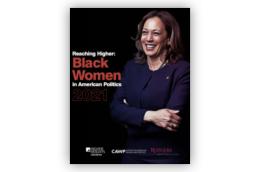
Black women are a powerful force in the American political system, and their political power continues to grow and garner recognition for the force it is.
As we look ahead to the midterm elections, which offer greater opportunities for Black women’s gains in statewide offices where they remain especially underrepresented, it’s important to take stock of Black women’s political successes, the persistent hurdles they faced in the 2020 cycle, the outlook for the 2022 election, and the current levels of Black women’s representation nationwide. In this update, we outline the status of Black women in American politics as of fall 2021, one year ahead of the 2022 election.
Click here to download the full report.

In July 2021, UN Women convened the global conference “Gender-inclusive peace processes: Strengthening women’s meaningful participation through constituency building”, in partnership with CMI – Martti Ahtisaari Peace Foundation, and with financial support from the German Federal Ministry for Economic Cooperation and Development (BMZ), in cooperation with Deutsche Gesellschaft für Internationale Zusammenarbeit (GIZ) GmbH and the Finnish Ministry for Foreign Affairs. The conference attracted the participation of more than 320 peace practitioners from 70 countries worldwide, with a focus on the MENA region.
This report on the conference proceedings explores current challenges, best practices, and recommendations on how best to leverage the practice of constituency building to further gender-inclusive peace.
Click here to read the full report.
In December 2020, the European Commission released its third Gender Action Plan (GAP III), which lays out how the European Union should promote gender equality in its external relations over the following five years. Just like its predecessor, the new plan highlights women’s equal political voice and participation as one of the EU’s central gender-equality priorities.
The EU’s renewed commitment to women’s equal political participation comes at a critical time. Globally, the COVID-19 pandemic and the resulting economic fallout have deepened existing gender inequities. At the same time, women in most societies—including in the EU—remain woefully underrepresented in political decisionmaking, particularly at the highest levels. Their continued marginalization violates women’s rights to equal political citizenship and representation. It also weakens the legitimacy and effectiveness of democratic institutions: women bring distinct policy priorities to the table and raise the likelihood that political decisions respond to the needs of all citizens, including women and girls.
Click here to read the full article published by Carnegie Europe on 6 December 2021.
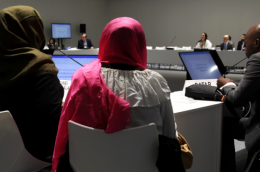
New reports published ahead of the UN Climate Change Conference COP26 in Glasgow in November show that decision-making and technical panels under UN Climate Change (known as “constituted bodies”) are increasingly integrating a gender perspective into their work, but that male overrepresentation on constituted bodies and on government delegations still remains an issue of concern.
Equal and meaningful participation and leadership of women is vital to achieve climate goals. While women and girls around the world are demanding more climate action at the national and international level and have received increasing recognition for their leadership, in the international climate decision-making process, women’s voices are not yet equally represented.
Click here to read the full article published by UN Climate Change on 12 October 2021.