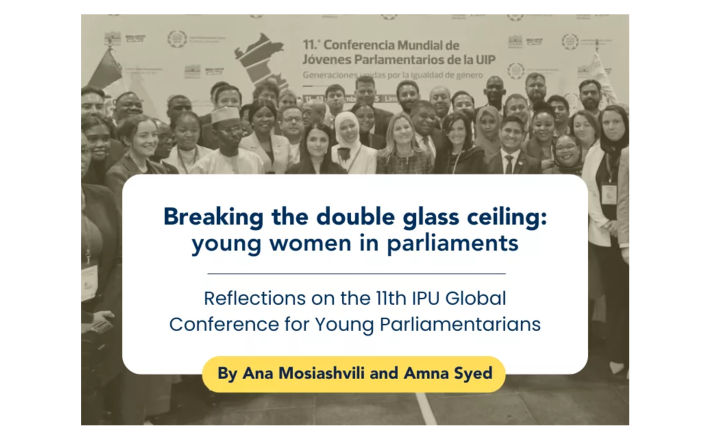
Breaking the Double Glass Ceiling: Young Women in Parliaments
Reflections on the 11th IPU Global Conference for Young Parliamentarians
“Gender equality is most of all an issue of justice and democracy,” stated Nour Abu Ghosh, Member of Parliament in Jordan and the President of the IPU Bureau of Young Parliamentarians. Listening to her speech at the 11th Inter-Parliamentary Union Global Conference for Young Parliamentarians in Lima, we could not agree more: Social justice, equality, equity and sustainable development cannot be achieved without gender equality.
With this spirit under the theme of gender equality, the conference took place from 11-13 September in Peru’s capital. Over 200 participants, including 120 parliamentarians from 44 countries, gathered to reaffirm their commitment to gender equality, equity and parity, through inclusive and intergenerational collaboration. In addition to country delegations, attendees included representatives of the Government of Peru, including its former first female president, international organisations, civil society and experts, as well as Generation Equality Forum leaders, and women and youth leaders.
The outcome document celebrated that the average age of young parliamentarians at the conference was 34, and half of the participants were women, reaching parity for the first time ever. However, globally, the proportion of women in parliaments as a whole has regressed. According to IPU data, while women's representation among young parliamentarians under 30 is higher than in other age groups, only 27% of parliamentarians globally are women, and this proportion grew by only 0.3 percentage points last year. For young women, the situation is disturbingly worse: only 1.2% of the world’s parliamentarians are women aged 30 and under, a decrease of 0.2 points since 2023. This trend highlights that women’s representation remains limited, and progress is often slow and increasingly compromised by the rise of anti-rights and anti-gender movements worldwide.
Beyond limited representation, young women parliamentarians are disproportionately targeted, both online and offline. They face heightened levels of sexism, harassment, and violence. This includes coordinated online abuse, threats to their personal safety, and efforts to delegitimise their political credibility based on gender and age. These attacks are part of a broader pattern of gender-based political violence that undermines democratic processes and reinforces structural inequalities within political institutions.
This is also confirmed by the Global Youth Participation Index (GYPI), according to which those countries with societal and systemic barriers, persistent gender inequality, and authoritarian governance tend to perform worse in overall rankings. The GYPI includes variables such as access to state jobs by gender; the Not in Education, Employment or Training (NEET) rates of female populations; the absence of early marriage and other indicators related to intersectionality.
Cyber threats, misinformation, deepfakes, and the misuse of artificial intelligence (AI) were raised by several delegations as pressing challenges, especially in today’s context. AI is increasingly being used to manipulate public perception, with young women politicians often targeted the most. Delegations emphasised the urgent need for comprehensive responses, including regulatory frameworks, digital literacy efforts, and effective preventive mechanisms to address these evolving threats. #ShePersisted was presented as a crucial initiative that works to address gendered information attacks against women in politics and build digital resilience. Among other research projects, the “Monetizing Misogyny” series explores how digital harms are weaponised to undermine women’s political participation and to weaken democratic institutions and human rights. It also looks at the responsibilities of digital platforms and outlines the solutions needed to address this problem.
“Simply electing more women is not enough; we must also ensure parity in political leadership and influence, and apply equity criteria for access to the most influential committees, so that women and young people can overcome the structural barriers that have historically limited them.” IPU Outcome Document
Echoed in the conference report, questions of quota, parity and the distribution of power were actively discussed among delegations and the experts. Marianne Mikko, the Vice-Chairperson of the United Nations Committee on the Elimination of Discrimination against Women (UN CEDAW Committee), emphasised the need to move beyond quotas and advocate for parity. While some delegations praised quotas as an important mechanism for ensuring women's political participation and pointed to the positive results achieved through their implementation, the need to continue advocating for full gender parity was also emphasised. In this context, reference was made to CEDAW General Recommendation No. 40 on the equal and inclusive representation of women in decision-making systems, which calls for achieving parity, for example, through measures such as so-called “zebra lists”, which means alternating women and men on electoral lists. The outcome document also conveys the support expressed by delegations to the plan of action on gender parity in parliaments adopted at the Global Conference of Women Parliamentarians, as well as mobilisation of MPs, especially male MPs, through the “Achieving Gender Equality Action by Action” campaign.
The attending delegations shared the progress achieved in their respective countries and reaffirmed their commitments to advancing gender equality. However, questions remain as to whether these commitments will translate into concrete actions or whether they will remain aspirational statements made in the context of the conference.
As the Secretary General of the Inter-Parliamentary Union, Martin Chungong, mentioned in his opening remarks, we need an “all hands on deck approach.”So in order to overcome barriers, we need a multi-stakeholder, comprehensive and actionable approach. He emphasised the role of men in achieving gender equality, the importance of intergenerational dialogue and partnerships among various institutions and movements. This was further discussed at the WYDE (Women and Youth in Democratic Engagement) session on “Intergenerational Alliances for Gender Equality”, which included a moderated discussion with both senior and young MPs on how they can better collaborate to ensure intergenerational continuity and mobilisation to advance gender equality objectives.
Violence Against Women in Politics and specifically Technology-Facilitated Gender based violence, are key barriers to the advancement of gender equality. Here, the role of digital platforms that promote narratives of transformative change and inclusive democracies is critical. With a focus on fostering intergenerational dialogue, iKNOW Politicshas worked on the inclusion of women in politics and providing a one-stop shop for the critical knowledge needs of stakeholders working in the space of political inclusion and political empowerment for women since 2008. With the aim of spotlighting lived experiences, identifying joint solutions and creating a narrative of change, iKNOW politics works with networks of young women in politics to bring attention to the most pressing issues experienced by women in politics today.
In a recent webinar on “Women’s Political Participation in the Digital Age”, experts agreed that both electoral commissions and political parties need to develop actionable policies and legal frameworks to support and protect female candidates. Furthermore, Election Management Bodies (EMBs) should raise awareness among their staff about the challenges faced by women in digital political spaces, collaborate with civil society organisations to better understand and address these challenges, and advocate for and participate in policy reforms to protect women online.
Online abuse against women should be publicly condemned by political parties, and disciplinary action should be taken against perpetrators. Moreover, women’s rights organisations have a crucial role to play in advocating for stronger support for women in politics from political parties and electoral bodies. They should also push for digital literacy programs that incorporate a gender perspective. Digital platforms must implement and enforce gender-sensitive community guidelines to protect women in political spaces. Initiatives such as iKNOW Politics and the Global Youth Participation Index (GYPI) support developing evidence-based actions to tackle existing barriers for participation in politics, and beyond, particularly for young women.
Authors:
Ana Mosiashvili
Ana Mosiashvili is a Research and Programme Manager at the European Partnership for Democracy (EPD). Ana coordinates the research pillar of the WYDE Civic Engagement project and leads the Global Youth Participation Index.
Amna Syed
Amna Syed is the Project Coordinator for iKNOW Politics under the WYDE Women’s Leadership Initiative at International IDEA. Her work focuses on promoting inclusive political spaces and leveraging digital technology to advance gender-inclusive political participation and action.

Hear from women leading change in the political space share their experiences and insights.

Explore a wide-range of audio-visual resources on key topics of gender equality.

Hear from a diverse list of panelists and guests as they reflect on critical issues pertaining Women in Politics.