Parliaments & Representatives

A groundbreaking handbook titled Beyond Numbers: Stories of Gender Equality in and through Parliaments was released on 10 October 2024, focusing on the vital role of gender representation in legislative bodies worldwide. Developed by INTER PARES within the EU’s Women and Youth in Democracy (WYDE) initiative, this publication delves into the transformative impact women have had in parliamentary processes globally. It features real-life accounts of how parliaments have embraced gender-sensitive reforms and empowered female legislators to drive change.

The handbook highlights the progress made in gender representation, noting a significant rise in the presence of women in parliaments—from 12 percent in 1995 to nearly 27 percent today. Despite this progress, only a small number of parliaments have reached or surpassed the 30 percent target set by the United Nations Economic and Social Council (ECOSOC). These statistics underline that, while strides have been made, the journey toward equal representation is far from complete, with diverse regions exhibiting different levels of progress.

Read here the full handbook published by Inter Pares on 10 October 2024.


Women in politics receive twice as many sexist comments on social media as their male colleagues, writes Het Laatste Nieuws on Tuesday. This also applies to local councillors and politicians with an immigrant background.

Research by the Institute for Gender Equality, ULB and UGent, which analysed 44,000 reactions to politicians' posts on Facebook, Instagram and X, shows that every four out of 10 comments are negative.

Women receive many more negative comments, especially sexist ones. For female politicians, four per cent of all comments are sexist, compared to two per cent for men.

Women with a migration background receive twice as many negative comments as women without a migration background. Groen co-president Nadia Naji told Het Laatste Nieuws: "My colleague Jeremie Vaneeckhout gets comments about what he says. With me it's about my hair".

Read here the full article published by the Belga News Agency on 8 October 2024.

Image by the Belga News Agency


A record number of women are expected to run in the next general election but insults and misogyny make the job of parties more difficult to encourage women to enter politics.

South Dublin county councillor Teresa Costello was sitting at home on a Saturday afternoon last month when she received a phone call from an unknown number. The 47-year-old had just returned from a clinic, where she listens to and attempts to assist locals from her electoral ward of Tallaght Central.

“I answered the phone and it was a man. He asked me: ‘Are you Teresa Costello?’ and said: ‘You look like a porn star, how could you be capable of doing anything for your community?’” the Fianna Fáil representative recalls. “He said: ‘With your dyed blonde hair, your fake face and teeth.’

“He was saying, how could anybody take you seriously with how you look, and told me to let my hair grow out and not have any blonde any more.”

Costello has been a councillor since 2019 and in recent months was announced as a general election candidate for Fianna Fáil in Dublin South West, alongside the party’s sitting TD John Lahart. While she loves her role as a local representative and describes herself as a “strong-willed person”, she asks rhetorically: “Would a man get that call?”

Read here the full article published by The Irish Times on 5 October 2024.

Image by The Irish Times


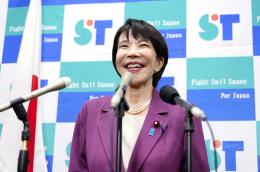
New Prime Minister Shigeru Ishiba on Tuesday named two women ministers to his Cabinet, down from five in the outgoing administration.

Women are poorly represented in politics and business in Japan, and the world's fourth-largest economy has never had a woman prime minister.

Japan ranked 118 among 146 nations in the 2024 World Economic Forum's gender equity rankings, up from 125th but still the lowest among Group of Seven nations.

The two women in Ishiba's 20-strong Cabinet have been given relatively minor positions, with Junko Mihara responsible for policies on children and Toshiko Abe in charge of education.

The government and businesses have regularly missed a range of self-imposed targets and plans to increase the number of women in leadership positions.

Read here the full article published by The Japan Times on 2 October 2024.

Image by The Japan Times


According to Gulmira Ileuova, a sociologist and the head of the Strategy Centre for Social and Political Research, gender equality in Kazakhstan has severely deteriorated. In an interview with TCA, she explains how social regression and a depletion of human resources are making it difficult for women to participate in political parties, social movements, and public services.

TCA: Sources illustrate that after the 2023 parliamentary elections, the representation of women deputies in the Majilis fell from 27% to 18%. In addition, Kazakhstan’s performance in the Global Gender Gap Index (GGGI) has deteriorated. This year, the country fell from 62nd to 76th place. This index, which can be used to judge the economy’s stability and legal security, has a serious impact on investors.  What, in your opinion, is the reason for this deterioration?

First of all, I would like to point out that until 2021, the Labor Code had restrictions on where women could work based on concerns about their health. Now that the restrictions have been lifted, progress is steadily being made in involving women in areas previously inaccessible to them. Some companies have already published data that women have begun operating heavy machinery, such as big trucks, which was not the case before.

As for politics and the civil service, it appears that under the spread of influence from the south, the country is reinstating traditional social relations. Independent Kazakhstan has entered a new period where traditional and non-traditional forms of Islam thrive, and hyper-masculine and patriarchal attitudes are on the rise. I emphasize the patriarchal division of life through reinforced gender roles because it is gaining strength and spreading across all regions of the country. Furthermore, this trend is moving into the sphere of politics and civil services.

Read here the full interview published by The Times of Central Asia on 16 September 2024.

Image credits: The Times of Central Asia


Online threats of death, rape, and physical violence against women in politics and public life have become alarmingly common, and the rise of artificial intelligence may further intensify the scale and reach of such online abuse, UN Women says in an explainer for the the International Day of Democracy on 15 September, and in the run-up to the 30th anniversary of the Beijing Declaration and Platform for Action for the achievement of gender equality.

“Having more women in policymaking has shown to help advance legislation on crucial issues, such as health, education, childcare, infrastructure and ending violence against women and serve as an inspiration for girls to pursue higher education and career opportunities.”

“In 2024 that is one of the biggest electoral years in recent history, 107 countries have never had a woman Head of State. In 2024, women held only 27% of seats in national parliaments and 35.5 of seats in local governments.”

The countries going to elections include some of the highest and lowest in terms of women’s participation in the parliament: Mexico and Rwanda are the only two countries with 50/50 representation of women and men.

Read here the full article published by Moonshot on 12 September 2024.

Image by Moonshot


A unique visual tool to capture women’s participation in executive government and in parliament on a given date – 1st January 2017. The map of Women in Politics not only provides a country ranking for both ministerial and parliamentary representation, but also statistics on women in political leadership positions – Heads of State or government, women Speakers of Parliament, as well as ministerial portfolios held by women throughout the world. Borders are depicted and used on the map in order to present data. They are not the expression of any opinion concerning the legal status of any country, territory, city or area, or concerning the delimitation of frontiers or boundaries.

Click here to download the map in English. 

The annual brochure provides an overview and analysis of progress made and setbacks encountered by women in parliament further to elections and renewals held over a year. Produced every year on the occasion of International Women's Day (8 March), it presents data on women in national parliaments, regional and world trends, information on women presiding officers and women candidates. It also analyses mechanisms aimed at supporting women's access to parliament. The brochure is short and easy to read, providing a snapshot on the situation of women in parliaments worldwide.

Click here to access the brochure. 

Gender quotas have emerged globally as a key solution for improving women's political representation. Yet in Britain—where they take the form of all-women shortlists (AWS)—they remain contentious, both within and outside political parties.

In this article, Mary K. Nugent and Mona Lena Krook identify and evaluate nine common criticisms of AWS in the British context, which—similar to predictions made in other cases—focus on dynamics of candidate recruitment and selection, party and voter support and the effectiveness of ‘quota women’ as politicians. The authors do not address purely principled objections (i.e., ‘quotas are unfair’), but rather focus on claims—including some principled arguments—referencing assumed realities that can be assessed using empirical data (i.e., ‘quotas are unfair because they undermine merit’). The nine claims emerged as common themes across extensive interviews and comprehensive searches of news coverage around AWS. The data used to evaluate these claims come from various sources, including qualitative interviews conducted in 2012 and 2013 with men and women from the three main parties; as yet unpublished data on candidate selection collected by the Labour Party; original quantitative datasets constructed from publicly-available sources; and existing quantitative studies by other scholars. The authors also include evidence from international studies, whenever possible, to situate these findings in relation to the conclusions reached in other contexts.

The authors find, in short, that criticisms against these measures do not hold when subjected to rigorous empirical analysis. AWS, much like gender quotas elsewhere, do not facilitate the entry of unqualified women, jeopardise a party's electoral fortunes or lead to the election of sub-par MPs. Rather, they reduce barriers for well-prepared women to stand as candidates, have neutral or positive effects on party vote shares and produce diligent and active MPs. 

Click here to access the article. 

This Issues Brief aims to clearly delineate the issues at stake by analysing the results of a first study specifically devoted to the subject of sexism, harassment and violence against women in parliament. It seeks to clarify what this phenomenon consists of, where, why and in what forms it occurs, who are the perpetrators and what is its prevalence.

Click here to access the brief.

Gender equality is fundamental to responsive and accountable democratic societies. Women’s representation in elected institutions in equal proportion to men is key to the credibility and legitimacy of parliaments, national assemblies and local governments. Yet, globally, just over a fifth of members of parliament are women.

To combat discriminatory legislation and policies and improve gender equality outcomes in policymaking, elected representatives in countries in the region have established structures and strategic plans to improve women’s political participation and gender equality. UNDP has facilitated the creation of such structures in many countries, recognizing the important role they play in empowering women as parliamentary representatives, supporting the emergence of gender-sensitive parliaments, and adopting gender-sensitive policy and legislative frameworks. The UNDP Gender Equality Strategy 2014-2017 highlights the critical importance of gender equality and women’s participation in decision-making to sustainable development, and calls for the empowerment of women as voters, political actors and decision-makers.

This paper examines UNDP’s parliamentary assistance programming and support to existing gender equality initiatives in political participation, in particular, the role and impact of parliamentary structures for gender equality in the ECIS region. It illuminates existing and planned UNDP parliamentary assistance initiatives, highlights good practice and identifies entry points for replication or scaling up. Its findings are intended to assist members of parliament and parliamentary institutions as well as civil society organizations and international organizations in advancing gender equality in parliamentary practices. Click here for more information.   

Extensive research shows that when women run for office, they perform just as well as men. Yet women remain severely under-represented in our political institutions. In this report, we argue that the fundamental reason for women’s under-representation is that they do not run for office. There is a substantial gender gap in political ambition; men tend to have it, and women don’t.

The results put forward in this report are based on the Citizen Political Ambition Panel Study, a research project the authors Richard L. Fox and Jennifer L. Lawless have been conducting over the course of the last seven years. In 2001, they surveyed more than 3,700 lawyers, business leaders and executives, educators, and political activists about whether they ever considered running for office. They re-surveyed more than 2,000 of these individuals in 2008. Because they surveyed well-matched pools of men and women who work in professions that most typically precede a political candidacy, they could provide the first comprehensive investigation of the process by which women and men decide to enter the electoral arena. They could also determine the extent to which political ambition has changed over time.

The authors offer clear and compelling evidence that women, even in the highest tiers of professional accomplishment, are substantially less likely than men to demonstrate ambition to seek elected office. These results hold regardless of age, partisan affiliation, income and profession.

The authors link the persistent gender gap in political ambition to several factors. Women are less likely than men to be willing to endure the rigors of a political campaign. They are less likely than men to be recruited to run for office. They are less likely than men to have the freedom to reconcile work and family obligations with a political career. They are less likely than men to think they are “qualified” to run for office. And they are less likely than men to perceive a fair political environment.

In the end, this report documents how far from gender parity we remain, as well as the barriers and obstacles we must still overcome in order to achieve it. But the results also offer guidance to organizations and individuals seeking to increase the number of women in elected positions. Recruiting women candidates, disseminating information about the electoral environment and working with women to quell their anxiety about campaigning can help narrow the gender gap in political ambition and increase women’s numeric representation.

Access the report here