Parliaments & Representatives
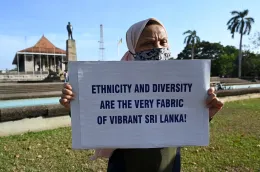
Women from minority ethnic and religious groups in Sri Lanka continue to be systematically discriminated against and marginalized in mainstream politics, new research shows.
Quotas for women’s representation have not enabled enough minority women to enter politics; just 3 minority women sit in Parliament among 22 women – less than 2 per cent of all MPs, despite majority women’s representation having improved. Only 11 minority women have ever been elected.
‘Minority women in politics are not just underrepresented — they are systematically excluded. Though determined to represent their communities, they are shut out by cultural, religious, language and patriarchal barriers from their own communities and all political parties’, said lead author Dr Farah Mihlar of the Centre for Development and Emergency Practice, Oxford Brookes University.
The report finds that the quotas have not circumvented the specific obstacles faced by minority women, such as tokenistic nominations, exclusion from leadership and limited access to financial resources and networks. A crucial finding is that minority women unanimously identified their own community as presenting the greatest obstruction to their political careers.
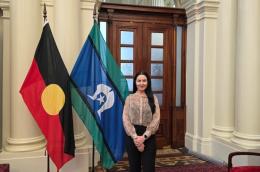
Tekan Cochrane is an Australian Indigenous lawyer with Kooma, Yuwaalaraay and Torres Strait Islander heritage, as well as diverse European heritage. Raised on a farm in central Queensland, away from major population centres, and the first in her family to attend university, Tekan’s work is grounded in lived experience, community accountability, and a deep commitment to justice and systemic reform.
In 2025, Tekan was a finalist for the Australian Human Rights Commission’s Law Award, selected from more than 100 national nominations and recognised for her work supporting First Nations peoples and individuals in disadvantaged and marginalised communities.
Tekan is the Executive Officer of Tarwirri Indigenous Law Association of Victoria, a not-for-profit membership organisation representing Aboriginal and Torres Strait Islander legal professionals, graduates and students. Tarwirri is funded through the Victorian Aboriginal Justice Agreement due to the strong need for more Indigenous lawyers in Australia.

What happens to citizens’ perceptions of political decisions when legislatures achieve gender balance through quotas, policies that require parties to include women as candidates? Critics have long argued that mandating women’s presence casts doubt on elected officials’ qualifications and erodes the legitimacy of the decisions they make. Examining public attitudes across 12 democracies, Amanda Clayton, Diana O’Brien, and Jennifer Piscopo find the opposite. Citizens strongly prefer gender-balanced decision-making bodies, and this preference holds even when balance is achieved through quotas. The real threat to democratic legitimacy, they argue, is not affirmative action but the continued exclusion of women from political power.
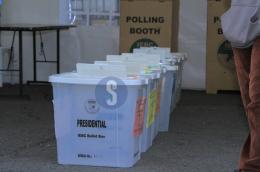
Politics has long been viewed as a male-dominated arena, with only a handful of women daring to venture into it.
Even then, women politicians often face dismissal, branded as mere “flower girls” for party leaders.
In Kenya, where politics has historically been associated with aggression and at times violence; the challenge is even greater.
For women with disabilities, the barriers are multiplied.
A fight beyond the ballot
In Mombasa, Hamisa Zaja has twice vied for the Woman Representative seat in 2017 and 2022 without success. Yet she insists she is not giving up.
Hamisa, who has a physical disability and is the founder of Coast Association of Persons with Disability, says the political space is far from welcoming for women like her.

When the public turns hostile: Political violence against parliamentarians reveals that members of parliament (MPs) are facing a worrying rise in intimidation and harassment from the public. The report draws on a broad survey of 519 MPs globally and case studies focused on five countries: Argentina, Benin, Italy, Malaysia and the Netherlands, to reflect diverse political and regional contexts.
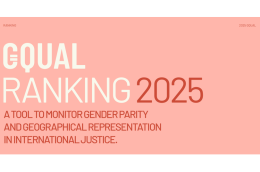
The GQUAL Ranking, released annually, is one of our most powerful advocacy tools. It tracks data from 145 countries whose nationals serve in international bodies and mechanisms tied to the development of international law and justice and disaggregates this information by gender and geographical representation.
The three rankings we produce offer valuable insights into trends in the nomination practices of States and United Nations Regional Groups, as well as into representation records. Together, the Rankings provide a global and regional overview of women’s representation in international bodies at a given point in time, grounded in systematically collected, gender-disaggregated data.
This type of data is essential to advancing gender parity in international decision-making spaces, as it makes visible patterns of inclusion and exclusion that would otherwise remain obscured. The dataset allows for a clearer understanding of where women are being nominated and appointed, which bodies are performing better, and which countries are conducting nomination processes that take gender parity into account. This is critical to shedding light on one of the main obstacles to women’s equal participation in international decision-making: the lack of transparency and the limited consideration of gender parity in nomination and international appointment processes. States rarely track or make public their nomination records, and the information available through international bodies is often fragmented, incomplete, or difficult to access.
The GQUAL Ranking responds to this structural gap by providing the only comprehensive, publicly accessible tool that consolidates this information in a systematic and comparable manner. Its consistent application over the past 9 years makes it possible to identify patterns and trends over time, offering an evidence-based foundation to assess progress, stagnation, or regression in States’ approaches to gender parity in international appointments.
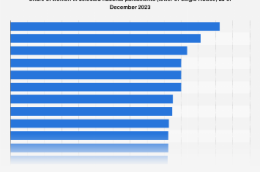
As of December 2023, women constituted 61.3 percent of the Rwandan parliament (lower or single house). This makes it the country with the highest share of women in parliament worldwide. Cuba had the second highest share of female MPs with 53.4 percent, followed by Nicaragua. The European country with the highest percentage of women in their parliament was Andorra with 50 percent.
See here the full graphic published by Statista on 4 July 2024.
Image by Statista

As women increasingly participate in political decision-making around the world, the research emphasizes the need to further understand how informal barriers shape women's political participation. At the same time, the persistent stability of hybrid political regimes calls for additional inquiry into the impact of hybrid regimes on gender politics and its actors. Based on the case of Turkey, a hybrid regime, this study explores how women MPs navigate gendered, informal obstacles in parliament and to what extent their navigation strategies reflect the broader implications posed by the hybrid regime context. This exploratory study draws on qualitative, in-depth semi-structured interviews with eight women MPs in the Turkish parliament from government and opposition parties. The findings illustrate that navigating the informal barriers women MPs experience in the Turkish parliament happens both individually and in collective ways. Individually, women MPs choose to navigate the informal barriers of gender norms by either assimilating or contrasting the masculine way of doing politics. Collective navigation strategies of women MPs in the Turkish parliament illustrate their approaches to representing women's interests, seeking women's solidarity across the parliament, and linkages with civil society to empower women, which also reflect the different positionings of government and opposition within the Turkish hybrid regime dynamics. The findings reveal the need to further research the complex, dynamic interplay of how informal practices and hybrid regime tactics target gender politics and its actors, while also giving more attention to women's agency in tackling and countering obstacles to their political power within and beyond political institutions.
Read here the full article published by Frontiers on 1 July 2024.
Image by Frontiers
Abstract
This study draws together theories of women’s substantive representation and research on politicians’ knowledge of constituent preferences. We ask whether politicians are better at predicting their constituents’ policy preferences when they share the same gender. In doing so, we contribute to knowledge about the mechanisms underlying substantive representation. Using original surveys of 3,750 Canadians and 867 elected politicians, we test whether politicians correctly perceive gender gaps in their constituents’ policy preferences and whether women politicians are better at correctly identifying the policy preferences of women constituents. Contrary to expectations from previous research, we do not find elected women to be better at predicting the preferences of women constituents. Instead, we find that all politicians — regardless of their gender — perform better when predicting women’s policy preferences and worse when predicting men’s preferences. The gender of the constituent matters more than the gender of the politician.
Read here the full article published by the Cambridge University Press on 25 March 2024.
Image by Cambridge University Press

Women’s participation in politics is essential to advancing women’s rights and contributes to countries’ overall stability and economic prosperity. According to a 2023 report by UN Women and the Inter-Parliamentary Union, one-fourth of parliamentary positions worldwide are held by women. Although current representation is still far from equal, it represents a significant increase over the last 20 years.
However, a new paper from Washington University in St. Louis — published in the journal International Organization — shows that the progress women have made in politics is threatened when conflict strikes.
A team of WashU researchers led by Margit Tavits, the Dr. William Taussig Professor in Arts & Sciences, conducted an analysis of Ukrainian politicians’ engagement on social media in the months leading up to and after the 2022 Russian invasion of Ukraine — a rare opportunity to observe the effect conflict has on politicians’ behavior in real time.
Their research provides evidence that violent conflict pushes politicians to conform more strongly with traditional gender stereotypes, so that men become more politically engaged than women, and politicians gravitate toward their respective gendered communication styles and issue spaces. They also show that gender biases among the public are magnified during war.
“Our findings suggest that women leaders’ voices may be drowned out by their male counterparts during conflict, which is troubling,” Tavits said. “We know that who engages, and how, in response to conflict can have significant consequences for how the conflict unfolds, how long it lasts, whose concerns are heard and represented and so on.”
Read here the full article published by the Washington University in St. Louis on 29 May 2024.
Image by Washington University in St. Louis
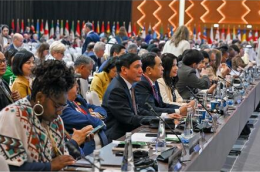
The IPU grew in 2023 with the accession of the parliaments of Liberia and the Bahamas, its 179th and 180th Members respectively, as well as many observers and partners signing up to join or rejoin our global parliamentary community.
Read here more highlights of the year in the Impact Report 2023 published by the Inter-Parliamentary Union on March 2024.
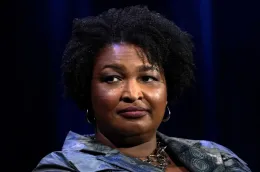
It’s no secret that women have made unprecedented strides in seeking and attaining elected office over the last decade. Twenty-eight percent of elected officials in Congress are women (compared to 19 percent 10 years ago), nearly one-third of our state legislature seats are held by women, and we have our first-ever woman vice president.
But while more women are winning elected positions, the looming gender bias within our political system persists. And according to a number of women elected throughout various levels of government — it’s one hurdle to win an election, but quite another to thrive in office.
That was the consensus among more than 60 women across the political spectrum — including Sens. Kirsten Gillibrand, D-N.Y., and Tammy Duckworth, D-Ill., former Georgia House Minority Leader Stacey Abrams, Massachusetts Gov. Maura Healey and Phoenix Mayor Kate Gallego — who were interviewed for a year-long reporting project by Cosmopolitan, “How to Succeed in Office.” The report was produced in partnership with Melinda French Gates-founded Pivotal Ventures.
Read here the full article published by MSNBC News on 16 May 2024.
Image by MSNBC News
.