Women's Leadership
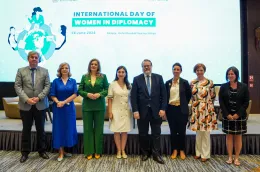
Skopje, North Macedonia, 24 June 2024 – UN Women in North Macedonia, for a second consecutive year in partnership with the Ministry of Foreign Affairs, marked the International Day of Women in Diplomacy with a high-level panel discussion highlighting the pivotal role that women play in international relations and diplomatic efforts.
By commemorating this day, we as UN Women, reaffirm our commitment to gender equality and highlight the importance of inclusive policies that encourage women’s participation in all levels of foreign policy.
A diverse panel of ambassadors spoke at the event, sharing their experiences and insights on how their countries support gender-inclusive policies and empowerment programmes for feminist foreign policy, and advocating for the advancement of women’s roles in foreign policy in North Macedonia.
“Women are still largely excluded from positions of power and diplomacy, globally only 20.54% of all ambassadors are women. This day is a call to recognize critical contribution of women and their indispensable role in diplomacy, and we all, every day shall support equal opportunities for all women in all fields of life, including in diplomacy,” said Vesna Ivanovikj-Castarede, Head of the UN Women Office in North Macedonia.
The outgoing Deputy Minister for Foreign Affairs, Fatmire Isaki, in her opening address underlined that “women are ambassadors of peace, they have the wisdom to soften the temper through their calmness and gentleness, speaking with their kindness. Peace reigns in their spirit and their intellect produces warmth. Therefore, it is in our collective responsibility to continue to uplift and empower women-who are the change makers across the globe. It has been proven time and time again that without the involvement of women, sustainable peace and security cannot be achieved.”
A relatively recent development in international politics, ‘feminist foreign policy’ is the result of a growing recognition of gender issues. From development policy, the gender focus has gradually extended to human rights, security, conflict resolution, and now foreign policy.
Read here the full article published by UN Women on 27 June 2024.
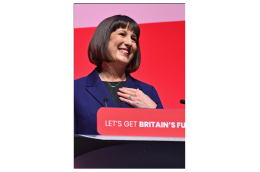
Another election, another round of politicians who tout the same ideas, speak the same way, wear the same suits and, possibly, the same aftershave. Another round of politicians who, a little too often, claim to represent women’s interests, or be outraged on the basis of familial connections – being a “father of daughters”, a “husband of a wife”.
Maybe I’m being cynical here, but women’s interests aren’t yet adequately represented in British politics. This under-representation can partially be attributed to a pervasive culture of misogyny, which continues to shape modern politics. It is a culture that bleeds into both women’s personal and professional lives, a culture in which former Home Secretary James Cleverley can “joke” about spiking his wife’s drink, where women are labelled, as Theresa May was, “bloody difficult”, and threats and intimidation are endemic.
Read here the full article published by Vogue on 5July 2024.
Image by Vogue
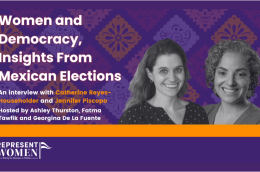
Welcome to the first installment of the new "International Election Series," where they explore the vital role women play in shaping democratic processes around the world. In this episode, they delve into the recent Mexican elections, examining how women candidates influence politics.
RepresentWomen’s Communications Director Ashley Thurston, International Research Manager Fatma Tawfik, and Mexican scholar interviewed Jennifer Piscopo and Catherine Reyes-Housholder about the historic Mexican elections.
See here the full episode published by RepresentWomen on 8 July 2024.
Image by RepresentWomen
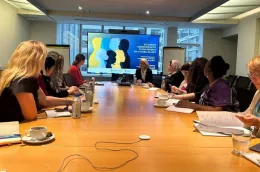
The Friedrich Naumann Foundation’s Washington, D.C. office hosted a distinguished international delegation of twelve female professionals working in politics, from May 4th – May 11th, 2024 in Washington, D.C., and Denver, Colorado. The group comprised of participants from: Argentina, Armenia, Bhutan, Bulgaria, Chile, Germany, Hungary, Jordan, Lithuania, Pakistan, Philippines, and Tanzania. The delegation met with experts across various political women’s institutions, non-profit organizations, political NGOs, legislative offices, and more specifically with The World Bank Group, researchers, journalists, and academics. The group discussed in detail initiatives and policies that have helped to promote gender equality as well as the persistent economic, political, legal, and social barriers for women.
Across meetings there was one consistent theme: we are far from reaching gender equality and there is much to do. However, the bleak outlook was countered with many examples of policies and tangible ways to take steps toward equality. One cannot start to draft policies without fully understanding the economic, political, legal, and social barriers that exist for women in the context of their home country. What might be feasible or encouraged somewhere, will not always work in someone else’s context. For the purposes of this policy takeaway, we will focus pointedly on the United States.
Read here the full article published by the Friedrich-Naumann-Stiftung für die Freiheit on 27 June 2024.
Image by Friedrich-Naumann-Stiftung für die Freiheit

This year, countries accounting for nearly half of the world’s population are holding national elections. Instead of representing a triumph of democracy, however, the results suggest something darker: in many places, voters have flocked to the polls only to elect or reelect autocratic populists. They have notched victories this year in some of the largest countries, including India, Indonesia, and Russia. And these wins come on the heels of last year’s populist victories in Argentina and Turkey.
Today, more than 70 percent of the world’s population lives under autocratic rule, and a minority of the world’s governments are democratic, according to the most recent annual report from the V-Dem Institute, an organization that studies democracy. What the report does not reveal is that a central component of this assault on democracy is the targeting of women political leaders and women’s rights by far-right extremists and elected autocratic populists who represent the leading edge of democracy’s decline. For three decades, the share of women legislators across the globe was growing thanks to mandated quotas in many countries, but the rate of increase has stalled over the past two years, a signal U.S. Ambassador-at-Large for Global Women’s Issues Geeta Rao Gupta calls “scary.” Women today only occupy 27 percent of the world’s legislative seats. An even starker sign is that the number of women leading countries has sharply declined in the past year.
Read here the full article published by Foreign Affairs on 3 June 2024.
Image by Foreign Affairs
India, the world’s largest democracy, has made significant strides in women’s political participation since its independence in 1947. However, a substantial gender gap persists in Indian politics, reflecting deeper societal inequalities and cultural barriers. This article examines the current state of women’s representation in Indian politics, the progress made so far, and the challenges that continue to hinder gender parity in the political sphere.
Current State of Women’s Representation:
While women constitute nearly 50% of India’s population, their representation in political bodies falls far short of this proportion. As of 2024, women make up approximately 15% of the Lok Sabha (the lower house of parliament) and 14% of the Rajya Sabha (the upper house). At the state level, women’s representation in legislative assemblies averages around 9%. These figures, though gradually improving, highlight the significant underrepresentation of women in Indian politics.
Read here the full article published by Odishabarta on 27 June 2024.
Image by Odishabarta